“The Catholic Church: Our Lord is the Way to Eternal Life, but there is paperwork involved.”
It was a good line, I thought, certainly worth a chuckle, so I shared it to X.
It struck a nerve: 17,000 views and 15 reshares, which is a lot for me, but it wasn’t the biggest social media hit I had all week, not by a long shot.
That came from the story to which that quip I just mentioned was a follow-up, my contribution to people’s accounts of “petty tyranny” in the Church, many of them turning on the strict enforcement of mostly bureaucratic procedure that isn’t strictly necessary or even useful.
That one – the really big one (for me) – has nearly 170,000 views, upward of 70 reposts, and close to 2000 “likes” to date.
(Look, I’m a middle-aged man and I don’t really “do” social media, so this is exciting for me.)
There’s a serious point underneath this, though, which got right at something we all sense at least vaguely even when we can’t quite see it clearly, which is that red tape at the local level is keeping people from the sacraments, especially the ones that are supposed to draw people in.
A few people have posted stories of “petty tyranny” from Catholic staff – here is mine: Once a friend asked me to be godfather to his son in another state. The parish there needed a message from my parish saying I was “qualified”. The parish secretary refused to give it to me…
— Charles Collins (@CharlesinRome) June 11, 2026
“[A] friend asked me to be godfather to his son in another state,” I wrote in the post that hit big.
“The parish there needed a message from my parish saying I was ‘qualified’,” but “[t]he parish secretary refused to give it to me because you have to take a class, and that class only happens every three months.”
“Thing is,” I explained to my apparently vast social media audience, “I taught the class!”
“I worked for the diocese, and just got the bishop to write the note,” and that was the end of it, at least for me (and my godson), at least that time.
Most people, however, don’t have a bishop down the hall. They began sharing their own stories, most of which were just a step beyond the sublime.
A few people recounted how they had to complete a class to have their children baptized because, to hear them tell it, the Church wanted to make sure they “understood” what the sacrament meant.
They were perturbed because it wasn’t their first child being baptized – they had to take the same class they had taken two years before. One of them said she just didn’t bother getting her next two children baptized.
Now, one could argue that her response shows she could have used a refresher on the sacrament, but that’s neither here nor there for the baby, who was without the cleansing from original sin, infusion of sanctifying grace, and membership in the Church that baptism gives.
In any case, the lady’s relative (who was a nun) finally got her to get it done, praise God and the sister-relative.
RELATED: Culture wars in the Church have innocent victims, who are the parishioners
I usually write stories about things happening at the Vatican, or the latest “hot button” issues in the Catholic press: Conservatives are concerned about the Latin Mass, and Progressives wonder if there will ever be women clergy.
President Donald Trump has been good for business.
His ongoing criticism of the first U.S.-born pope may be somewhat troubling, but it makes good copy.
I have worked at Crux Now for nearly a decade, and before that I worked at Vatican Radio in Rome for 15 years. I began my official life in the Church when I was 23, working a job at a diocese.
We often speak about helping “Catholic professionals” in the world, but some of us are “professional Catholics” – which means being Catholic is not only our Faith; it is also our job.
A new papal document excites us; we get upset when a cardinal does something stupid in another country; we wonder who will become the next bishop in a big city. We forget that most people don’t really care.
Because of this, “professional Catholics” often see such and similar things as needing urgent dealing-with, crucial to turning the tide in the battle against declining Church attendance and the dwindling numbers of self-identified Catholics seeking marriage for themselves or baptism for their children.
It’s not that the “professional Catholics” are wrong – I am one, remember – but there are lots of other wrinkles to the story.
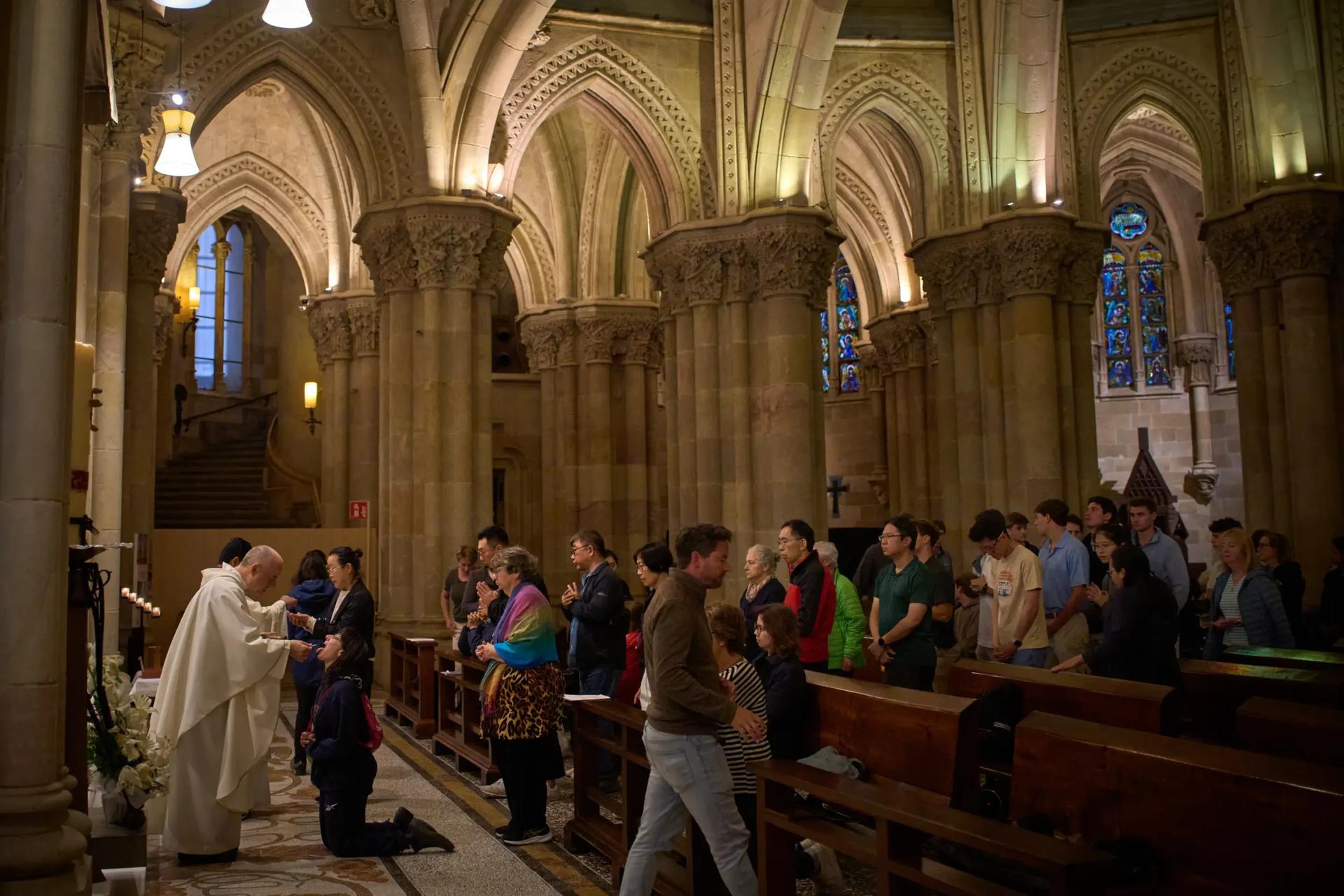
Most ordinary people attending a Catholic church care about their parish: They want to get married, have their children receive the sacraments and possibly attend a Catholic school, and to love our Lord.
They get frustrated by the bureaucracy and silly rules, and often just say, “I am done with it.”
Many “professional Catholics” think this can be solved by “more catechesis” – and that’s not exactly wrong – but it does tend to multiply the rules and procedures and hoops through which to jump: Go to lots of classes, make people wait even longer to receive their various sacraments, and fill out the paperwork necessary to prove this has happened.
Some people go through with it because they want to do what they think is the Lord’s will; some do it because they are like Rex Mottram in Evelyn Waugh’s Brideshead Revisited, who just did what they told him to do to get what he needed.
What about the folks who just throw up their hands and say they’re done with it?
You can blame it on Original Sin – exactly right, as far as it goes – but that’s the thing from which the Church is supposed to save us.
Through the sacraments.
Follow Charles Collins on X: @CharlesinRome