The Holy See on Thursday formally declared the bishops of a breakaway traditionalist order to be in schism and excommunicated.
The declaration came from the Dicastery for the Doctrine of the Faith, just one day after the group illicitly made four men bishops without papal approval and in defiance of repeated warnings from senior Vatican officials and even the pope himself.
The decree states that the excommunications are “reserved to the Apostolic See,” meaning only the pope can lift the penalty.
The DDF decree declares that the bishops involved in the illicit consecrations are excommunicated, while an attached explanatory note states that clerics and faithful who “formally adhere” to the SSPX schism have likewise incurred excommunication.
The explanatory note also states that confessions heard by SSPX clerics are invalid, as are marriages at which SSPX clerics officiate.
Pope Francis had given SSPX clerics faculties to hear confessions and officiate at weddings.
In a letter published Monday, Pope Leo XIV had warned the SSPX leadership that the illicit consecrations would have that consequence.
According to the decree and the explanatory note, all Masses celebrated by SSPX priests and bishops are illicit – clerics under the penalty of excommunication lose their legal rights under Church law to exercise any ministerial power – though SSPX Masses remain valid.
The highly technical language of the Thursday decree from DDF essentially means the ordinations performed Tuesday at the SSPX seminary facility in Écône, Switzerland, were by law (if not by their very nature) schismatic – a formal and deliberate injury to the unity of the Church.
It also means the men who performed the consecration and received the consecration incurred the canonical penalty of excommunication by virtue of their participation in the very act.
In declaring the excommunications, the decree gives formal legal recognition to a state of affairs that exists in fact, which came about when the illicit consecrations took place.
The body of the decree also contains a stern warning for clerics and lay faithful, who are warned “not to adhere to the schism of the Priestly Fraternity of Saint Pius X, as they would thereby incur ipso facto the penalty of latae sententiae excommunication.”
The Decree and its interpretation
The explanatory note attached to the Thursday decree does not have force of law, but it does control the interpretation of the decree.
The explanatory note DDF states that the lay faithful who “formally adhere” to the SSPX “are to be considered excommunicated,” as well, though it places a significant qualification on the statement.
The explanation included beneath the Thursday decree cites conditions established in a 1996 explanatory note of the Pontifical Council for Legislative Texts, which defined formal adherence by two criteria.
The first of those criteria is “freely and consciously sharing,” that is, agreeing with “the substance of the schism,” and the second is “outward manifestation of that choice.”
The 1996 note, which DDF adopts for purposes of understanding the Thursday decree, says “exclusive participation in [SSPX] ‘ecclesial’ acts” would be “the most evident sign” of adherence to the schism in the formal sense.
“[T]hat is,” the 1996 note states, “opting for the followers of [the SSPX] in such a way as to place that choice above obedience to the pope.
“At the root of this attitude,” the 1996 note adds parenthetically, “there will typically be positions contrary to the Magisterium of the Church.”
In fact, both the clerics of the SSPX and the laity who support the group have adopted a posture of ambivalence – at best – toward the 1962-1965 Vatican Council II.
The Church requires acceptance of the Council’s validity in fact and law.
The Church also requires all the faithful likewise to recognize the validity of the conciliar teachings as expressed in the documents of the Council, a requirement that has proved a sticking point in the more than four decades of dialogue between the SSPX and Rome.
The 1996 note also recognizes, however, that determining a lay person’s “formal adherence” is easier said than done.
“In pastoral practice,” the 1996 note states, “it may prove more difficult to judge their [the laity’s] situation.”
“Account must be taken, above all, of the person’s intention and of how that interior disposition is translated into action,” the 1996 note says.
“Consequently,” the note continues, “the various situations must be judged on a case-by-case basis within the appropriate forums – both the external and the internal,” that is, respectively in the public pastoral and juridical action and in sacramental confession.
“In the case of [SSPX] deacons and priests,” the 1996 note says, “it seems beyond doubt that their ministerial activity within the schismatic movement is a more than evident sign that the two aforementioned requirements are met.”
“There is, therefore, formal adherence,” to the schism on the part of clerics participating in the SSPX.
Six bishops
The Dicastery for the Doctrine of the Faith issued the Decree declaring the schism and imposing the penalty on the four men who received episcopal consecration illicitly and on the two bishops who acted as their consecrators.
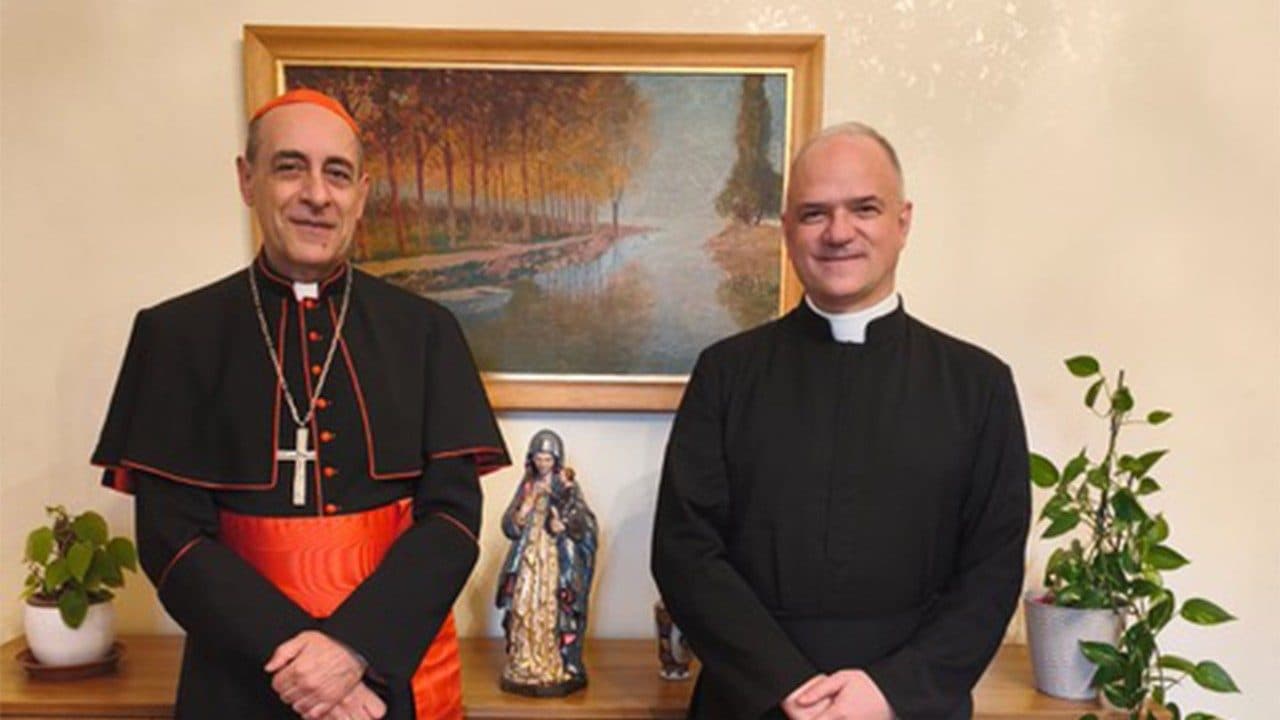
The instrument, signed by Cardinal Victor Férnandez – the dicastery’s prefect – and written in the first person, is also signed by both senior secretaries, Archbishop John Kennedy of the DDF’s discipline section and Monsignor Armando Matteo of the doctrinal section.
“Despite the warnings issued to the Superior General [Father Davide Pagliarani] of the Priestly Fraternity of Saint Pius X,” the decree states, “Bishop Alfonso de Galarreta – having committed an act of a schismatic nature through the episcopal consecration of four priests without a pontifical mandate and against the will of the Supreme Pontiff – has incurred ipso facto the penalties provided,” by canon law.
The SSPX has been in a canonically irregular situation for nearly 40 years, ever since a similar episode occurred when the breakaway traditionalist group’s founder ordained four bishops over then-Pope John Paul II’s express wishes to the contrary.
Fernandez also declares that Bishops Pascal Schreiber, Michael Goldade, Michel Poinsinet de Sivry, and Marc Hanappier – the four who illicitly received consecration, “have incurred ipso facto the latae sententiae excommunication reserved to the Apostolic See.”
The decree declares as well the excommunication incurred by Bishop Bernard Fellay, who participated directly in the liturgical celebration as a co-consecrator.
Fellay led the SSPX from 1994 to 2018 and oversaw the milestone 2009 lifting of the excommunications formally imposed on him and three others who illicitly received consecration as bishops in 1988.
In that year, 1988, Archbishop Marcel Lefebvre – the SSPX’s founder – and Bishop Antonio de Castro Mayer – a longtime supporter of the SSPX – also incurred excommunication for their role as consecrators in the illicit ordinations.
Lefebvre and de Castro died under the penalty.