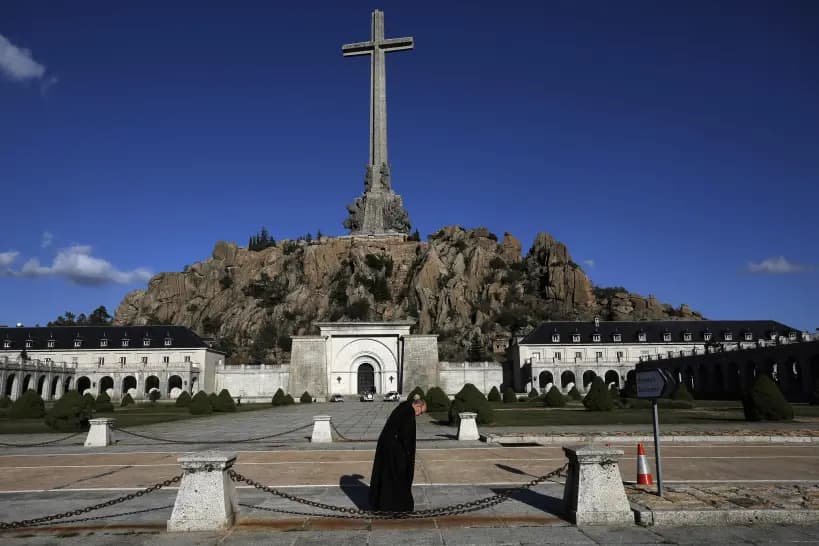
In Spain, the government has awarded a multimillion-dollar contract to the winners of an architectural competition to “redefine” the Valley of Cuelgamuros – a Franco-era monument formerly known as the Valley of the Fallen – amid legal battles aimed at stopping the project.
The monument was originally built to commemorate the victims of the Spanish Civil War who fought for the nationalists and was the burial place of General Francisco Franco until 2019, as well as being home to a basilica and a community of Benedictine monks.
It is also home to the largest cross in the world.
The government wants to reinterpret it as “a tool at the service of reconciliation and collective memory.”
General Francisco Franco led Spain as a right-wing dictatorship after the Spanish Civil War in the late 1930s until his death in 1975, when the nation became a constitutional monarchy.
Right-wing and left-wing grievances still cause political controversies in the country.
Prime Minister Pedro Sánchez’s government will pay over the next four years over 3.5 million euros (over $4 million) to Pereda Pérez Arquitectos SCP and Lignum SL after their proposal won the international competition to redefine the space. In 2026, the figure will be 1.1 million euros.
The firms will also receive 60,500 euros for being finalists, along with the nine other proposals that made it to the final stage.
The Ministry of Housing and Urban Agenda (MIVAU) has published the contract breaking down the payment structure. The government estimates that the overall cost of the project will be approximately 30 million euros.
Last April, competition guidelines included a map of the spaces open to reinterpretation, including “the vestibule, the atrium, the intermediate space, the unoccupied nave, and the dome.”
The agreement signed last March by the minister of the presidency, Félix Bolaños, and Cardinal José Cobo, the archbishop of Madrid, was released by the Spanish newspaper El Debate and shows that the places designated for worship are the altar and the pews.
“Access to the space intended for worship will be independent and will take place through the main entrance of the basilica, and such independent access must be respected and allowed,” the document reads.
Everywhere else in the monument is open for “artistic and museographic” reinterpretation.
Legal challenges
While the government presses ahead with its efforts, a number of legal challenges have been filed to try to stop the controversial redefinition.
In February this year, the Christian Lawyers Foundation (La Fundación de Abogados Cristianos) filed an administrative complaint with the National Court against the agreement.
One of the foundation’s key arguments was that Cobo did not have the ecclesial authority to sign the agreement because “the Basilica of the Holy Cross of the Valley of the Fallen, [is] a pontifical basilica whose modification requires the express intervention of the Holy See.”
“The Basilica of the Valley of the Fallen is a sacred place in its entirety, and any intervention that limits or conditions worship violates religious freedom and the rights of the faithful,” the foundation added in a statement.
The Benedictine community based in the valley also filed an administrative appeal against the redefinition after the competition was announced. Their appeal was one of nine filed.
El Debate also reported that there were legal challenges based on canon law, religious freedom, and the argument that the decision violates international agreements between the Holy See and Spain.
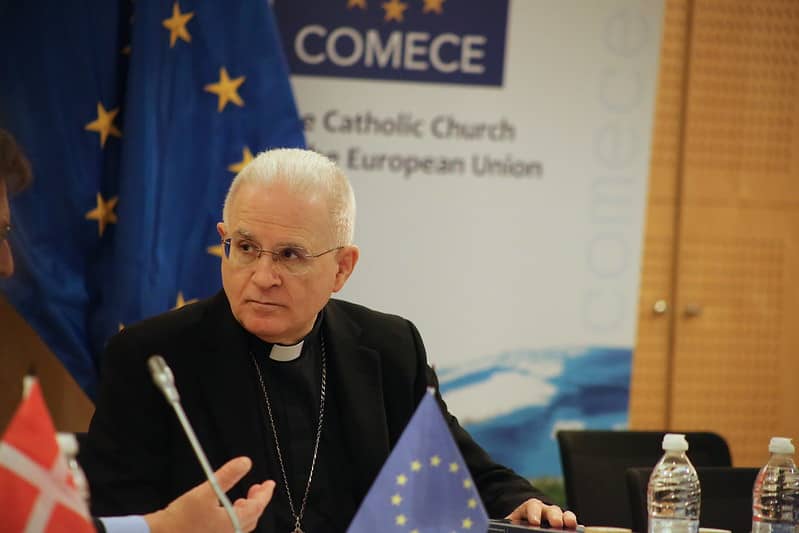
Cardinal Cobo responds
In January this year, Cobo made comments to journalists at an off-the-record meeting later leaked by the website InfoVaticana which argued that because it wasn’t invited to the meeting it wasn’t bound by the meeting’s secrecy agreement.
Cobo suggested that he had acted more as an intermediary between the Vatican and the Spanish government and denied having authorized any specific decision.
“I haven’t discussed that or intervened in it. That’s a negotiation between the government and the Holy See,” he said.
He said Bolaños had visited the Vatican on a number of occasions to meet with Cardinal Pietro Parolin, the Vatican secretary of state, to discuss the basilica.
“If they speak with Parolin, and Parolin says nothing, it means he agrees,” he said.
In December last year, Cobo hit out publicly at those who had been critical of the tense negotiations that took place with the government.
“Everything has been interpreted ideologically and taken out of context. The presence of some media outlets or pseudo-media outlets uses other bishops or the pope, no matter what we do, and it goes so far as to involve slander and attacks on honor,” Cobo said.
The archbishop of Madrid added that some of these outlets “live off Catholicism without being Catholic” and emphasized that the hierarchy “established a framework to signify the Church’s assets that appear in the monument.”
This means that during “complex” negotiations it was made clear that “the monks would remain in the valley, that worship would be protected, that the basilica would be protected with independent access, and that the interior and exterior religious signs would be respected,” the cardinal said.