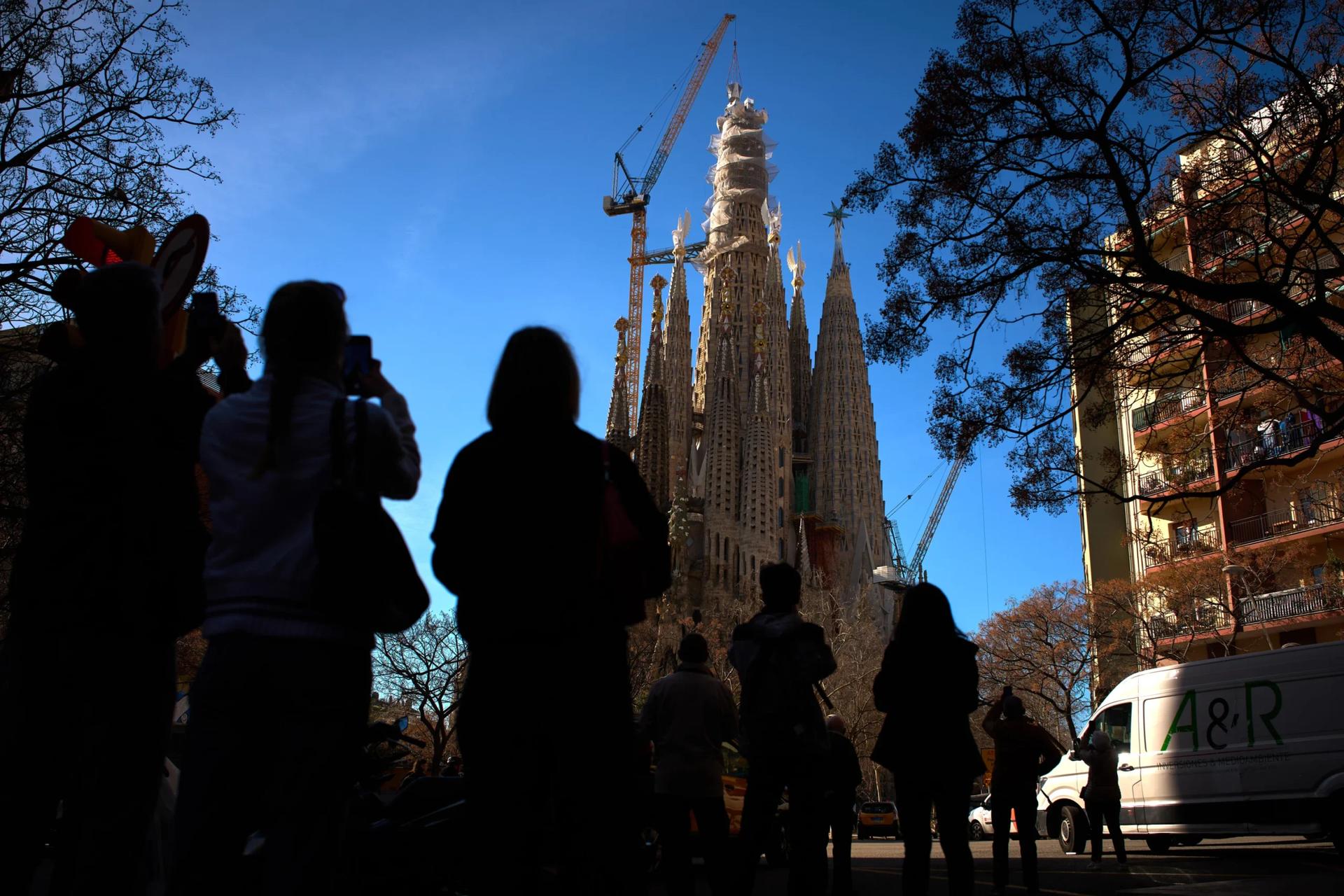
Ahead of Pope Leo XIV’s visit to Spain, during which he will inaugurate the Tower of Jesus at Barcelona’s famous Sagrada Familia, an expert in Venerable Antoni Gaudí’s work has explained that the architect’s genius was driven by his faith in God.
Speaking to Crux Now, José Manuel Almuzara, who is also an architect and has been president of the Association for the Beatification of Antoni Gaudí since 1992, explained how integral Gaudí’s faith was to his work.
“Gaudí considered himself a collaborator in God’s creation. He placed all his gifts at the service of God and of his clients, working collaboratively to bring out the best in each person, with humility, mercy, and sacrifice, and through religious practices that helped him win the battles of life – prayer, daily communion, the rosary, etc.,” Almuzara said.
The pope will inaugurate the Tower of Jesus on June 10, which Almuzara called a “significant event.”
“The visit of Pope Leo XIV for the inauguration of the Tower of Jesus Christ is a significant event – the culmination of the tallest tower of the expiatory temple of the Sagrada Família, and the most symbolically charged one,” he said.
Alongside inaugurating the tower, the pope will also celebrate a Solemn Mass on what will be the hundredth anniversary of Gaudí’s death.
The full interview is below.
Crux Now: Pope Leo XIV will inaugurate the Tower of Jesus during his visit to Barcelona. What does this mean?
José Manuel Almuzara: The visit of Pope Leo XIV for the inauguration of the Tower of Jesus Christ is a significant event — the culmination of the tallest tower of the expiatory temple of the Sagrada Família, and the most symbolically charged one. The cross, rising above the twelve apostles, the four evangelists, and the tower dedicated to Mary, his Mother, Our Mother. That moment will bring to mind a particular phrase of Jesus: “And I, when I am lifted up from the earth, will draw all people to myself” (Jn 12:32).
Gaudí used to say: “The Church never stops building, and that is why its head is the Pontifex — which means the one who builds bridges — temples are the bridges to reach Glory.”
Pope Leo XIV is visiting Spain at a time when the faith of the country is very different from that of Gaudí’s era. What role can Gaudí play in the evangelization of Spain today?
At the Consecration of the Sagrada Família, November 7, 2010, Benedict XVI said: “Gaudí, through his work, shows us that God is the true measure of man. That the secret of true originality lies, as he himself said, in returning to the origin, which is God. He himself, by opening his spirit to God, was able to create in this city [Barcelona] a space of beauty, faith, and hope, that leads man to an encounter with the one who is Truth and Beauty itself.”
Benedict XVI also said that one of Gaudí’s strengths was “overcoming the divide between human consciousness and Christian consciousness, between existence in this temporal world and openness to eternal life, between the beauty of things and God as Beauty itself.”
Gaudí himself expressed his feelings in these words: “A temple is the only thing worthy of representing the spirit of a people, since religion is the highest thing in man.”
What will the completion of the Sagrada Família mean for the city of Barcelona? And for Spain?
The culmination of the architectural work of the Sagrada Família (independently of the completion of the decorative and symbolic elements of the interior of the Crypt, the Basilica, and the cloister) will represent the fulfillment of a dream begun on March 19, 1882, by a people who made it possible — and continue to do so — and who see themselves reflected in it; it is their way of being. It is a work that lies in the hands of God and in the will of the people. The architect – and I would add every single one of those who followed Gaudí – living with the people and looking toward God, carries out his work. Providence, according to its designs, is the one who brings the work to completion.
The completion of the Sagrada Família should help us give glory to the Most Holy Trinity — to discover what is essential in it, beyond the sculptures, the forms, the light, the acoustics.
Why do you think Gaudí captivates the imagination of the world?
His architecture is rooted in nature — it is an organic architecture, emphasizing sustainability, light, color, and so on. I am particularly moved by a letter from Yun Young-Joo, an executive of the Pusan Chamber of Commerce and Industry in Korea, written on 19 March 1998:
“I visited the Temple of the Sagrada Família as part of my tour of Gaudí’s works around Barcelona. I cannot describe the impression it left on my heart. I could not help but bow my head before the solemnity, the holiness, and the grandeur of the building. A deep feeling overwhelmed my heart. Through Gaudí’s works, and the divine touch they carry, I became convinced of the existence of God. Although I had previously been a devout Buddhist, I converted to Catholicism upon returning to Pusan, through the profound inspiration brought about by Gaudí’s works.”
How important was Gaudí’s faith to his work?
Gaudí considered himself a collaborator in God’s creation. He placed all his gifts at the service of God and of his clients, working collaboratively to bring out the best in each person, with humility, mercy, and sacrifice, and through religious practices that helped him win the battles of life – prayer, daily communion, the rosary, etc.
I recently published an essay this past March, “Gaudí, the Architect of the Soul,” with which I wish to present — in a personal, reflective, and subjective way — Gaudí the man, the architect, and the Christian.
Gaudí the man: As a life model, with joys and sorrows, victories and defeats, with love and sacrifice, who strove to fulfill his family, social, and professional responsibilities and human relationships.
Gaudí the architect: As a genius, a pioneer in applying the laws of nature to his architecture, a forerunner of sustainability and recycling, a champion of love for both individual and teamwork, born of collaboration.
Gaudí the Christian: As an instrument who placed his gifts at the service of God and of others, with charity, mercy, and humility; in need of religious practices to win the battles of life.
There is an open cause for the canonization of Gaudí. What do you believe makes him a potential saint? And what are the chances of his being canonized?
Gaudí is on the path to Sainthood. From the title of “Servant of God,” he became “Venerable” on April 14, 2025 (he cannot yet receive public veneration), a step prior to being declared “Blessed,” for which the recognition of a miracle is required. And what does it mean to be Venerable?
For many years, work was carried out on the positio super vita, virtutibus et fama sanctitatis — a printed volume compiling:
- An account of the history of the cause or process, and the body of evidence.
- The testimonies of witnesses, and documentation on the life, work, and reputation for holiness and intercession of the Servant of God.
- An assessment of his writings.
- A documented biography of the Servant of God.
- The Informatio on the virtues exercised by him in a heroic degree.
The historical and theological consultors and the ordinary congress of cardinals and bishops of the Dicastery for the Causes of Saints studied the positio super vita, virtutibus et fama sanctitatis. Their opinions were unanimously favorable regarding the heroic exercise of virtues by the Servant of God, and the Prefect of that Roman dicastery presented Pope Francis with the corresponding decree of heroic virtue for authorization of its publication. And so it was, on April 14, 2025. From that moment, Antoni Gaudí i Cornet is “Venerable.”
The driving force behind the canonization process has been the Association for the Beatification of Antoni Gaudí since June 10, 1992 — a lay association of which I have been president since then. Since December 4, 2023, the leading body is the Canonical Association for the Canonization of Antoni Gaudí, under the Archdiocese of Barcelona.
What inspiration can Gaudí offer to Catholic artists and creators?
The work of Antoni Gaudí is a reflection of both his interior life and his architectural studies (materials, forms, sunlight, landscape, etc.). I would not separate the two: his projects took into account the three fundamental principles of architecture as set out by Marcus Vitruvius Pollio (1st century BC) — utilitas, firmitas, and venustas: utility or functionality, solidity, and beauty.
Gaudí’s interior life is reflected in his work, growing with time. He once remarked: “Everything I have done depends on circumstances; if they go well, I adapt to them; if badly, I fight against them; they always serve a purpose — they are the manifestations of Providence.”
His deep faith and his connection with nature led him, at the end of his life, to withdraw entirely to the expiatory Temple of the Sagrada Família, abandoning civil works — underscoring his profound spiritual life and the unity between architecture and faith. In his design for the Passion façade, following a serious illness in 1911, we can discover the theological depth of Gaudí, rooted in the poetry of Saint John of the Cross — a design that was ultimately not used. In the Teresian College in Barcelona, we discover his rendering of the interior castle of the seven mansions of Saint Teresa of Jesus of Ávila, and so on.
In Gaudí’s own words: “Worthwhile things are not done with an eye to reward; for we know that nothing is fruitful without sacrifice, and sacrifice is the diminishment of the self without compensation.”
This interview has been edited for length and clarity.