A leading British bishop has said he is “deeply alarmed” by the Israeli military’s decision to declare the Palestinian Christian village of Taybeh a closed military zone after a series of settler attacks on the village.
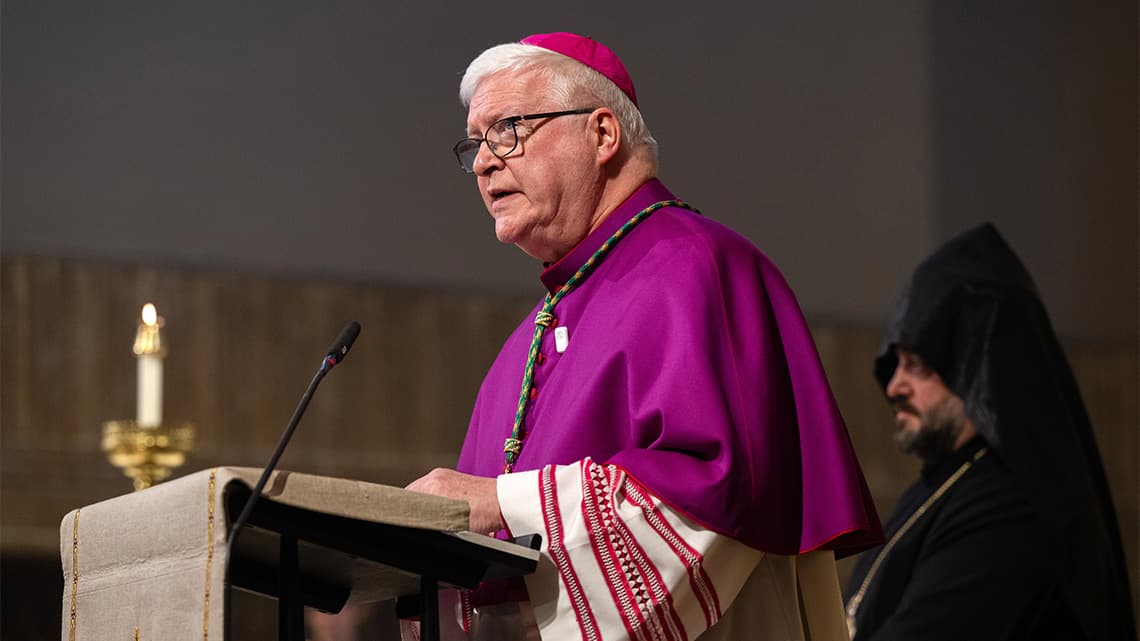
Bishop James Curry, auxiliary of Westminster and Lead Bishop for the Holy Land for the Catholic Bishops’ Conference of England and Wales (CBCEW), expressed his concern at the move in a statement published Wednesday.
“I was deeply alarmed to hear that Taybeh has been declared a closed military zone prohibiting Israelis, foreign nationals, and journalists from entering. It is claimed that this is designed to prevent attacks on residents by Israeli settlers, but it is far from clear that this move will achieve that objective,” he said.
“The Israeli government must find a way of protecting the legitimate communities from settler violence whilst allowing citizens to go about their normal business. This ban will lead to a vital loss of income from tourism and pilgrimages and, thereby, international scrutiny on the situation,” he added.
Having visited the village in January this year, Curry said the problem of settler violence “is a very real one” which is causing families to leave their homes.
“The problem of settler intimidation is a very real one. When I visited the village as part of the Holy Land Coordination in January, the community reported ongoing attacks and intimidation, a growing number of checkpoints and endless financial pressures,” Curry said.
“Families were leaving because they simply could not see how they could raise their children in safety and security. It was unacceptable then and it is unacceptable now. The universal Church has been very clear on this – human dignity cannot apply to one person and not the other,” he said.
In the New Testament, Taybeh is referred to as Ephraim, a place where Jesus and his disciples stayed after Jesus raised Lazarus from the dead, and Curry underlined how important the Christians in the Holy Land are.
“The Christian presence in the Holy Land is a vital part of the region’s DNA and has survived for more than 2,000 years. It would be a tragedy for Palestinians and Israelis alike if it were to disappear altogether,” he said.
“The parish priest of Taybeh, Father Bashar Fawadleh, summed it up when he pointed out that Christians simply want to live alongside their neighbours ‘in peace, with justice and dignity’,” he added.
Curry also said that he had been raising the serious issues in the West Bank with British politicians although “our government does not appear to be acting with sufficient urgency in responding to grave human rights abuses taking place in the West Bank.”
“These attacks constitute a serious breach of international law and stand in violation of freedom of religion,” he said.
Taybeh’s parish priest speaks out
Earlier this week, Father Bashar Fawadleh from Taybeh gave an interview with Vatican News, saying that Israeli settlers were creating a “climate of fear” designed to make locals move from their land, after settlers broke into the home of one of the families in his parish on Aug. 5.
RELATED: Israeli settlers creating ‘climate of fear’ for West Bank Christians
“Over the span of several days,” he said, “two settlers broke into the property multiple times. They occupied the land and brought a flock of sheep right up to the house.”
“It is a deliberate strategy of harassment designed to create a climate of fear and [to] pressure Palestinian families into leaving their land. We give thanks to God that the family is physically safe,” he added.
“Many families across the west, east, and south of Taybeh are suffering from this settler violence. As they always do, they have been setting fire to vacant land. Most recently, they torched a hillside southeast of the village. The Israeli settlers come to cause harm and occupy the land,” Fawadleh explained.
Fawadleh also called for the international community to help Palestinians suffering under such conditions, and asked for prayers.
“We feel forgotten, and we feel entirely alone. Legal options exist, but they are unfortunately very limited and rarely effective. That is why international presence and pressure are vital right now. We need concrete protection for civilians and genuine political will to bring an end to this violence,” he said.
______
You are reading this Crux Now article for free. You can register for our free daily newsletter here, and you can become a Crux Now supporter for full access to all our premium content here. To find out more about why becoming a Crux Now supporter is a great idea, go here.