As the US state of California reports a dramatic increase in assisted suicides, the Archdiocese of Los Angeles is working on different fronts to foster support the vulnerable and to educate the faithful.
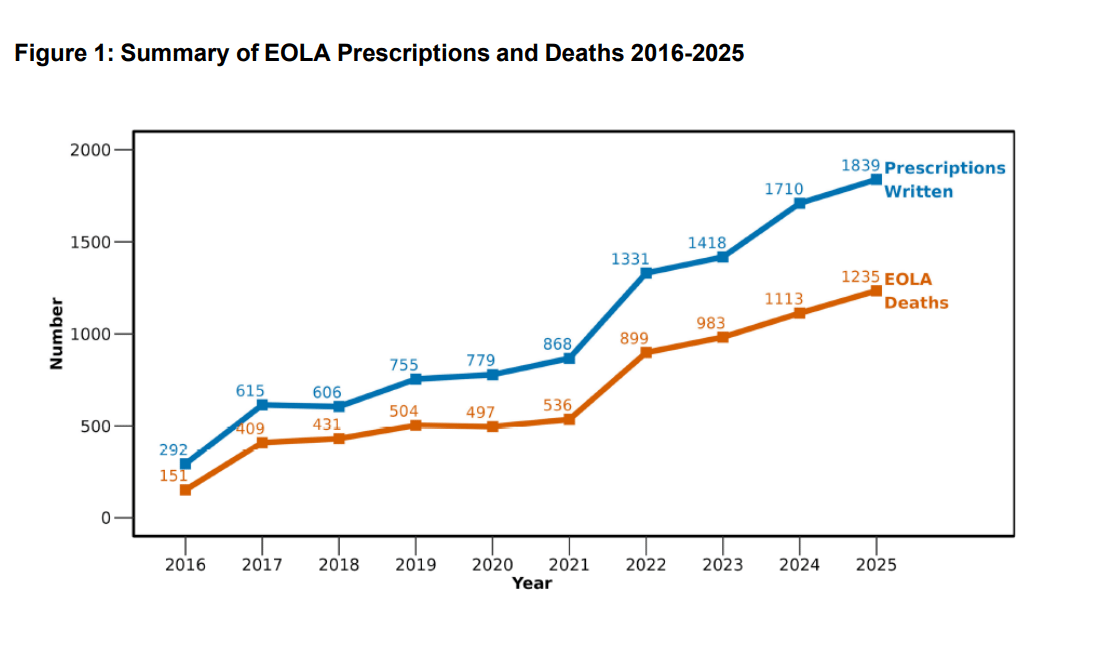
Released earlier this month, the California End of Life Option Act 2025 Data Report shows a record-high 1,235 deaths by assisted suicide, a nearly 11 percent increase over the past year. Over the five-year period from 2020 to 2025, the report shows an increase that is close to 150 percent.
Esmeralda Sosa of the Los Angeles archdiocesan Office of Life, Justice, and Peace told Crux Now the statistics are more than sobering, and a call to action.
“It is both concerning and heartbreaking to look at the 2025 data and see the continued increase in people seeking prescriptions to end their lives,” Sosa said.
“Our office is committed to upholding human dignity from conception to natural death,” Sosa said, “and this data reminds us that we cannot stop working to protect and affirm the dignity of every human life.”
Non-medical factors
The focus on the inherent dignity of human life is all the more timely in light of the California report, which shows non-medical concerns playing an outsized role in the decision-making of persons who chose assisted suicide.
Nearly 85 percent of respondents cited “loss of dignity” as a reason for their choice. Nearly 85 percent of respondents also reported the inability to manage pain as a factor.
Loss of the ability “to engage in activities making life enjoyable” was a reason 96.1 percent of respondents cited in 2025, a figure similar to 2024 but several points higher than the seven-year average from 2016 – when assisted suicide became legal in California – to 2023.
Nearly all respondents – 94.7 percent – also cited “loss of autonomy” as a reason contributing to their choice of assisted suicide, and the vast majority of those who chose assisted suicide ingested the life-ending prescription at home.
Compiled by the California Department of Public Health, the report presents aggregated information collected on all patients who died in 2025 under California’s End of Life Option Act and on patients who died under the state’s suicide regime in previous years.
California’s assisted suicide law allows an adult diagnosed with a terminal disease who meets qualifications defined in the state’s Health and Safety Code to request an aid-in-dying drug from a physician.
The law requires physicians to use forms specified in statute for submitting information to state’s Department of Public Health.
In 2025, 378 California physicians prescribed a lethal dose to 1,839 patients, 604 more patients than died from a lethal dose, according to the report.
Just this week, the Office of Life, Justice, and Peace led workshops designed to help individuals accompany parishioners and their families through illness and end-of-life care.
Conducted in both English and Spanish, the workshops provided practical and spiritual guidance “rooted in human dignity, hope, and trust in God’s promise,” Sosa told Crux Now.
Sosa also told Crux Now the 2025 report from the Department of Public Health has galvanized her office.
“We must continue doing everything we can to support our elderly, sick, homebound, and caregivers by accompanying them through the end-of-life journey,” Sosa said, “whether it is the natural progression of age or the result of a chronic or serious illness.”
“No one should feel alone, forgotten, or that they are a burden,” she said. “Rather,” she said, “they should feel supported, loved, and valued throughout this stage of life.”
Sosa told Crux Now the task is urgent and pressing, and one that calls for “compassionate care, meaningful accompaniment, and appropriate medical and spiritual support.”
“[W]e can help ensure that assisted suicide is never seen as the answer to suffering or loneliness,” Sosa said.
Respect Life Month
October is the US bishops’ Respect Life Month, an annual recurrence this year focusing on “Mary, Mother of Life,” a theme chosen to underline how the life of the Blessed Mother teaches us to respect each human life in every stage and circumstance.
Sosa told Crux Now her office is always dedicated to defending the dignity of every human person from conception to natural death – “a consistent ethic of life,” she said, “that recognizes the sacredness and value of human life at every stage.”
The Los Angeles archdiocese is planning a series of webinars focusing on the unborn, foster care, mental health, and the elderly.
“While these topics address different circumstances and stages of life,” Sosa said, “they are all rooted in the principle that every human life is sacred, and every person is precious and deserves dignity, care, and respect.”
“Our goal is to help build a culture that recognizes and protects human life and promotes human dignity throughout every age and stage of life,” Sosa said.
______
You are reading this Crux Now article for free. You can register for our free daily newsletter here, and you can become a Crux Now supporter for full access to all our premium content here. To find out more about why becoming a Crux Now supporter is a great idea, go here.