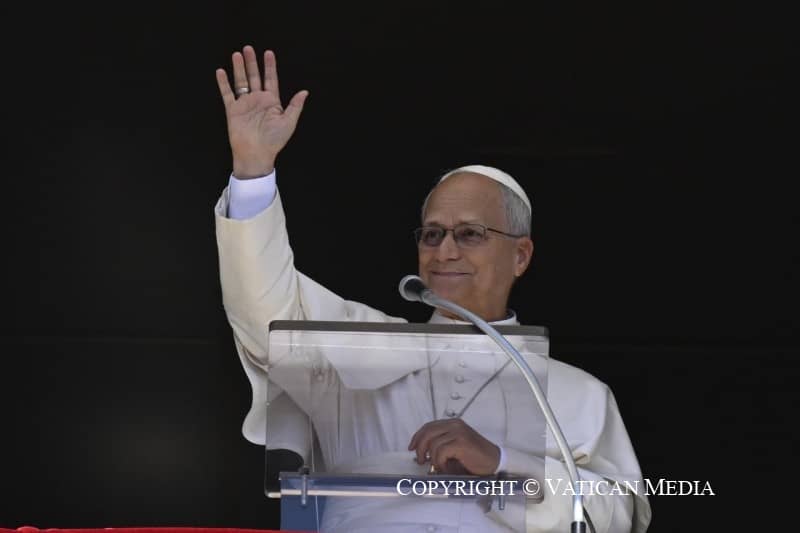
As the world’s attention turns to Italy for the Winter Olympics, Pope Leo XIV took the opportunity to send a letter marking the occasion.

Leo’s letter, however, didn’t only speak about the Olympics. More broadly, the pontiff’s letter was on “The Value of Sport” in the world.

Leo’s letter has appeared more than 20 years after Pope St. John Paul II established his “Church and Sport” office within the Pontifical Council for the Laity in 2004, the year the Summer Games were held in Greece, the ancient birthplace of the Games.
When Pope St. John Paul II established the office, Vatican watchers wondered what, exactly, a Vatican office would actually do?

The one priest given the task of running the office – for all intents and purposes, he was the office – even told me at the time he wasn’t given much or even anything in the way of a mission statement or profile, and that he was figuring it out on the fly.

John Paul II died the next year, and sports was a low priority for the Council on the Laity, and then Cardinal Gianfranco Ravasi at the Council for Culture established his own sports office under Pope Benedict XVI a few years later, but all that is – ahem – so much inside baseball for Vatican political junkies.

The confusion in the Vatican was often discussed (privately) among workers in the Vatican media departments (I worked at Vatican Radio at the time), and turned on a prior question: What did the Church mean by “Sport”?

Was it looking at local sports? Amateur or professional players? Did the Vatican City State want to participate in international sporting competitions or join international sporting bodies?

Even the Olympics comes into play when looking at the Church and Sports. Tradition has it that the original Olympic games were held in 776 BC and continued until AD 393, when they were ended because Christian leaders objected to their connection to Greek paganism.

The Catholic Church has always had a mixed relationship to sports, although Saint Paul often referred to different sporting events in his Epistles, telling Christians to “fight the good fight,” and to keep their “eyes on the prize.”

In the modern era, the Church objected to sports being played on Sundays, and frowned on the violence that could often occur. The high death rate in auto racing that happened until the 1990s even made the Vatican newspaper to call for it to be banned.

Modern sports have seen problems with drug use, gambling, and hooligans outside (and sometimes inside) stadiums.

Yet sporting competitions often take place in the Catholic schools and universities, and those same schools have sports programs, while Catholic dioceses and Catholic organizations organize and sponsor athletic leagues all around the world.

Pope St. John Paul II was an inveterate sportsman, himself.

On the spectator-side, Pope Francis was an avid supporter of Argentina’s San Lorenzo soccer club (and he was hardly the first or only pope to have a favorite side).

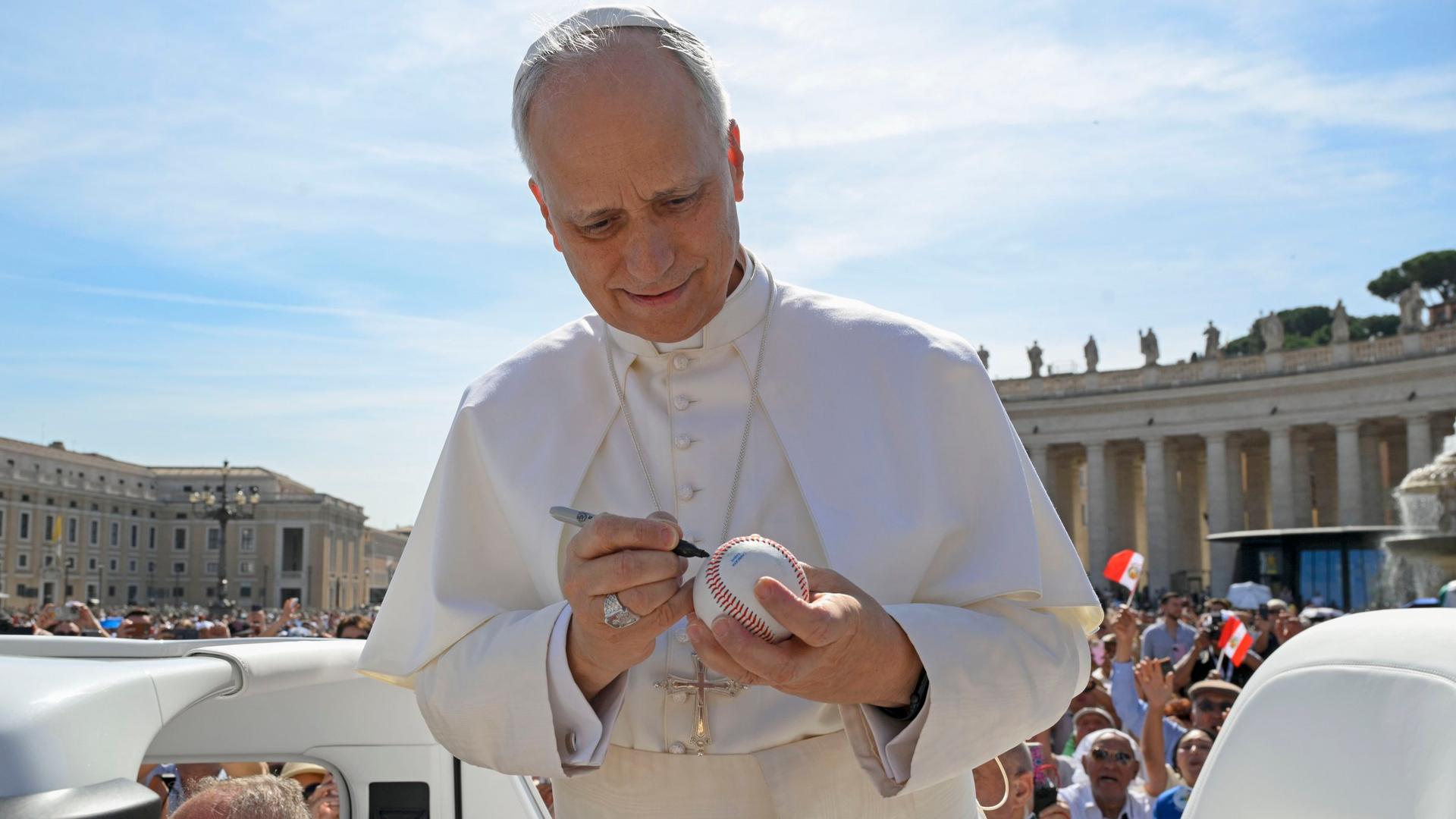
Pope Leo XIV is known to play tennis regularly. He is a lifelong fan of the Chicago White Sox baseball team and even had the briefest of appearances on TV while wearing a White Sox jersey when he was taking in a 2005 World Series game.

It happens that then-Father Robert Prevost was the prior general of the Order of Saint Augustine in Rome when the Vatican established its “Church on Sports” office in 2004.

To read the letter Leo just released on sport, one could be forgiven the impression he must have been a fly on the wall during those water cooler conversations in the Vatican media offices back in the day.

“Life in Abundance: Letter of His Holiness Pope Leo XIV on the Value of Sport” is very long, and covers both the virtues and problems facing sport in the modern world.

In it, Pope Leo XIV notes how sport “became a mass phenomenon” as the nineteenth century turned into the twentieth.

“The work of great educators, from Saint Philip Neri to Saint John Bosco, also fits into this context. The latter, through the promotion of oratories, established a privileged bridge between the Church and the younger generations, also making sport a field of evangelization,” he said.

“In this vein, we can also recall Leo XIII’s Encyclical Rerum Novarum (1891), which stimulated the birth of numerous Catholic sports associations, thus responding on a pastoral level to the changing needs of modern life and emerging new trends. Here I think of the conditions of workers after the industrial revolution,” he added.

Leo said the Catholic Church, through the voice of the popes, has proposed a vision of sport “centered on the dignity of the human person, on his or her integral development, on education and on relationships with others, highlighting its universal value as a means of promoting values such as fraternity, solidarity and peace.”

Leo also drew attention, however, to the dynamics that can undermine the benefits of sport.

“This occurs primarily through a form of ‘corruption’ that is plain for all to see. In many societies, sport is closely linked to economics and financial interests. It is clear that money is necessary to support the sporting activities promoted by public institutions, other civic bodies and educational institutions, as well as private competitive and professional sports,” he said.

“When the objective is to maximize profit, what can be measured or quantified is overvalued to the detriment of the incalculable and important human dimensions: ‘It only counts if it can be counted.’ This mentality creeps into sport when attention is obsessively focused on results and the monetary rewards that winning can bring,” the pope explained.

“In many cases, even at the amateur level, commercial demands and values have come to overshadow the human values of sport that ought to be safeguarded,” he said.

Leo said a particular risk arises when the financial benefits of success in sport are prioritized over the intrinsic value of participation.

“The dictatorship of performance can lead to the use of performance-enhancing substances and other forms of dishonesty, and can cause participants in sport to focus on their own financial well-being rather than on loyalty to their sport,” the pope said, pointing out especially the problems caused by the gambling industry.

The leader of the Catholic Church also remarked on the way sport is not uncommonly invested with a quasi-religious dimension these days.

“Stadiums are perceived as secular cathedrals, matches as collective liturgies and athletes as saviors,” he wrote.

“This sacralization reveals an authentic need for meaning and communion, but risks stripping both sport and the spiritual dimension of their essence,” Leo said.

“When sport claims to replace religion, it loses its character as a game that benefits our lives, becoming instead aggrandized, all-encompassing and absolute,” he wrote, adding that it also causes the “danger of narcissism, which permeates the entire sporting culture today.”

Leo also said another distortion of sport happens with the political exploitation of international sporting competitions and that contemporary challenges are intensified by the impact of transhumanism and artificial intelligence on the world of sport.

“Technologies applied to performance risk introducing an artificial separation between body and mind, transforming the athlete into an optimized, controlled product, enhanced beyond natural limits,” the pope said, adding that when technology is no longer at the service of the person but claims to redefine it, “sport loses its human and symbolic dimension, becoming a laboratory for disembodied experimentation.”

Ahead of the Winter Olympics, Pope Leo used over 5000 words to define the Catholic Church’s relationship with the world of sport and set the agenda for the Church in its relations with the sporting world.

In many ways, he has synthesized papal statements made over the past 150 years, making it easier for the Vatican to have a “policy” on sports.

Some might speculate this synthesis is Pope Leo XIV’s inner canon lawyer showing himself, a fellow uncomfortable with merely splicing together previous statements and agendas. If so, the letter may be a sign of how the still-new pope will deal with issues facing the Vatican, both now and in the future.

It may even be a key to understanding the mind of the man in the office.

Follow Charles Collins on X: @CharlesinRome