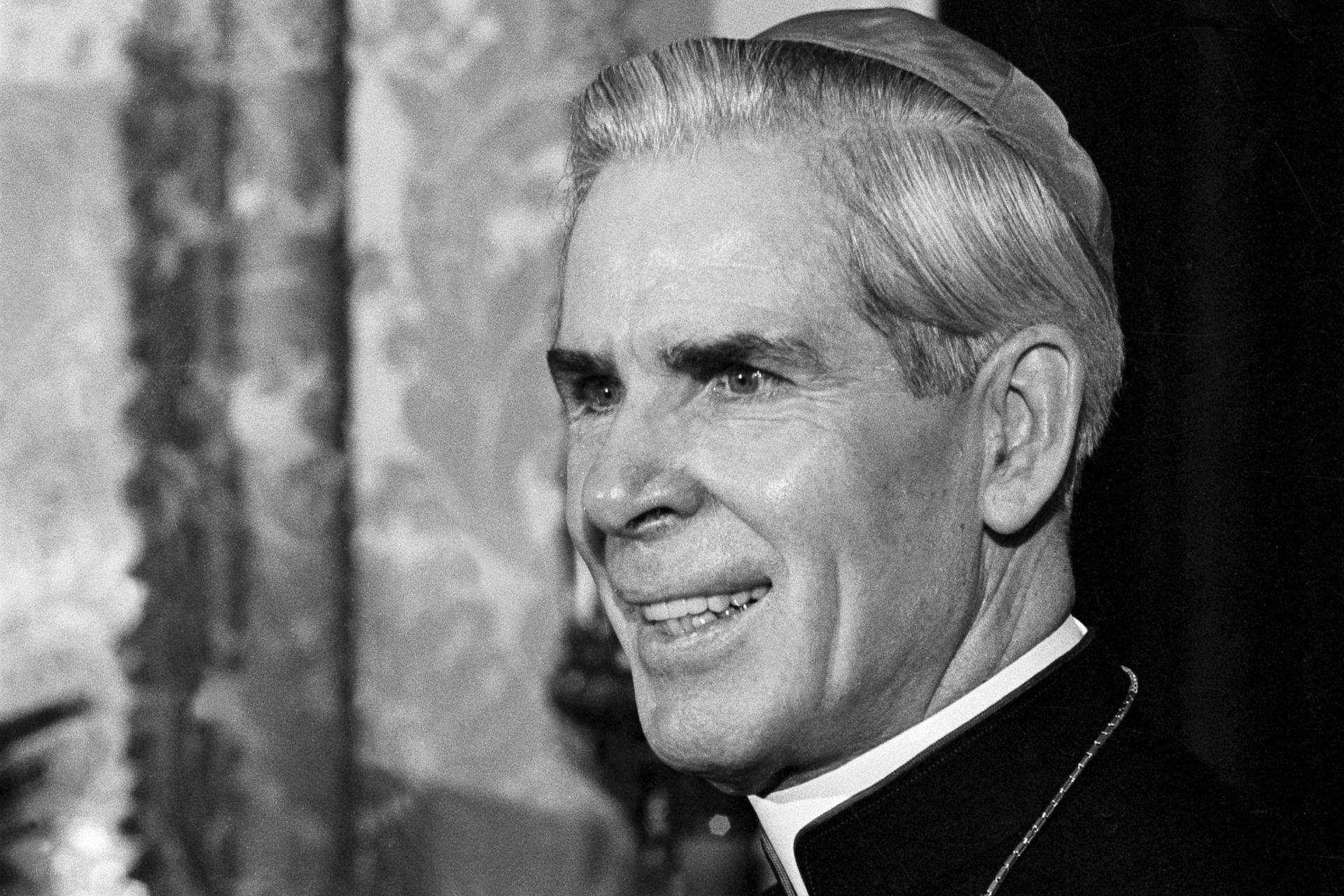
Archbishop Fulton Sheen, who was beatified on Thursday in St. Louis, is frequently described as the first televangelist, since he popularized a medium later overrun by evangelical Protestants.
Sheen certainly has a legitimate claim to the title, and his beatification last week in St. Louis moved him one significant step closer to becoming an official patron of Catholics in mass media.
In Sheen’s own day, the broad public considered the archbishop a “great enigma,” a puzzling figure who was impossible to fit into any of their ready-made categories.
The conservative Catholic journalist William F. Buckley Jr., for example, used those exact words – “great enigma” – to describe Sheen for his television audience on Jan. 6, 1970, introducing Sheen on an episode of Buckley’s long-running program, Firing Line.
It was a remarkable episode of television, featuring two highly educated and eloquent men – both Emmy-winners – on opposite sides of some (but not all) fundamental questions of politics and even basic morality, conversing with each other for an hour.
If it was remarkable in 1970, the episode is astounding today.
In any case, Buckley illustrated the enigmatic character of Sheen’s public persona by noting how the archbishop made it difficult for both conservatives and liberals to understand him.
“Those who like to disparage his evangelism,” Buckley said, “have a difficult time accounting for his extraordinary academic record.”
Sheen, in fact, was a renowned academic who won accolades in Europe for his contributions to philosophy and taught for many years at the Catholic University of America, as well as a popular preacher and TV host.
“Those who claim him as a conservative are continually amazed at his positions in behalf of statist welfarism,” Buckley also noted.
As Bishop of Rochester, New York – a post in which he served from 1966 to 1969 – Sheen pursued a partnership with the U.S. Dept. of Housing and Urban Development to promote racial and economic justice through his Bishop Sheen Ecumenical Housing Foundation.
“Those who have been inspired by his anti-Communist lectures which began in the early thirties cannot understand his current calls for withdrawing from Vietnam,” said Buckley, a staunch supporter of U.S. involvement in the Southeast Asian country.
The Vietnam War, which began for the United States in the early 1960s, was still being fought in 1970, and wouldn’t end until five years later.
It is crucial to recognize that Buckley wasn’t criticizing Sheen when he called his guest a “great enigma.”
In many ways, the 1970 Firing Line interview echoes debates still going on in the Catholic Church in the country, not only regarding the use and abuse of U.S. power in the world, but over the effects of Vatican II.
Speaking to Buckley, Sheen said his statements against the Vietnam War were not to denounce only that conflict, but “the immorality of war itself,” not the idea that force could be justified in principle, but modern industrial war, especially in the nuclear age.
Sheen was not questioning the fact of evil being done around the world after World War II, and the archbishop acknowledged that Christians were suffering even genocidal attacks in some places.
“Yes, but given genocide, given the extinction of Christians in China and in northern Vietnam, a million and a quarter of them brought down to the south and expelled, is war the only means?” Sheen asked.
“Are there not other means?” Sheen asked, during an exchange in which he noted the enormous material prosperity of the U.S. and questioned the use then being made of it.
The way the two – again, very much on opposite sides of burning public questions that were dividing the American people – conducted their exchange of views is remarkable, and instructive for us in the present.
Sheen also spoke about the rise of secularism in society and about changes to the Mass after Vatican II (at the time of the interview, the Missal of Paul VI had only officially come into force very recently and was still being tested throughout the world).
“Yes, the secular has, of course, a great appeal today. But there’s a reaction against that,” the archbishop said, claiming it is “more dead today” than when the idea of the “secular city” was popular.
“The secular city didn’t turn out to be quite as idealistic as [advocates] thought it was, and even in its secular order, today, look at those who are trying to find hope,” Sheen said.
The archbishop also noted how many daily newspapers published astrology columns and other content suggesting that many people were following a sort of polytheism rather than monotheism.
“All of the Protestants and the Catholics talked about their necessity of the church getting into the world,” he said. “What did the Communists talk about?” he asked. “Transcendence,” he said.
“First of all, in the Vatican Council the world came into the Church, and the Church went out to the world,” Sheen claimed.
The archbishop even took a question from a young person who missed the older forms of worship – yes, this was in 1970 – and he addressed an issue that is still hanging over the Catholic Church.
Sheen’s young questioner wondered whether among “the beauties and the strengths of religion is oftentimes tradition – the good parts of the traditions,” and whether the attempts to modernize the liturgy were not “[in]appropriate, but that it’s not effective?”
“In viewing such things as the folk Mass, the Jazz Mass, and all these attempts [to modernize the liturgy],” Sheen’s young interlocutor said, “it seems to me various factions of the Church have made [efforts] to get into it.”
“But,” he said, “they’ve kind of petered out,” and perhaps appear to be one of the drivers of the drop in church attendance already underway in 1970.
“I was wondering how you feel about that?” Sheen’s young questioner asked.
“I have heard some evidence to that there has been a decline now [to folk Masses and such],” Sheen said.
“As regards your expression of tradition: Tradition is a memory; law has precedent. An individual without memory is suffering from amnesia,” Sheen offered.
“A Church, a nation that has no history, is apt also to be without memory, so no children are born into the world to give us novelty,” he said.
“There are old people that are born into the world to remind us that there is such a thing as a heritage, and again we have to keep both together, the nova and the vetera,” the new and the old, he said.
As the Church enters the mid-point of the 21st century, we could learn a thing or two from the enigmatic Blessed Fulton Sheen, and allow ourselves and each other space for complexity and time to think things through together.
Follow Charles Collins on X: @CharlesinRome