MADRID – Pope Leo XIV on his second day in Spain invoked the country’s rich faith traditions and expressions of popular piety as a path, especially for young people, out of the polarized ideological divisions that grip much of global society.
He spoke of the path forward in remarks to those engaged in culture, art, the economy and sports, highlights also the need to form networks built on respect, dialogue, collaboration and selflessness.
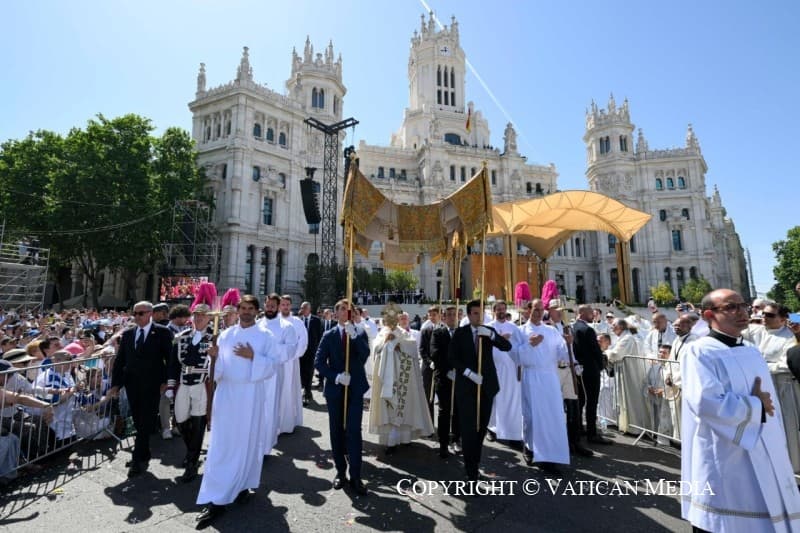
Also on Sunday, 1.2 million people were present for his Mass and procession in Madrid’s Plaza de Cibeles, where the pope said Spain’s present and future task is “to ensure that the religiosity which has shaped and defined this country for centuries is not a museum of the past to be visited, but a school of faith from which to draw even today.”
It must be a school, he said, “that teaches us to kneel before God and before our neighbor, because no one can kneel before the Lord and despise their brother.”
He stressed the need to go beyond selfishness and to “be present in the realities and challenges of society, not shying away, but personally committing ourselves to the building of the common good.”
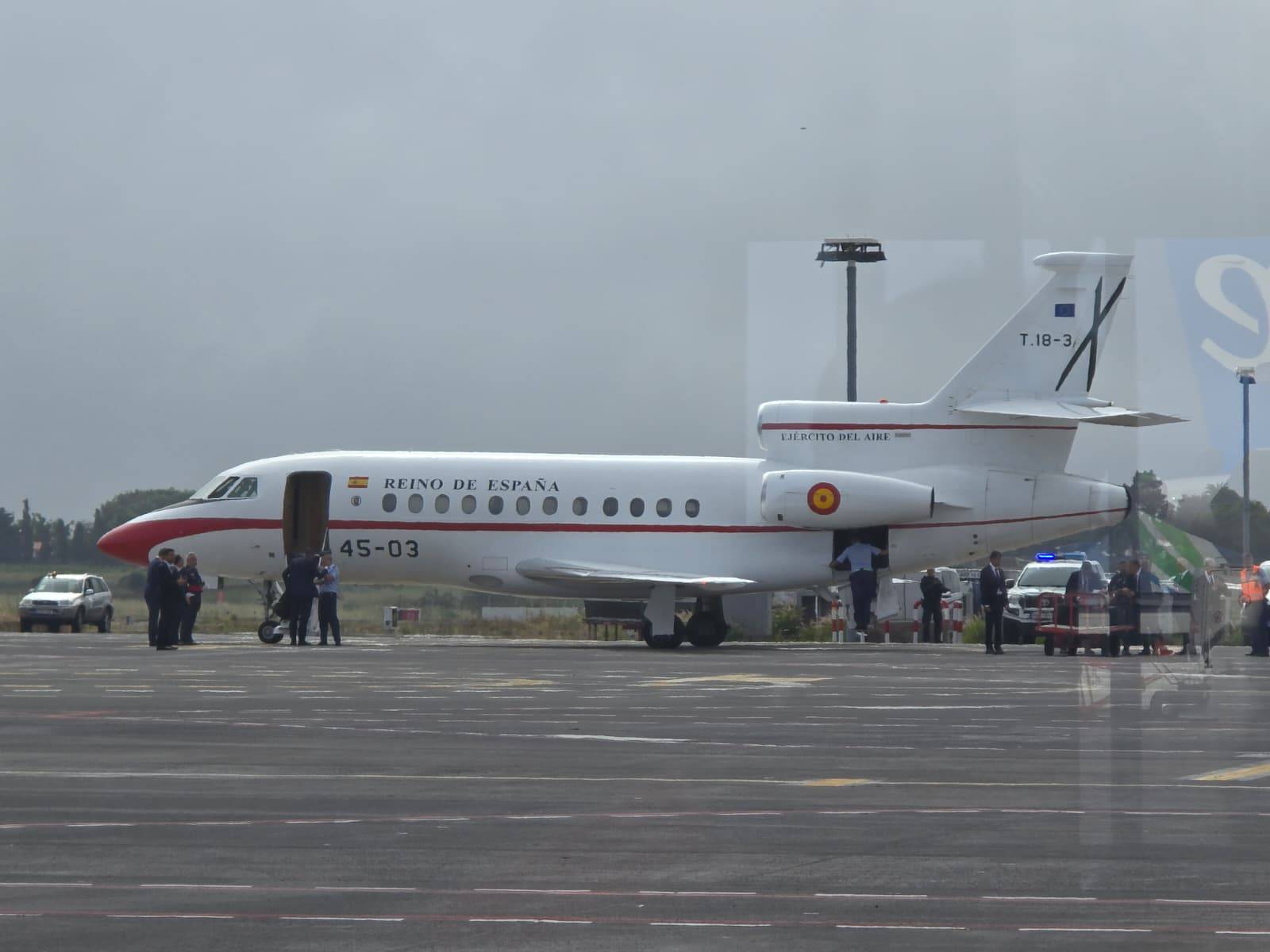
Pope Leo is currently on a seven-day tour of Spain, making stops in Madrid, Barcelona, and the Canary Islands.
Sunday’s Mass marked the Solemnity of Corpus Christi Mass and was followed by Eucharistic procession, which Leo led, walking over the traditional flower carpets intricately designed and delicately prepared for the occasion.
His visit comes as Spain, previously one of the world’s greatest global evangelizers and home to some of the most famed mystic saints in the world, is experiencing a rapid growth in secularism and as Europe more broadly grapples with geopolitical instability.
RELATED: In Spain, Pope points Europe to future of faith, solidarity amid global upheaval
Yet despite a sharp decrease in the percentage of practicing Catholics in recent years and the ongoing concert tour of famed Puerto Rican singer Bad Bunny in Madrid, that has not stopped people from flocking to papal events, including Sunday’s Mass and a youth vigil Saturday that drew some 600,000.
It is this Catholic instinct Pope Leo has sought to tap into during his first two days in Madrid, and which he drove home in Sunday’s Corpus Christi Mass.
An ode to memory
In his homily, the pope noted that Eucharistic devotion is, “deeply rooted in the faith and the history of your people.”
He invoked Spain’s deep Catholic roots, saying Corpus Christi processions have long been more than just “another celebration” on the calendar, but for centuries have shaped the piety, art and culture of Spain.
Processions, he said, demonstrate that Jesus “is not confined to the church, but comes out to meet us,” and they point to God’s presence in everyday life.
He stressed the importance for Spaniards of remembering their Catholic roots, saying the feast of Corpus Christi and the colorful processions associated with it ought to be more than just “wistful nostalgia.”
Rather, “it stands as an invitation in the present moment, in our daily lives, in our relationships, in society, and in the building of the future,” he said.
Leo urged faithful to return to Jesus “with sincere love” and forge a relationship with him, so as to “go forth into the paths of life and history, bringing to the people this stream of fresh water, a stream of love, peace, justice and joy.”
“Let us drink anew from this Eucharistic spring, which does not enclose us in private devotion, but sends us out to refresh our brothers and sisters, our families, the poor, the suffering, and those who have lost hope,” he said.
This devotion, he said, “transforms us and makes us protagonists of the transformation of history, a sign of hope for those we meet.”
A message that inspires
Among the 1.2 million attending the pope’s Mass and procession Sunday were Ramona and Jose Antonio Reyes Fernández, with their sons Pedro and Diego, who made their first communion just two weeks ago and who were eagerly waiting Pope Leo’s arrival to present him with a stuffed lion.
Speaking to Crux Now, Ramona said the family was “so, so incredibly excited to see the pope,” calling the papal visit “a unique opportunity” for Spain, as her son Diego chimed in saying they wanted “to listen to his words.”
The family, who had attended the pope’s prayer vigil with youth Saturday, during which many became emotional, said the pope’s message is one that Spain, and Europe, need to hear. Ramona said they listened to the pontiff speak Saturday and “we loved hearing him talk about being more human.”
“Lifting our gaze, in the end, means looking up and to our side, raising our eyes from our phones and computers. We believe his message needs to reach everyone, and we are here to listen to it and, starting tomorrow, keep spreading it,” she said.
Commenting on the rapid growth of secularism in Europe and throughout the West, Ramona said that being Christian, and a practicing Catholic, “isn’t anything strange; we aren’t aliens.”
“I believe that what [Pope Leo] transmits to this secularized culture is the Gospel. The Gospel is love; love for God and love for one’s neighbor. And that is exactly what this secular world needs. More love for our neighbor,” she said.
This love, she said, must begin, as Pope Leo said, in the community, “in the family, at work, at school, right now, with the people right next to us whom we don’t even know. Love for everyone.”
Similarly, Chiara, a Peruvian woman who has lived in Spain for 18 years, told Crux Now that “it is an emotional experience that the pope is here,” but it is especially so for Peruvians, as Pope Leo himself holds Peruvian citizenship, having served over 20 years there as a missionary.
Chiara, who attended the procession with her mother Maria, voiced her belief that the papal trip – the first in 15 years – was “a historic moment for Spain that allows all people to be united, everyone together, united in the end, because of the pope.
“I think it is something that will bear a lot of fruit in the future, meaning that more people will be able to follow God and be with the pope,” she said, voicing her belief that the pope’s presence can change the direction of the country.
The major events that happen during a papal trip, she said, “allow many people who perhaps aren’t as devout or involved to come and meet him. Besides, the pope has given what I think are very important messages, especially of unity, both for our country and for Spain.”
She voiced her belief that the pope’s message is sinking in, and that “both young people, who need it and are looking for a sense of purpose, and adults, can unite, and that God’s message can reach us through him.”
A path forward
One of the most notable aspects of the pope’s trip to Spain so far, for many observers, has been not only the sheer size of the crowds showing up, but the ability of these same crowds to be silent and to recollect in prayer amid a buzzing fast-paced world full of distractions.
It is this disposition of listening that Pope Leo is leaning into during his visit, using an event on “Building networks with the world of culture, art, economy and sport” in Madrid’s Movistar Arena Sunday evening to offer a blueprint for Europe to free itself from polarized divisions, and step into a future based on mutual respect and solidarity.
In his speech for the event, which included an intervention by Spanish actor and singer Antonio Banderas and performances from other famed Spanish artists, the pope questioned attendees about what legacy they are leaving for the future “and, by extension, what kind of community are we building?”
“Our society does indeed possess an extraordinary capacity to produce, innovate and communicate; however, it seems we still need to learn how to safeguard the soul of what it generates,” he said.
The Church, he said, is aware of both its successes and its errors in the past, but it “longs to remain in dialogue with the contemporary world” in order to help build a better future.
This future, Leo said, must be directed toward “toward a life of dignity and the common good.”
Asking what it means to be truly human, he urged attendees to ponder “what it is that we are sowing today, what exactly is flourishing and what is silently withering in our society; what values are we preserving and which are we allowing to die.”
“These are profound and necessary questions that cannot be ignored,” he said, and stressed the need to build networks of dialogue among individuals and institutions that is based on human dignity.
What this entails, he said, is that “the university not ignore the working world nor renounce the truth; that business does not view the employee as just another factor in the equation of its interests.”
It also requires that art not only be accessible to the elites and that sports not be reduced to “a spectacle or turned into mere business; and that technological progress take into account the elderly, the poor and those without a voice,” Leo said.
Christians, he said, must base everything on the inalienable human dignity, “respect of which is the basis of dialogue.”
Building networks also means creating beauty together, and it requires selfless service, especially to those most in need.
To this end, he noted that it is largely people and institutions of faith that have built and run hospitals, schools, and solidarity initiatives throughout the world, and who continue to be at the forefront of the defense of human dignity.
“For this reason, we would do well to ask ourselves honestly if the world – and Europe in particular – would have forged its identity without that spiritual influence that has permeated its history,” he said, recalling secular Europe’s deeply Christian roots.
This question, he said, is an invitation for European society to reflect on whether eternity “can still be reconciled with everyday life.”
“Is it seriously possible to believe that Europe – which we deeply love – would be the same without the influence of faith?” he asked, in a plug for the continent to return to its founding Christian values.
The pontiff stressed the need to care for the poor and excluded, saying, “We cannot ignore the fact that the condition of the poor is a cry that, in the history of humanity, constantly challenges our lives, our societies, our political and economic systems, and the Church.”
The one who can show humanity how to restore dignity and balance is Christ and the Church as “an expert in humanity,” he said, saying, “economic and institutional structures are just only to the extent that they serve the integral development of the person and promote the responsible participation of all.”
RELATED: Leo XIV: Leveraging the Church’s ‘expertise in humanity’
Antonio Banderas in his speech at the event reflected on his own faith and lamented the societal trend toward violence and exclusion, saying the alliance between civil society and the Church is needed to tackle modern challenges.
Noting that Jesus Christ is the most depicted figure in art, he said art “must continue to be, the mirror that reflects lives that pass right by an injured neighbor” and it must also be a place where the “empty creeds that forgot love” are denounced, he said.
Art, Banderas said, must be “the voice or warning for societies that have grown accustomed to injustice. Art must be an alternative to violence. All forms of violence.”
Calling for a reinforcement of the relationship between the church and civil society, he said this rapport “is not only timely: it is necessary.”