In response to Sunday’s coup attempt in the Republic of Benin, Catholic Bishops in the tiny West African country have made the defense of peace and unity a key priority, describing national cohesion as a “precious gift” that must not be tempered with.
In a release signed by the Archbishop Roger Houngbedji of Cotonou, the bishops expressed “grave concern’ at what happened.
In the early hours of Dec. 7, a group of soldiers appeared on National Television and announced that President Patrice Talon had been toppled, and the government dissolved.
The soldiers identifying themselves as the Military Committee for Refoundation said that Lt. Col. Pascal Tigri-the coup leader-had replaced Talon as the country’s new leader.
In their televised statement, the coup plotters mentioned the deteriorating security situation in northern Benin “coupled with the disregard and neglect of our fallen brothers-in-arms”.
The Episcopal Conference of Benin “strongly condemns any resort to violence or actions likely to compromise peace and unity. Indeed, national cohesion is a precious asset that must be preserved at all costs through peaceful and legal means,” the statement says.
The coup was however foiled, thanks both to the commitment of the Beninese army and the intervention of Nigerian forces.
“This commitment and mobilization enabled us to defeat these opportunists and avert disaster for our country. This treachery will not go unpunished,” said Talon in a national address to the nation Sunday evening.
“I would like to reassure you that the situation is completely under control and therefore invite you to go about your business peacefully,” the president said.
The coup is a major test for Benin’s democracy-a country that witnessed several coups following independence from France in 1960, but which has been politically stable since 1991 following the two-decade rule of Marxist-Leninist Mathieu Kérékou.
Calm has returned
Benin journalist and lay Christian, Marlyse Ligan told Crux that calm has returned to the capital,Cotonou, and that citizens were going about their businesses.
“When people learned that the coup d’état was under control, they felt once more safe,” she said
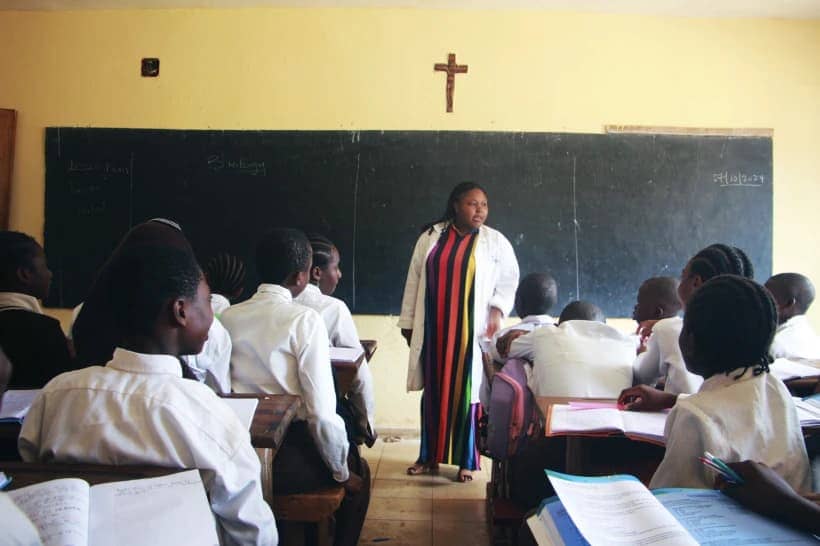
“So by Monday, everything seemed as if nothing had happened, although there is still that lurking fear-that psychosis,” she continued. “People are going to their offices; schools are operating normally…that is the prevailing atmosphere.”
The coup tells a deeper story
The coup might not have succeeded, but that it took place in the first place tells a deeper story, says Arian Silva, a lay Catholic journalist based in the capital, Cotonou.
“For a while now, democracy has been a bit tested in our country,” she told Crux.
She cited the 15 November revision of the Constitution as one area of contention, where members of Parliament voted to extend terms of office for elected officials from five years to seven years, and introduced the Senate.
Coming just months to the April 2026 presidential election, the reform received its share of criticism, with many observers wondering what the reform could have for the country’s democratic experiment.
“I believe that all parties never appreciated the reform,” Silva said.
“That created some discord, some misunderstanding within certain political parties. It created some frustration,” she continued.
“So for a while now, people are fed up. There is a lot of criticism against the regime in place, because people don’t appreciate all the laws, or all the measures of the government in place. So, there is a lot of friction against the government. I’d say that it is for all these reasons, which provoked what we witnessed on Sunday,” she said.
West and Central Africa form what has become known as “the coup belt” stretching from Guinea to Niger. The failed coup in Benin followed a familiar pattern across the region: Disputed elections, constitutional upheaval, and security crises and youth discontent.
Mali, Chad, Guinea, Guinea-Bisau, Niger, Sudan, Gabon, and Madagascar have all witnessed coup d’états since 2020.
Silva told Crux she believes the Benin coup failed because it lacked popular support-unlike what happened in other West and Central African countries.
“Popular support is sometimes also needed for a coup d’état to succeed. As soon as the coup d’état is set up, the population accompanies the movement, which we did not observe in Benin. And generally, the people of Benin are fearful of bloodshed and of chaos and they believe so much in the institutions of government. That is why they could not support a coup,” she said.