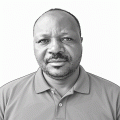
YAOUNDÉ, Cameroon – Bishop John Tatah Berinyuy, the auxiliary Bishop of the Archdiocese Bamenda in Cameroon, was once kidnapped by separatists fighting to create a new country made up of the English-speaking part of the majority French-speaking African country.
The bishop argues that the ongoing conflict in Cameroon’s English-speaking North West and South West regions persists because too many stakeholders are profiting from the instability. He, however, offers a hopeful view of Pope Leo XIV’s recent visit to Cameroon.
“I think the Holy Father came to sow the seed of peace. That seed needs to be watered and manured to grow,” the bishop told Crux Now.
The following are excerpts of that interview….
Crux Now: Can you speak to your early upbringing? What inspired you to go into the priesthood?
Berinyuy: I was born in Shisong, grew up there, and served as a mass server. In 1982, the Capuchins came to work in the parish. Seeing the Capuchins made me think maybe I could become a priest. At that time, the principal of Bishop Rogan College came for interviews. Our head teacher indicated that people were being interviewed. Six of us went in, and we all passed, but finally only two of us went down to Bishop Rogan College. When we got there, the other person dropped out, so I continued alone. The presence of the Capuchins in the parish triggered that vocation in me, as did the fact that I was serving at Mass.
And what was your family’s reaction like, especially as you grew up in Nso land where the expectation is for young people to grow up, get married and start a family?
When I said I was going to go to Bishop Rogan College, I thought the family was not going to afford that, but my mother, who was the breadwinner of the family, was very, very supportive. She took all her life savings and went to pay my deposit; it was CFA 90,000 [about $160] at that time. I didn’t even know she had done so. I was prepared to go to a government school because I knew my parents didn’t have that kind of money. However, my mother had paid my deposit, which I discovered when I found the receipts while searching in the house one time. How I was going to continue after that initial deposit, only God alone knows.
So, how did you manage to go through school, given the financial hurdle?
I had support from others within Bishop Rogan College; they used to assist us with school fees. That support continued until I became a priest.
How did your academic background shape your understanding of the human person?
When I was studying in the seminary, I became very interested in Archbishop Fulton Sheen. When I went to study in Rome, I first studied Spiritual Theology for a Master’s. Eventually, after finishing with my Spiritual Theology, I had some health challenges with my teeth that required therapy for two years. My bishop decided I could stay back, and a professor sponsored me to do a doctorate in Christian Anthropology.
I decided to study the works of Fulton Sheen in depth to understand his Christian Humanism. He wrote a lot about the “frustrated person,” looking at what the human person can do, especially during the time of the World Wars. In 2012, I was invited by a family in America and had the chance to buy some of his books and visit his tomb in New York. That started the course of his beatification, which was halted for a time, but he is going to be beatified in September.
I guess when you came back to Cameroon, you handled a lot administrative role. You’ve served as a parish vicar in Bafut, and a parish priest in…
I was ordained in 2005. I was appointed to St. Joseph’s Parish in Bafut for a year, then appointed chaplain of St. Joseph’s College, but I never took over that post because I was appointed to Babanki to become parish priest in 2006. I worked in Babanki from 2006 to 2010, and then went to Rome for further studies until 2015.
And in all these parishes where you served, how did that shape your understanding and your perception of the daily struggles of the Cameroonian people?
I think that when I went to Babanki, and even in Bafut, it wasn’t very easy. It was a time when the people were having a lot of crises. We actually took over from some priests in Bafut who had abandoned the parish due to difficulties. One thing that helped us was Eucharistic adoration. Inspired by Fulton Sheen, we had adoration every day from 5 a.m. to 6 a.m. When I went to Babanki, I continued that practice. It helped shape my life first as a Christian, and then as a priest. I used to get up every morning at 3 a.m. to prepare. At 5 a.m., we exposed the Blessed Sacrament, prayed, and then went about our activities.
Recently, the Holy Father appointed you bishop of the Bamenda Archdiocese. Were you expecting it?
No, I wasn’t expecting it. I was living my life very quietly. I had worked in Bambui for eight years as spiritual director and formator when I came back. After that, they appointed me to Kumbo where I worked as registrar for two years. Then the archbishop called me and told me he wanted to begin a university in Ndop and wanted me to go and start it. In August 2015, I went to Ndop.
The buildings were just at a certain level when I arrived; we took them off, roofed them, and prepared for the reopening in October. The university was inaugurated in November 2015. I was working quietly, trying to grow the university, and wasn’t expecting anything.
So, when finally, the announcement came, what was your immediate reaction?
It came to me as a surprise, but I knew that it is a very serious task to become a prelate at this particular time, given the challenges we are having.
You were once kidnapped…
Yes. I was kidnapped shortly after the inauguration of the Catholic University in Ndop. I was taken by some boys [separatist fighters] in Babessi. They locked us up—four priests, one lay person, and myself. Eventually, they wanted to release us but said they would keep one person. My parish priest was complaining he wasn’t feeling well, so I volunteered to stay. The rest went home, and I stayed. Social media took it up, but I didn’t know people were praying for me. It was not something easy, but somebody must do the work.
And when you were kidnapped, where did you find the strength to endure that captivity?
As a counselor, I read Man’s Search for Meaning by Victor Frankl, which says you have the choice to decide how you react to what happens to you. I was prepared for anything—to come out alive or dead. I wasn’t worried. Luckily, the boys guarding me respected me and didn’t harm me. I asked the Parish Priest to send two books to me. When we sat in an abandoned primary school in the bush, while they smoked marijuana, I read my books and prayed my rosary. That was my strength.
Do you mind sharing, maybe briefly, the contents of the books the Parish Priest shared with you?
One book was written by a Pentecostal pastor about the spiritual heart. He talked about how we take care of our physical heart but forget the spiritual one. Taking care of the spiritual heart means letting go of bitterness and thoughts of revenge.
This idea of spiritual heart therapy—purifying your heart—helped me a lot. When I prayed the rosary, I prayed that the Lord should forgive the kidnappers for they did not know what they were doing. Reciting that prayer gave me strength. The other book was on the precious blood of Jesus Christ by Brother Barnabas. It shared experiences on the spiritual life and reminded me of the spiritual theology I taught.
Did you happen to discuss with your kidnappers? And if so, did those discussions lead to your understanding of their mindset?
Yes, I discussed with them. They told me their stories; they had been fighting in this crisis since 2016. One of them had been shot in the leg, had an iron rod inserted, and still had bullets in his body. He was a mechanic. The military had surrounded the hospital where he was hospitalized, forcing him to escape.
They had taken oaths at the beginning [of the crisis], and it had become like a religion for them; they keep coming back. According to them, they are fighting for freedom, even though their minds are derailed because they now extort money on the roads. I mostly listened to them and didn’t stress them, as stressing them could be dangerous. One guard, who loved money, was later killed. In Kumbo, the main guard insisted I take a bath after 10 days because, as he said, “We can stay three months without bathing, but we know you have to bathe.” They shared their struggles, like how they needed to extort money to buy tracksuits for Christmas.
This is a crisis that has dragged on for 10 years. Why do you think it’s so difficult to resolve this crisis?
Yeah, it’s so difficult to resolve because people are gaining from this crisis from all angles. It has become something that people use to make money. The stakeholders who are making money from it will not want it to end.
As we wrap up this interview, your Lordship, you were one of those who welcomed the Holy Father to Bamenda, and he spoke extensively about the need for peace and justice. Do you think his presence and the message he came with has moved the needle on the ground?
I think that the Holy Father came to sow the seed of peace. That seed needs to be watered so it can grow and mature. His presence, and the fact that there was no incident, is a sign from God that it is possible to walk towards peace. It is a journey we must carry out. Peace does not come through speeches but through work.
We need to reconcile, leave bitterness, and look at the common good. Justice is giving to each person what they deserve. If I only think about myself, I will grab what belongs to you, and we will continue fighting.