As political polarization rises across Europe, a Spanish archbishop has warned that the Church should avoid being dragged into “partisan conflicts” while still emphasizing Christian values in the face of polarizing rhetoric.
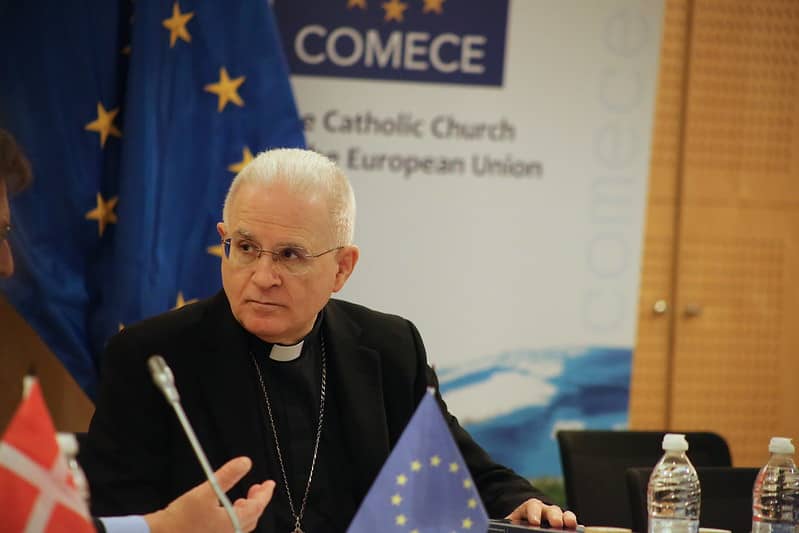
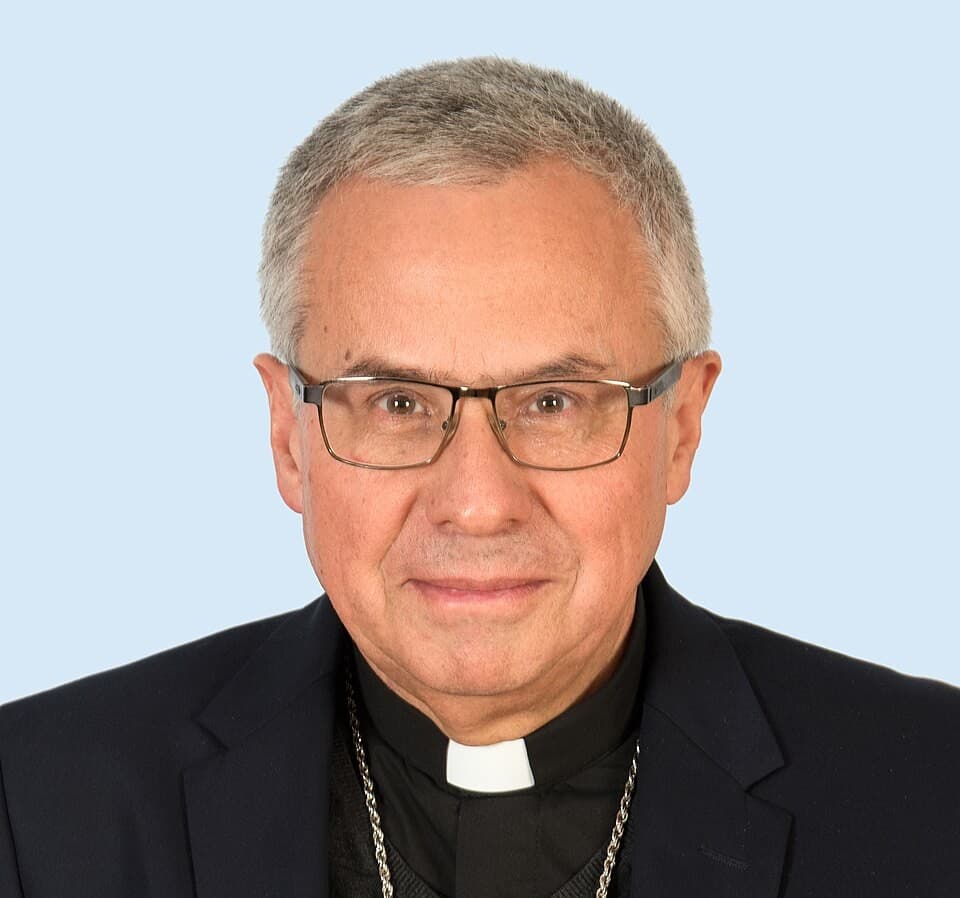
In an exclusive interview with Crux Now, Archbishop Joan Planellas of Tarragona – and president of the Tarraconense Episcopal Conference, a Catalonian regional bishops’ assembly established in 1969 – also said Christian values are “rooted in fraternity, social justice, and respect for human rights.”
“When any political group, of whatever persuasion, promotes rhetoric that excludes, polarizes, or generates fear toward those who are different, the Church must maintain a critical and prophetic stance,” he said.
“This does not mean entering into partisan conflict, but rather recalling that Christian values are rooted in fraternity, social justice, and respect for human rights, beyond ideologies,” the archbishop also said.
Planellas also said that following the regularization of 500,000 migrants in Spain earlier this year, the Church’s role is “to remind everyone that the migrant is not a problem, but a brother or sister.”
Planellas went on to outline his hopes for Pope Leo XIV’s visit to Spain this summer, discussed why Spanish people are no longer automatically Catholic, and gave insight into the reasoning behind a recent decision by the bishops of Catalonia to allow the local government to use church buildings to ease the housing crisis.
The interview is below.
Crux Now: Last year, Archbishop Argüello – president of the Spanish Episcopal Conference – said that Spaniards are no longer automatically Catholic. What do you think the Church needs to do to reach people?
Archbishop Joan Planellas: It is true. As [Archbishop] Luis Argüello said, we no longer live in a society where faith is automatically inherited. This should not be experienced with nostalgia or fear, but as a call to return to the essence of the Gospel.
Today the Church needs an attitude of listening, closeness, and coherent witness. It is not so much about strategies as about living, welcoming communities that accompany people’s real questions and knowing how to speak in a language that can be understood, especially to young people and to those who feel distant.
Do you think evangelization in Catalonia is different from evangelization in the rest of Spain? If so, why?
Catalonia has its own history, language, and cultural reality, and this also influences how faith is lived and perceived. Evangelization here relies much more on dialogue, respect for plurality, and on a Church that does not impose itself but proposes.
It is not “better” or “worse” evangelization than in other parts of Spain, but it does require a particular sensitivity toward a very secularized society that is, at the same time, highly attentive to ethical and social coherence.
Recently there has been considerable debate about groups such as the far-right Vox party and the Church following a report in El País about Pope Leo and the Spanish bishops. Setting aside the truth or falsity of that report, what is your opinion of Vox and the more radical groups in Spain?
The Church does not identify — nor should it identify — with any specific political option. Our mission is to proclaim the Gospel and defend the dignity of every person. When any political group, of whatever persuasion, promotes rhetoric that excludes, polarizes, or generates fear toward those who are different, the Church must maintain a critical and prophetic stance. This does not mean entering into partisan conflict, but rather recalling that Christian values are rooted in fraternity, social justice, and respect for human rights, beyond ideologies.
In January there was a major debate in Spain about the regularization of migrants promoted by PM Pedro Sánchez of the Spanish Socialist Workers Party. How will the Church navigate this issue in the coming years?
The migration issue will continue to be central in the coming years. In response to Government initiatives, such as those promoted by President Pedro Sánchez, the Church always seeks to stand on the side of people, especially the most vulnerable. Our task is not to dictate specific policies, but to accompany, welcome, and integrate, and to remind everyone that the migrant is not a problem, but a brother or sister. Caritas and many parishes are already carrying out quiet and essential work that will need to be strengthened.
The problem is that we do not accept or love those who are different, and we look for someone else to blame for what happens, without examining our own hearts. We have not understood Jesus’ statement: “There is nothing outside a person that by going into them can defile them; rather, it is what comes out of a person that defiles them” (Mk 7:15). Instead, certain simplistic and flat statements that blame others for all evils are more attractive and deceptive. It is enough for a leader to step forward and gather these ideas together…
Pope Leo will visit Spain in June, including Barcelona. What are your hopes for this visit?
Every papal visit is an opportunity for grace. Beyond names or headlines, I hope his presence in Spain, and specifically in Barcelona, will be an encouragement to renew faith, to build bridges, and to place those who suffer most at the center.
May it be a visit that helps the Church to go out of itself and to look at reality with evangelical hope. The Sagrada Familia and the figure of, hopefully soon, Blessed Antoni Gaudí can undoubtedly help in this regard.
Recently, the dioceses of Catalonia reached an agreement with the Generalitat of Catalonia to make Church buildings available for social housing. Can you tell us more about this process and what significance you believe it has?
The agreement reached with the Generalitat de Catalunya is the fruit of calm and responsible dialogue. There is very good harmony with the President of the Generalitat, Salvador Illa. The Church cannot remain indifferent in the face of the serious housing crisis. Making available Church buildings that currently have no pastoral use is a concrete way of living out the Church’s Social Doctrine.
It is not only about offering spaces, but about collaborating in a project that places the person at the center and shows that faith is also expressed through tangible social commitments.