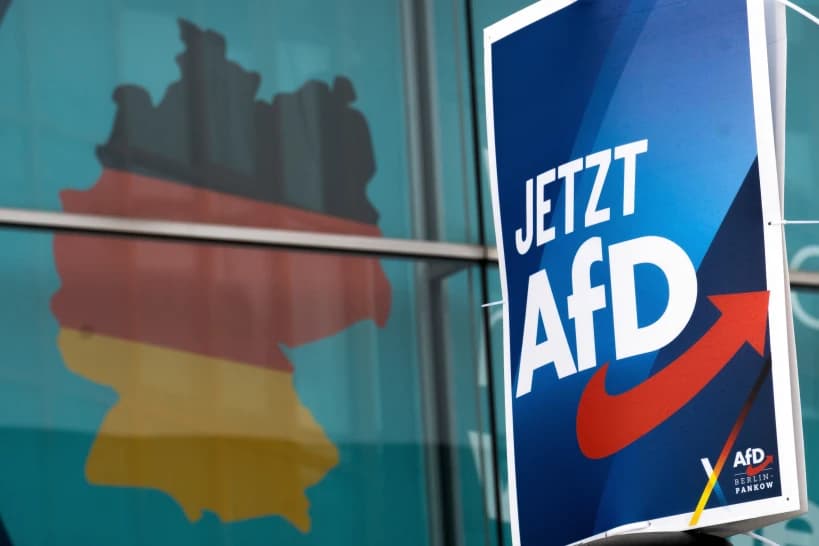
The Alternative for Germany (AfD) have won the local elections in Saxony-Anhalt while the local church has consistently warned against the burgeoning far-right party.
Although the party fell short of an outright majority in the eastern state of Germany, with nearly 44 percent of the vote, the victory has sent shockwaves throughout Europe and is widely considered a historic event.
Complex negotiations now beckon to determine who will govern the state. No far-right party has governed a German state since World War 2, which gives powers over local education, policing and culture.
Ulrich Siegmund, the leader of the AfD in Saxony-Anhalt, has said that if the party is able to form a government then it will ban rainbow flags in schools, begin a remigration and deportation campaign, and halt wind farm construction.
He has also pledged to bring back singing the national anthem and raising the flag in state schools.
Speaking Sunday on the day the elections took place, Bishop Gerhard Feige of Magdeburg, the diocese in Saxony-Anhalt, warned that “apocalyptic and racist ideas have taken root in the minds of so many.”
Although Feige didn’t explicitly name AfD, he called for action to be taken against extremist ideas. “Currently, this probably means in a special way resisting the nationalist and xenophobic spirit,” he said.
“Compassion is becoming a dirty word – and misanthropy is becoming socially acceptable,” he added.
In the build-up to the elections, the local church launched the “Vote Consciously” initiative which called on voters to avoid populist rhetoric and extremism.
The initiative included a poster campaign, training courses on dealing with right-wing extremism in youth work, argumentation training, and instruction on legal tools for responding to authoritarian attacks.
Siegmund was baptized as a Catholic as a child, but officially left the church in 2017, which in Germany involves formally deregistering so the controversial church tax doesn’t have to be paid.
Feige previously told Crux Now that Catholics who feel drawn to the rhetoric of the AfD should “respond to that feeling by reading and learning.”
Pointing to the frequent disparaging comments made by AfD politicians towards the Christian churches of Germany, Feige added that the “AfD therefore cannot be an alternative for Catholics, because anyone who takes the Gospel seriously and loves their Church cannot possibly vote for those who disparage it.”
Feige also challenged those on the right who reject immigration because of a desire to preserve Western civilization.
“Christ will certainly not ask us at the end of our lives: ‘Did you take sufficient care of yourselves and successfully defend the Christian West?’ Rather, his question will be: ‘What have you done for my sisters and brothers who fled to you because of hardship and persecution?'” he said to Crux Now.
The election results have put huge pressure on the ruling centrist coalition, particularly conservative Chancellor, Friedrich Merz, who had promised to reduce AfD’s popularity.
Donald Trump, the president of the United States, was one of many right-wing politicians who took to social media Sunday evening, with Trump sharing the exit polls that suggested the AfD would win on his Truth Social account.
A history of flashpoints
In May 2025, the Federal Office for the Protection of the Constitution (BfV) – Germany’s domestic intelligence agency – classified the AfD party as a confirmed right-wing extremist organization although in February 2026 a court in Cologne issued an injunction temporarily suspending this classification.
The Catholic Church in Germany has also frequently come to blows with the party, culminating in a decision by the German bishops’ conference to ban any AfD members from working for the church, calling the party “unelectable.”
In 2024, the German Catholic bishops’ conference released a statement that mentioned the AfD by name and said that ethnic nationalism was incompatible with Christianity.
“The AfD oscillates between genuine right-wing extremism, which the Office for the Protection of the Constitution attributes to some state associations and the party’s youth organization, and a right-wing populism that is less radical and fundamentalist,” the statement said.
“The dissemination of right-wing extremist slogans—which include, in particular, racism and antisemitism—is also incompatible with any full-time or volunteer service in the Church,” the bishops added.
Earlier this year, the AfD submitted a draft law that would stop some state payments to the country’s Christian churches.
Further, in Saxony-Anhalt, one of the manifesto promises was the desire to end state subsidies to public institutions, including the Catholic and protestant churches which it accuses of taking “left-wing positions.”
“Since the church tax churches no longer convey this message and have often distanced themselves from the Christian mission and are primarily active in socio-political matters, they cannot claim a special status through church tax collection and state subsidies,” the manifesto states.
The intention would be to make future state funding conditional.
______
You are reading this Crux Now article for free. You can register for our free daily newsletter here, and you can become a Crux Now supporter for full access to all our premium content here. To find out more about why becoming a Crux Now supporter is a great idea, go here.