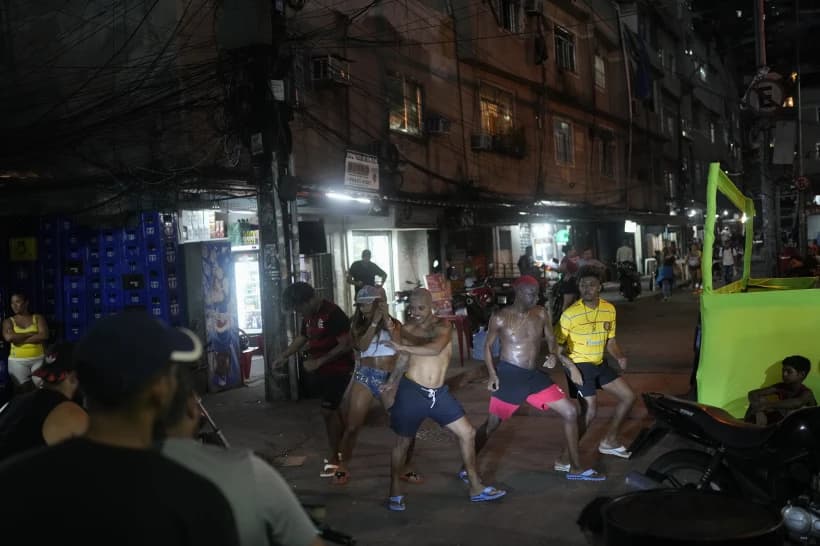
SÃO PAULO – With almost half of Brazilians living in inadequate housing and a rapidly growing number of slums called favelas, the Catholic Church is discussing ways to respond to the new demands of low-income families and to strengthen its presence in the country’s poorest areas. The issue is set to be one of the main items on the Church’s agenda this year in Brazil.
The Fraternity Campaign, a Lenten initiative promoted by the National Conference of Bishops of Brazil (CNBB) to raise funds for the Church’s social programs and to foster debate on pressing social issues, will focus on housing in 2026.
“The campaign presents several proposals, especially promoting advocacy for public housing policies and seeking new ways to strengthen the Church’s presence and work in favelas and poor neighborhoods,” Father Marcelo Toyansk Guimarães, who heads the National Housing and Favela Pastoral Ministry, told Crux.
The campaign’s guiding document, written by clergy members who work with housing issues along with leading scholars and experts, shows that the proliferation of informal favelas has accelerated in Brazil.
In 2010, the Brazilian Institute of Geography and Statistics (IBGE) reported 6,329 favelas nationwide. By 2022, that number had risen to 12,348. The population living in favelas grew from 11.4 million in 2010 (about 6 percent of Brazilians) to 16.4 million in 2022 (roughly 8 percent of the total population).
In some states, the proportion of residents living in favelas is particularly high. That is the case in Amazonas, where 34.7 percent of the population live in favelas, and in Amapá, where the figure reaches 24.4 percent.
But favelas are not the only challenge related to inadequate housing, Guimarães explained.
“Precarious conditions are also visible in large housing projects and in neighborhoods located in high-risk areas prone to flooding or landslides,” he said.
Inadequate housing also includes structural deficiencies, improper ceilings and flooring, the lack of a private bathroom and excessive overcrowding. According to IBGE, at least 26 million housing units in Brazil are considered inadequate.
In poor neighborhoods and favelas, these conditions often exist alongside poor sanitation, limited public transportation and a lack of trees and green spaces.
“Popular housing must be well located within cities so communities can thrive. But that is not what has been happening,” said Evaniza Rodrigues, a member of the Housing and Favela Pastoral Ministry in São Paulo and an activist with the Popular Housing Movements Union (UMM).
Climate change has further worsened the situation. Flooding has become more frequent, disproportionately affecting poor families who have built their homes irregularly along riverbanks.
Rising temperatures also make life increasingly unbearable in favelas and poor neighborhoods lacking trees and adequate ventilation, where construction materials tend to retain heat.
“Climate change affects everyone, but it hits the poor hardest,” Rodrigues told Crux, noting that recent studies show temperatures inside homes in favelas can reach 120 degrees Fahrenheit during the summer in cities such as Rio de Janeiro.
Housing has long been a structural problem in Brazil, Guimarães explained. Industrialization, which gained momentum in the early decades of the 20th century, was not accompanied by an urbanization process that took housing for workers into account.
“Wages were barely enough to cover food,” he said. As a result, decent housing was never treated as a right by the Brazilian elite. Access to land, both in rural areas and in cities, has also historically been denied to the poor.
“One of the campaign’s challenges is to argue that housing is a right and should not be commodified,” Rodrigues said.
When treated as a commodity, she explained, housing becomes inaccessible to the poorest.
“Everyone needs a place to live, not necessarily one they own, but a place where families can live and rest safely and with dignity,” he added.
Public policies, therefore, cannot operate solely according to market logic – such as offering cheaper credit to low-income buyers – but must also address the needs of those excluded from the housing market, Rodrigues argued.
Parishes and dioceses across the country are hosting discussions and workshops on these issues. The aim is to train local Church agents to address housing concerns within their communities and potentially establish new groups of the Housing and Favela Pastoral Ministry.
The initiative seeks not only to strengthen advocacy for better housing conditions, but also to expand the Catholic Church’s presence in areas it has struggled to reach.
“Faith is an important source of strength in confronting life’s challenges, including housing,” Guimarães said.
He lamented that the religious presence most commonly found in newly formed favelas is not always committed to the needs of the poor. Churches linked to so-called prosperity theology, he noted, often arrive more quickly in newly occupied areas.
“The Fraternity Campaign calls for a Church presence that does not promote an individualistic faith, but instead actively engages in the search for solutions to housing problems,” he said.
Those solutions, Rodrigues added, may come from popular movements. Initiatives involving the environmental upgrading of favelas, urban farming, solar energy projects in poor neighborhoods and self-construction efforts will be highlighted by the campaign.
“Being present is part of the Church’s mission. That is our struggle,” Guimarães said.

![The Pelourinho Novo (lit. 'New Pillory'), also known as Hath Katro Khamb[b] (lit. 'Hand-Cutting Pillar'), in Old Goa. (Credit: Wikimedia.)](https://cruxnow.com/cdn-cgi/image/width=1920,quality=70/https://wp.cruxnow.com/wp-content/uploads/2026/04/pillar-in-india.jpg)