SÃO PAULO – Conservative members of city councils across Brazil have been introducing bills against what they call “Christophobia,” targeting especially participants in Carnival parades who satirize Christian symbols.
In cities like Salvador, the capital of the state of Bahia — where a bill of this kind is awaiting the mayor’s enactment — and in neighboring Lauro de Freitas, where such a measure became law on Jan. 21, Carnival revelers may be fined and subjected to other sanctions if they dress up as nuns, for instance.
Over the past few years, such bills have been introduced in a number of Brazilian cities. Most of them aim to establish a Municipal Day to Combat Christophobia.
That is the case in São Paulo, where such a law was approved in Mar. 2025; in Maceió, in the state of Alagoas, where the measure took effect in Jun. 2024; and in Sete Lagoas, in Minas Gerais, where the law was enacted in May 2025.
None of those acts mention Carnival. In Belo Horizonte, the capital of Minas Gerais, the Municipal Day to Combat Christophobia was created in Sept. 2025. While it also does not mention Carnival, the festivity was cited by the city council member who introduced the bill during debates.
Pablo Almeida, a member of former President Jair Bolsonaro’s Liberal Party, argued that there is a “growing wave of abuse and attacks on the Christian faith.”
In the bill’s justification, he described a video posted on social media by the city government during the 2025 Carnival that showed two partygoers kissing. One of them was dressed as Jesus and the other as the devil.
He also mentioned a Carnival performance in which a participant allegedly impersonated Jesus while wearing underwear.
In Bahia, traditionally one of the Brazilian states with the largest Carnival celebrations, the bills included not only a Municipal Day to Combat Christophobia but also directly mentioned the festivity.
“Disrespectful campaigns and costumes targeting Christians are hereby permanently prohibited, particularly when promoted or supported by public authorities, including but not limited to Carnival, Saint John festivities, New Year’s Eve celebrations, festivals, and any other cultural events or activities,” the version approved in Lauro de Freitas reads.
The law specifies that “such prohibition includes, for example, acts that mock or vilify Jesus Christ during events or cultural activities, as well as costumes portraying nuns with sensual connotations or sexual appeal.”
Individuals and legal entities convicted of the offense of religious intolerance, particularly acts characterized as Christophobia, shall be barred from entering into contracts with the municipal government involving public funds.
“Companies, event organizers, Carnival street groups, VIP viewing areas, cultural groups, and duly identified individuals who are proven to have violated any provision of this Law shall be subject to an administrative fine in the amount of three minimum wages,” the act establishes.
The amount currently corresponds to $940. In the event of repeat offenses, the fine shall be doubled. Salvador’s bill contains similar provisions.
In its justification, councilman Cezar Leite — also a member of Bolsonaro’s Liberal Party — argues that Christophobia is “a growing problem” and that Evangelicals, in particular, “have been the target of attacks and discrimination in different social spheres.” The councilman mentioned a controversy involving pop singer Claudia Leitte in 2024.
Leitte gained fame in Brazil as the lead singer of Babado Novo, a Bahia-based axé music band, before going solo. Axé music emerged in Salvador in the 1980s, fusing Afro-Caribbean and Afro-Brazilian genres.
In axé songs, which are a major Carnival element in Bahia, references to orishas — deities of Afro-Brazilian religions like Candomblé and Umbanda — are common. Leitte, who converted to Evangelicalism in 2012, decided to change a verse of one of her songs from her time with Babado Novo.
In the song “Caranguejo” (“Crab”), the lyrics used to say: “The tide is high, wait for it to recede, throw flowers into the sea, greeting Queen Iemanjá,” a reference to the orisha associated with fertility, maternity, and river and sea waters.
In 2024, during a performance, Leitte instead sang: “I sing to my King Yeshua.”
The episode spurred outrage among Candomblé and Umbanda adherents, who called for an inquiry into Leitte. On social media, the singer faced fierce criticism, which councilman Leite referred to as ‘Christophobic’ attacks.
The councilman celebrated when his bill passed the City Council in Sept. 2025. He called on all Christians — “Evangelicals, Catholics, Spiritists” — to pressure Mayor Bruno Reis to enact the bill. It has not yet been enacted.
Father Lázaro Muniz, a longtime promoter of interreligious dialogue in Salvador, says there is no need for a law against Christophobia. About 70 percent of Salvador’s population identifies as Christian.
“It’s not as though everything Christian is being attacked,” he told Crux, adding that he considers the Lauro de Freitas law “too radical.”
He argued that an educational campaign promoting respect for all religious symbols would be a better approach.
“People need to have common sense. If a reveler shouldn’t dress up as an orisha during a Carnival party, costumes carrying Christian symbols should be equally avoided,” he said.
Performances during Carnival parades can be seen as a kind of theatrical representation and should not necessarily be considered scandalous by religious people, he added.
“But the problem is that the background of such performances is a feast marked by obscenities. It’s an unfavorable context for the inclusion of any religious symbol,” he said.
Muniz acknowledged that it is not always easy to deal with such situations from a religious perspective.
“Our biggest concern is the scandal. Some people may see somebody dressed as a nun or as a priest during a Carnival parade — someone who might be drinking alcohol or publicly kissing another person — and think that person is an actual religious leader,” the priest said.
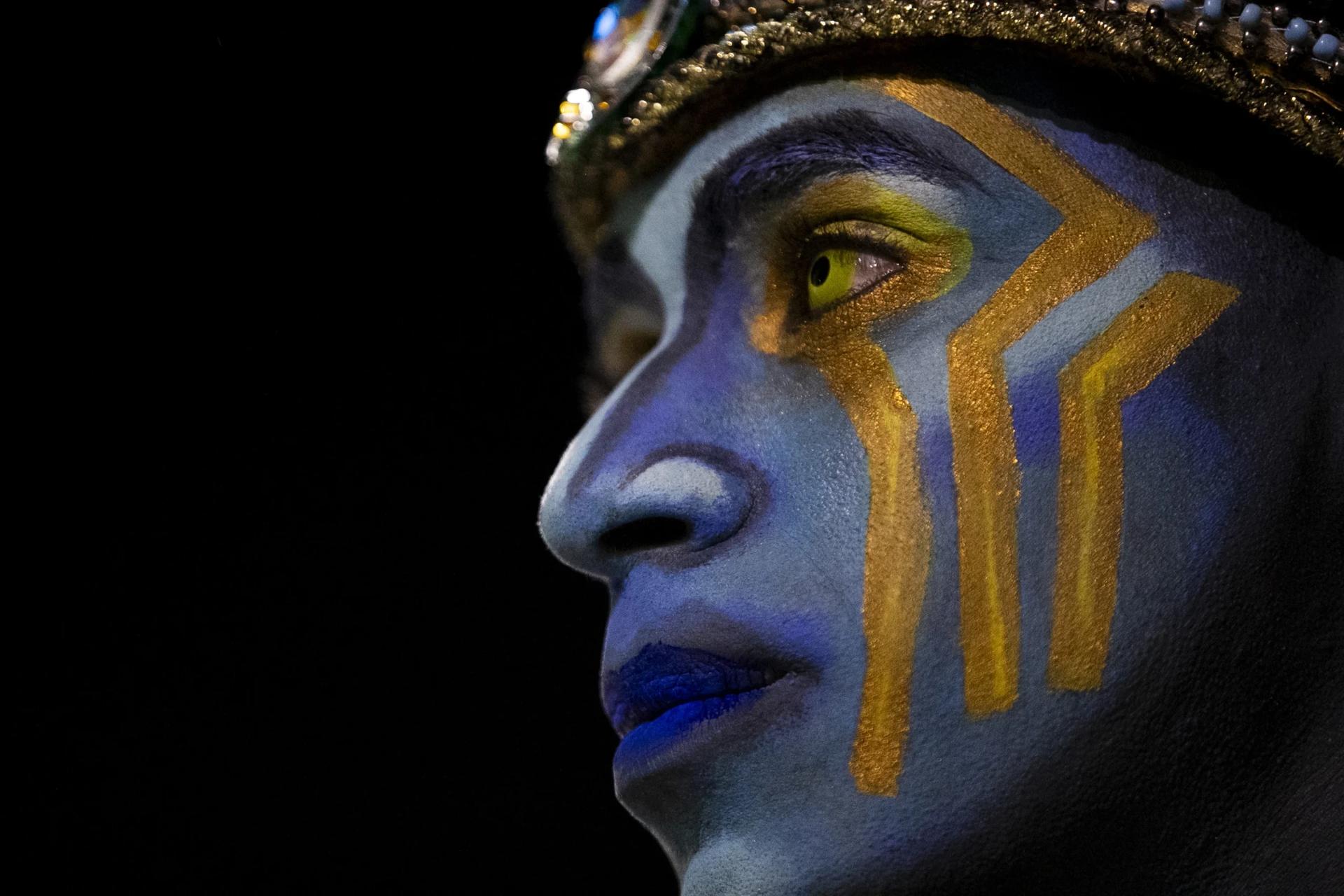
Massive Carnival parades in cities like Salvador can draw hundreds of thousands of participants. Because of the heat, many people wear minimal clothing, while others opt for a wide range of imaginative costumes. It is not uncommon to spot revelers dressed as religious figures.
In Rio de Janeiro, for example, there is a Carnival street group that parades every year in the Santa Teresa neighborhood — where a Carmelite convent is located — called the Carmelites’ Carnival group. Many of its participants attend dressed as nuns.
For Bishop Vicente Ferreira of the Diocese of Livramento de Nossa Senhora, in Bahia, Christians should be concerned about other kinds of abuse.
“Instead of bills like these, aimed at combating ‘Christophobia,’ we should be concerned about what truly wounds the Body of Christ — namely, the grave social injustice and environmental devastation caused by a system that places profit above life,” he said.