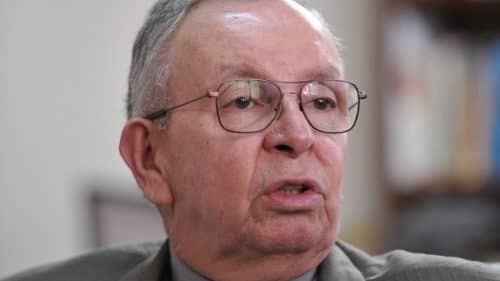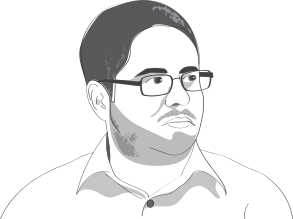
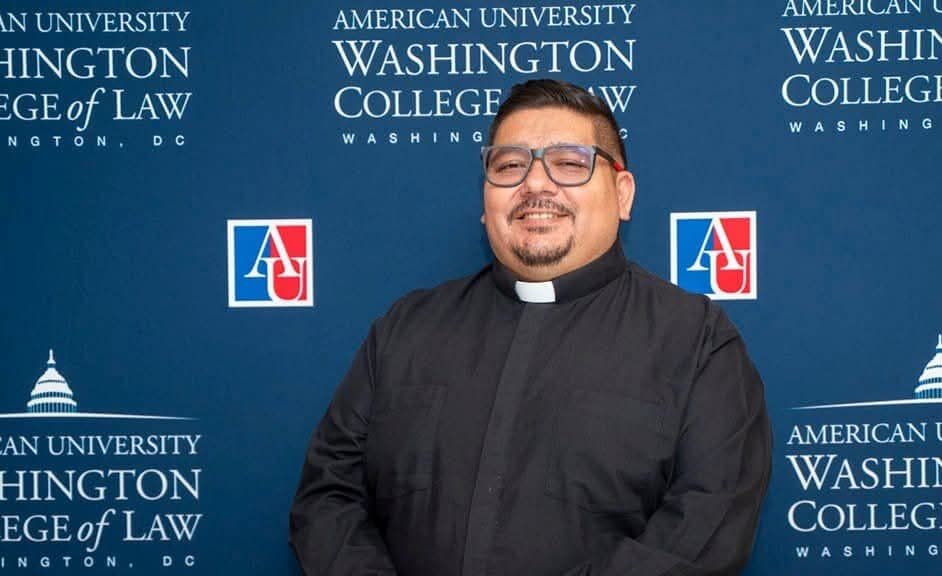
SÃO PAULO, Brazil – Mexican Father José Filiberto Velázquez, a human rights advocate in the Diocese of Chilpancingo-Chilapa, in Guerrero State, had to leave his community and ministry after receiving death threats in December. He’s now at an undisclosed location for an indeterminate period.
Bishop José de Jesús González of Chilpancingo-Chilapa told the press on Jan. 4 that the priest’s situation was “very concerning,” so the Church decided to “remove him from the immediate surroundings where he could be in danger.” On Jan. 15, Velázquez said to Crux that he had to leave his parish.
Velázquez heads the Minerva Bello Center for the Rights of Victims of Violence and accompanies people who have been impacted by criminal activities and conflict. On many times, he mediated peace dialogues between distinct criminal groups that operate in the region in order to prevent more deaths from occurring.
Due to such activities and the frequent threats to his life, Velázquez has been since 2024 under the Protection Mechanism for Human Rights Defenders and Journalists.
Despite that, threats continued to appear. In December 2025, he told Guerrero’s news media El Sur that there was an ongoing disinformation campaign against him, with people saying on social media that he had connections with armed groups in the State.
Those rumors, he said, not only impacted his honor, but also put his life in danger, given that each one of those criminal gangs has its enemies. The situation escalated and the priest was informed that a plan to attack him was being made. That’s when he and his bishop decided it was time for him to leave.
In October 2025, Velázquez had been appointed the temporary vicar of the Saint Christopher parish in the town of Mezcala, city of Eduardo Neri, replacing Father Bertoldo Pantaleón Estrada, who disappeared on Oct. 4 and later was found dead. Two men involved in Pantaleón Estrada’s killing were detained a few days after the crime.
Velázquez doesn’t know when he’ll be able to go back to his community.
“My priority now is to ensure the people’s integrity and allow the institutional and community process to keep going. When there are conditions for a safe return, that possibility will be evaluated with all necessary responsibility,” he told Crux.
He said that it would be “reckless” to talk about immediately coming back, given that the situations that provoked the threats cannot be solved overnight.
“We need time, real safety guarantees and minimal conditions for community life to go on without risks for anybody,” Velázquez said.
He has been working at a distance and trying to amplify his social and pastoral work in “creative ways” in the place where he now lives.
That’s not the first time Velázquez’s life is in danger. In 2023, men on a motorcycle shot at his car as he was driving back home. Miraculously, no bullet hit him. At the time, he told the press that his work with victims of violence in that area was focusing on the invasion of Nuevo Caracol town by La Familia Michoacana, a drug cartel.
In July 2024, his car was chased by an unknown vehicle on a road. A number of armed men were inside it and tried to make Velázquez stop. The federal security team that accompanied him decided to keep going. After a long persecution, the unknown car turned around.
Mexico has been a tough country for priests. A report released in 2025 by Aid to the Church in Need (ACN) informed that 10 priests were murdered during the 6 years of tenure of former President Andrés Manuel López Obrador (2018-2024). Other 10 priests suffered violence and 900 of them faced extortion.
The Multimedia Catholic Center, which monitors violence against the Church in Mexico, informed that 60 priests were killed there between 1990-2024.
According to Jesuit Father Jorge Atilano, who heads the National Dialogue for Peace, a broad initiative led by the Mexican Church to establish a roadmap for putting an end to violence, Mexico still “hasn’t managed to create the institutions of security and justice that are needed in order to contain violence.” In that scenario, the Church is specially targeted.
“Given that the Church has a territorial structure present in every corner, it’s vulnerable to groups that take advantage of institutional vacuums to advance control over the territories,” he told Crux.
Atilano said there’s an ongoing dispute over territories for the control of natural resources, whether private or public, and “this puts at risk those who are committed to community, harmony, or access to truth.”
“The institutions that are currently in greatest danger in Mexico are journalists, elected officials or local authorities, and religious people – actors who have a presence at the local level,” he said.
Velázquez said he doesn’t know if more people in his community are at risk or only himself.
“But it’s natural that, when somebody is in danger, those who are close to him or her also feel in danger,” he added.
“I’d like to come back right away, but that’s what falls to me now.”