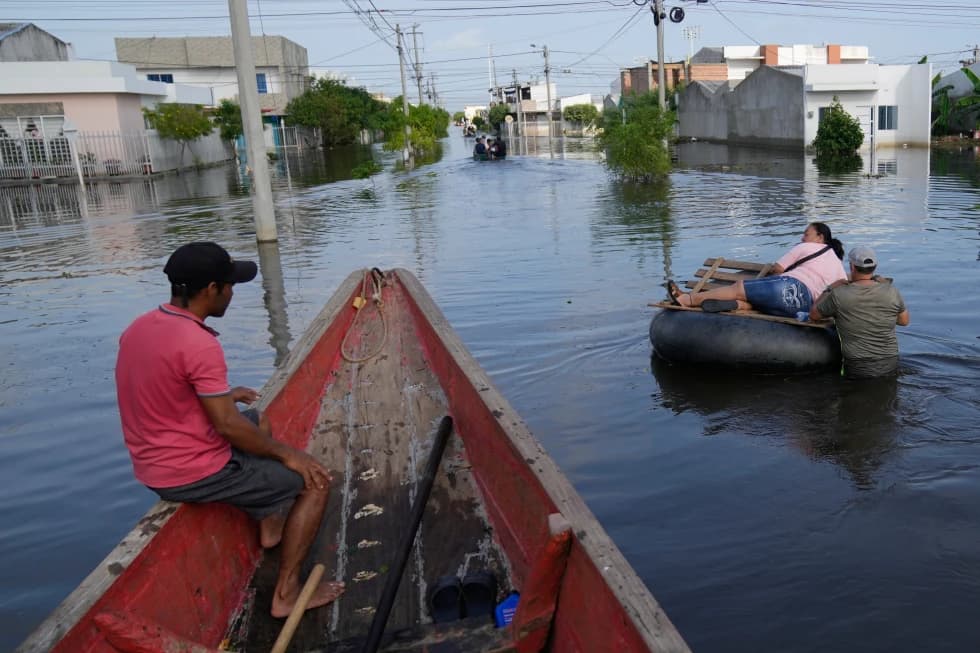
SÃO PAULO, Brazil – At least 69,000 families have been affected and 22 people have died in flooding triggered by extraordinarily heavy rains in northern Colombia. The Church has been working since the beginning of the crisis to deliver food and clothing to people who have lost everything, as well as to provide spiritual and emotional support.
About 9,000 homes were destroyed by the flooding of the Sinú, San Jorge and Canaletes rivers over the past week, when storms began to hit the department of Córdoba, as well as Antioquia, Santander and Chocó.
Colombian authorities said the amount of rain expected for an entire month fell in a single day.
“I’ve been a priest here for 22 years and I have never seen anything like this,” Father Elkin Arenas Torres, head of the Social Pastoral Ministry of the Diocese of Montelíbano, told Crux.
Arenas said that when local residents were advised to prepare for floods, they raised their furniture and household appliances by about 3 feet.
“Nobody expected the water level to be two or three times higher than that,” Arenas said, but levels have risen and entire houses have been swept away by the waters, along with livestock in rural areas.
In urban areas, numerous families lost all their belongings.
“We have been visiting people throughout the diocese. We find families completely isolated by water, with nothing to eat,” he said.
Arenas said that it is impossible at this point to assess the damage caused by the rains.
“It’s incalculable,” he said, but damages are already estimated at 8.8 trillion pesos ($2.2 billion) and there is talk of a corporate “wealth tax” to cover the cost of reconstruction.
Many hectares of farmland have been completely underwater in recent days. Arenas fears the destruction of crops will affect not only peasant families but also food supplies for cities.
“So far, we have been able to distribute food kits to people,” Arenas said.
“NGOs and government agencies have been very active,” Arenas also said, “and Colombians from other regions have been donating food and medicine.”
“That will come to an end at some point,” Arenas said, noting how some city governments have already announced they are running out of supplies.
Arenas told Crux the neighboring Diocese of Montería has been even more affected, as it is more densely populated than his largely rural region.
Father Dick Benjumea, director of the Social Pastoral Ministry of the Diocese of Montería, spoke with Crux to say Church agents have been throughout the area trying to reach isolated people and assist those in need.
“The first thing we have been doing is providing spiritual and emotional support to the victims. People are traumatized and very fragile,” Benjumea said.
Ten temporary shelters have been set up in the area by local governments with the help of the Church. A few Catholic schools, for instance, are housing displaced families.
“Many people have been able to stay with relatives. But 6,000 people are currently being housed in those shelters,” he said.
Benjumea said the Colombian Church has been promoting donation campaigns across the country. Aid has been arriving from numerous dioceses and major cities such as Bogotá, Cartagena and Barranquilla.
“Colombians tend to be very charitable. People have truly been giving what they can to help,” he said.
Arenas said the Church has set up collection and distribution points for donations in numerous parishes.
An appeal from Bishop Farly Gil Betancur of the Diocese of Montelíbano, who is also the apostolic administrator of Montería, was among the catalysts of the charitable response.
Last week, Gil Betancur released a statement reaffirming the Church’s closeness to families affected by the floods. He invited Catholics in Córdoba to contribute to the campaign for flood victims on Feb. 8.
“Each donation is a gesture of love that brings hope and relief to those in need,” the statement said.
Pope Leo XIV added his voice to appeals on Wednesday during his weekly General audience.
“I urge the entire community to support the affected families with charity and prayer,” the pontiff said.
February 2026 has been unusually rainy, and authorities fear the crisis may continue until March, when the rainy season typically begins in the Caribbean and the Andes.
President Gustavo Petro said the Urrá dam located between Córdoba and Antioquia was swollen by the rains and was not opened adequately, worsening the floods.
The acting president of the Urrá hydroelectric plant, Juan Acevedo, resigned following the criticism.