ROME – One Peruvian bishop who was recently in Rome for official meetings with Pope Leo and Vatican departments is determined to carry forward the pope’s push for social action, specifically through prison reform.
Speaking to Crux, Bishop Jorge Izaguirre of Chosica, Peru, said prisons in Peru and much of Latin America “are human warehouses,” overcrowded, rampant with corruption, and lacking in proper medical care.
“For us as Church, our mission is to accompany them and awaken hope,” he said.
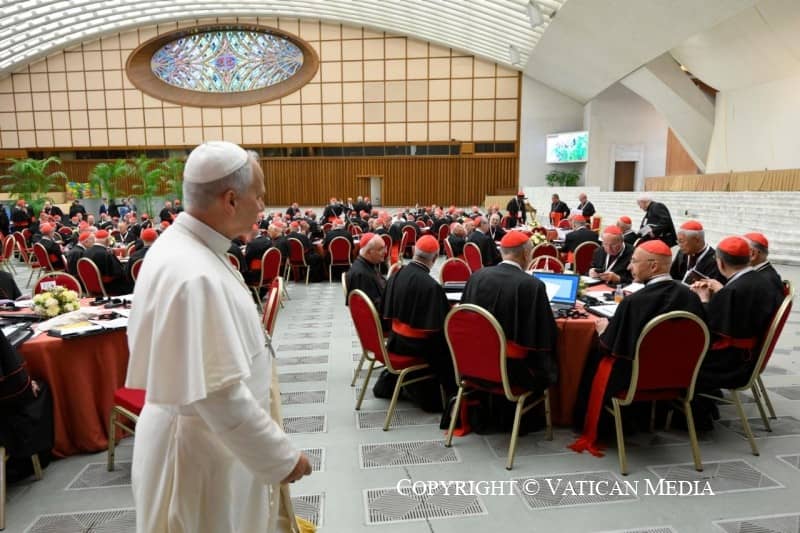
Izaguirre, a member of the Congregation of the Holy Cross who has served as bishop of Chosica since his installation a year ago, in February 2024, was among the 50-some bishops who came to Rome for the Peruvian bishops’ recent ad limina visit.
Occurring every five years or so, the ad limina visits are opportunities for members of a national episcopal conference to have face time with the pope, and to meet with various Vatican departments.
The Jan. 26-31 ad limina for the Peruvian Episcopal Conference (CEP) culminated with an event in the Vatican Gardens sponsored by the Peruvian Embassy to the Holy See, during which Pope Leo blessed a new mosaic and a statue of Saint Rose of Lima.
Leo had previously met with the bishops and surprised them during a lunch, stressing in his discussions with them the importance of carrying forward Pope Francis’s vision of synodality, and of standing beside the poor in a time of political instability and social division.
RELATED: Peru bishop expects papal visit, touts Leo’s vision of synodality
For Izaguirre, a big part of the social commitment with the poor is his longstanding work in prisons, having begun prison ministry shortly after his ordination as a priest.
He now serves as head of Peru’s National Prison Ministry, and he is also involved in prison ministry at the continental level through the Episcopal Conference of Latin America and the Caribbean’s (CELAM) Center for Programs and Networks for Pastoral Action, which includes prison ministry.
In December, Pope Leo authorized a longstanding request from CELAM officials to formally place its International Commission of Catholic Prison Pastoral Care within the competence of the Vatican’s Dicastery for Integral Human Development, appointing Archbishop Jorge Ignacio García Cuerva of Buenos Aires as the commission’s president.
Now, Izaguirre says, prison ministry – which had been a consistent priority for Pope Francis – has become not just a regional, but global priority for the Catholic Church.
Izaguirre said he felt the call to get socially involved as a young boy, before entering the priesthood, after meeting missionaries stationed at the parish where he served as Mass. He was especially inspired by a Jesuit priest and missionary, Luis Bambarén Gastelumendi, who served in Peru in the tumultuous decades of the 1980s and 1990s.
From a young age, he said, he was taught “to look at what is happening around me” and to discover “that faith is expressed in a commitment to reality, to life, to the needs of the people.”
He was eventually inspired to join the Congregation of the Holy Cross after working alongside missionaries who served in the poorest area of his come city of Chimbote, being edified by their “commitment to the people” and pastoral closeness amid difficulty.
Izaguirre described it not as a coincidence, but a “God-incidence” that of Peru’s 69 prisons and two minor detention facilities, the two largest prisons – Lurigancho, with 10,000 inmates, and Castro Castro with 8,000 inmates – are located in the San Juan de Lurigancho of Lima, where he had his first pastoral assignment after being ordained, meaning prison ministry was an important part of his pastoral activity from the beginning.
Given his commitment to prison ministry, shortly after being named bishop of Chuquibamba in 2015, he was invited to oversee prison ministry for the CEP’s Commission for Social Action CEAS. He was elected to two consecutive terms as president of CEAS, concluding his second mandate in 2025.
He was named a bishop shortly after then-Bishop Robert Prevost was appointed as apostolic administrator and subsequently bishop of Chiclayo, meaning they were new bishops at the same time, and always sat next to one another during CEP meetings, as seating was arranged by seniority.
The two also attended the course for new bishops together in Rome in 2016, being the only bishops from Peru to participate that year. Izaguirre’s time on CEAS overseeing prison ministry and as president also coincided with Prevost’s term on the commission, having volunteered to oversee outreach to migrants.
Izaguirre said that after stepping onto CEAS as head of prison ministry, he visited a prison at least once a week and advocated for prisoners’ rights during the COVID-19 pandemic.
During the pandemic, “the State abandoned them,” taking away essentials such as food, family visits, and conjugal visits for couples, leaving inmates completely isolated and malnourished, and without the proper medications for their needs.
“The medicines are very basic. You go for a clinic for a stomach problem, and they give you a basic pill for a headache,” he said.
In general, there is very little government support for the prison system, he said, saying this is a broader reflection of society’s attitude toward prisoners.
“Society as a whole condemns and stigmatizes the prisoner. It has a poor perception of them. People say, ‘these people will never change, they are only harmful, let them stay locked up. And if they can die sooner, all the better,’” he said.
As a pastors, “We try to change this societal perception through social advocacy, because we see conversion,” he said.
Izaguirre lamented that both the Lurigancho and Castro Castro, in particular, “have serious problems,” especially overcrowding, having a capacity for just 40 percent of the inmates they currently hold.
For this reason, “prison conditions are appalling, inhumane. There are no basic necessities in terms of sanitation, hygiene, healthcare, and general attention,” and justice is often slow, he said.
To this end, Izaguirre condemned the amount of corruption that plagues the justice system in Peru, noting that oftentimes, justice is “bought and sold.”
“Those with money get off easy, while those without are convicted. Corruption is almost institutionalized, widespread. People pay to open doors, to walk through corridors to receive family members,” or to get access to better medicines, even if the payoffs are nominal.
Another problem is the lack of distinction between men and women, meaning men and women are held together, and there is no section set aside for women with children or who are pregnant.
Violence among youth is another major problem, as many mafias or organized crime rings use minors 14 years old and even younger to commit both petty and violent crimes. These youths are then processed and jailed as adults, which Izaguirre said is “absurd” and exacerbates the cycle of violence.
Prison ought to be a place of rehabilitation and reparation, he said, saying he sees it as the church’s role to push for this.
“Confining someone in a prison does not mean excluding them, nor does it mean violating their rights. There are rights that must be respected and that are fundamental: the right to life, to health, to education, to work,” he said.
He spoke of faith in prisons, saying even behind bars inmates can find hope and many have converted through the spiritual support pastors offer, whether it is Mass, catechesis courses, processions for major feast days, confession, or simple prayer events.
“Faith in prisons can transform and liberate,” he said.
Speaking of the importance of rehabilitation, Izaguirre said it is a “total change” in mentality and approach from what is in place currently, because “the system is not designed to achieve adequate internal rehabilitation.”
“Pope Francis used to say that the prison is a reflection of society, a mirror of what is happening outside, on the street,” he said, noting that many behind bars come from difficult backgrounds, having experienced poverty and abuse.
For this reason, he said, “we must work for the prisoner through prevention, out on the street, so that familial and social conditions do not make it easy for someone to end up in prison, but rather to work from that starting point.”
In terms of prison ministry’s place in the broader commitment to social development, Izaguirre said he believes his lifelong work in prisons “helps me keep my feet on the ground, it grounds me in reality.”
It is a reminder, he said, “not how we want life to be, but how the world and reality really are: difficult and challenging,” but also filled with hope.
“We like to touch the Lord of the Miracles, we like to touch the image of Mary and so we draw near. This ministry is for that, it is for touching” the people and their wounds, and helping them draw near to God, he said.
In Peru, “one cannot carry out an evangelizing mission without touching the people’s experience of the cross, the pain of the people, and also their resurrection. Because these are the two aspects of life that are lived as daily, everyday experiences,” he said, voicing hope that Pope Leo will visit a prison during his visit to Peru, expected later this year.
Follow Elise Ann Allen on X: @eliseannallen