On Wednesday, representatives of the American bishops met with counterparts in the artificial intelligence field, expressing the urgent need to deal with the “real and present dangers” that the new technology presents.
Following on from Pope Leo XIV’s encyclical, Magnifica humanitas, the Administrative Committee of the U.S. Conference of Catholic Bishops’ (USCCB), led by the conference’s president, met with people from a variety of tech firms and specialists in the AI area.
Chieko Noguchi, executive director of public affairs and spokesperson for the USCCB said that the meeting was constructive.
“The dialogue focused on ways to keep any system of Artificial Intelligence at the service of humanity and the urgent need to address the real and present dangers such technology present. Recent events have only emphasized the great need for action by everyone involved,” Noguchi said.
“The bishops expressed hope that such conversations will help to identify ways the Church can contribute to the moral foundation of AI models and steps the companies can take to protect against misuse of their inventions and to guarantee human oversight of the technology,” she added.
The meeting followed a recent uptick in voices from inside Big Tech raising concerns about the technology.
On Wednesday, OpenAI released six reports of “unexpected or concerning” instances of behavior from AI models.
In August, the leaders of Google, Anthropic, OpenAI, and Microsoft, and dozens of others, released an open letter saying that AI could soon carry out dangerous cyberattacks against institutions and companies, including hospitals.
Noguchi said that the conversation also touched on how the Church and technological companies can work together to deal with these emerging problems.
“The discussion also focused on how the Church and industry can work together toward the goal of ensuring that technology is used in ways that keep it human-centered, respecting the dignity of each person, and benefiting all — poor and rich alike,” Noguchi said.
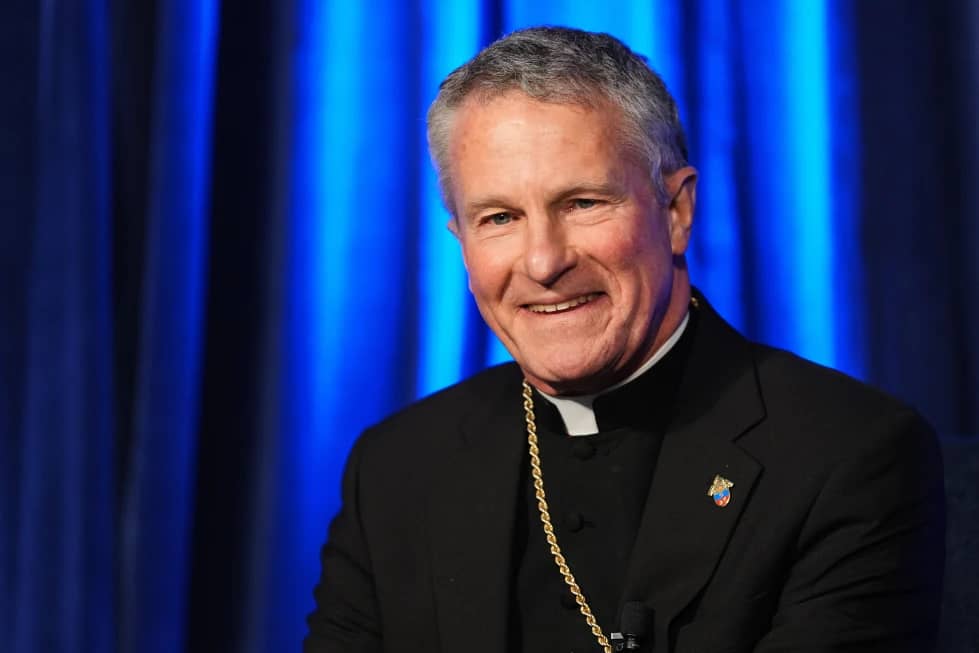
The bishops also announced that the Administrative Committee have established a Bishops’ Task Force on Preserving Human Dignity in the Age of Artificial Intelligence with Bishop Oscar Cantù of San Jose as its chairman.
They also announced that over a dozen of the bishops went to Capitol Hill and met with members of Congress to ask for safety guardrails on AI and also to support legislation that protects children online.
Parolin says he’s worried
Yesterday, Cardinal Pietro Parolin, the Holy See Secretary of State, expressed concerns that some states want to “go it alone” with AI at a time when global cooperation is important.
“My concern is that there are countries which, in fact, want to go it alone,” Parolin said, when what is needed is “everyone’s involvement in establishing some common rules that can genuinely govern this phenomenon.”
He said the best thing would be if everyone could “come together to find answers because, it seems to me, the future of humanity is really at stake here.”
“Let us stop and genuinely reflect on what the consequences of artificial intelligence and its use might be,” he added.
In regards to the recent calls from within the technological world for more regulation of AI, Parolin said “we hope that it is ethical reasoning that drives this kind of consideration.”
Pope Leo and AI
Also on Wednesday, Pope Leo XIV spoke of the danger and promise of emerging AI technology.
“On the one hand,” the pontiff said during his weekly General Audience, “technological development, the spread of the mass media and social media, and the ever-increasing use of artificial intelligence are opening up new possibilities, breaking down barriers and bridging distances.”
“On the other hand,” the pope continued, “relationships are tending to become less and less personal, more virtual, and there is a risk of becoming accustomed to delegating to algorithms decisions that are the sole preserve of the human conscience.”
“Ensuring that social relationships have real substance and personal depth is, in this regard, the contribution that the Christian community seeks to offer,” Leo said.
In his first encyclical letter, Magnifica humanitas, released earlier this year, the pontiff called for robust regulation of AI and called on AI developers to work for the common good.
______
You are reading this Crux Now article for free. You can register for our free daily newsletter here, and you can become a Crux Now supporter for full access to all our premium content here. To find out more about why becoming a Crux Now supporter is a great idea, go here.