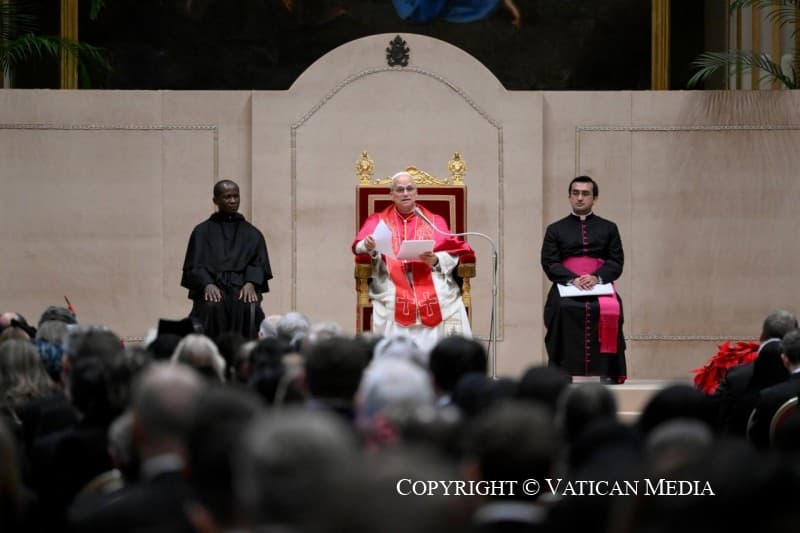
If there is one line to take from Leo XIV’s first “state of the world” address to  diplomats accredited to the Holy See, it is this: “Seeking only immanent goods undermines that ‘tranquility of order’, which, for Augustine, constitutes the very essence of peace, which concerns society and nations as much as the human soul itself, and is essential for any civil coexistence.”

It would take more than one hefty book to unpack the Augustinian notion of tranquillitas ordinis – the “tranquility of order” – that Leo invoked there, and I will not be attempting any more unpacking here, except to say the term refers at once to the right disposition of states in their relations with each other, to arrangements conducive to flourishing within political and social communities, and to order in the souls of citizens.

Suffice it to say that the line is a near-perfect encapsulation of the new pope’s thoroughly Augustinian vision not only of geopolitical affairs but of the human condition, hence his approach to politics (broadly understood) and to the very human souls of those who shape and are shaped by human events.


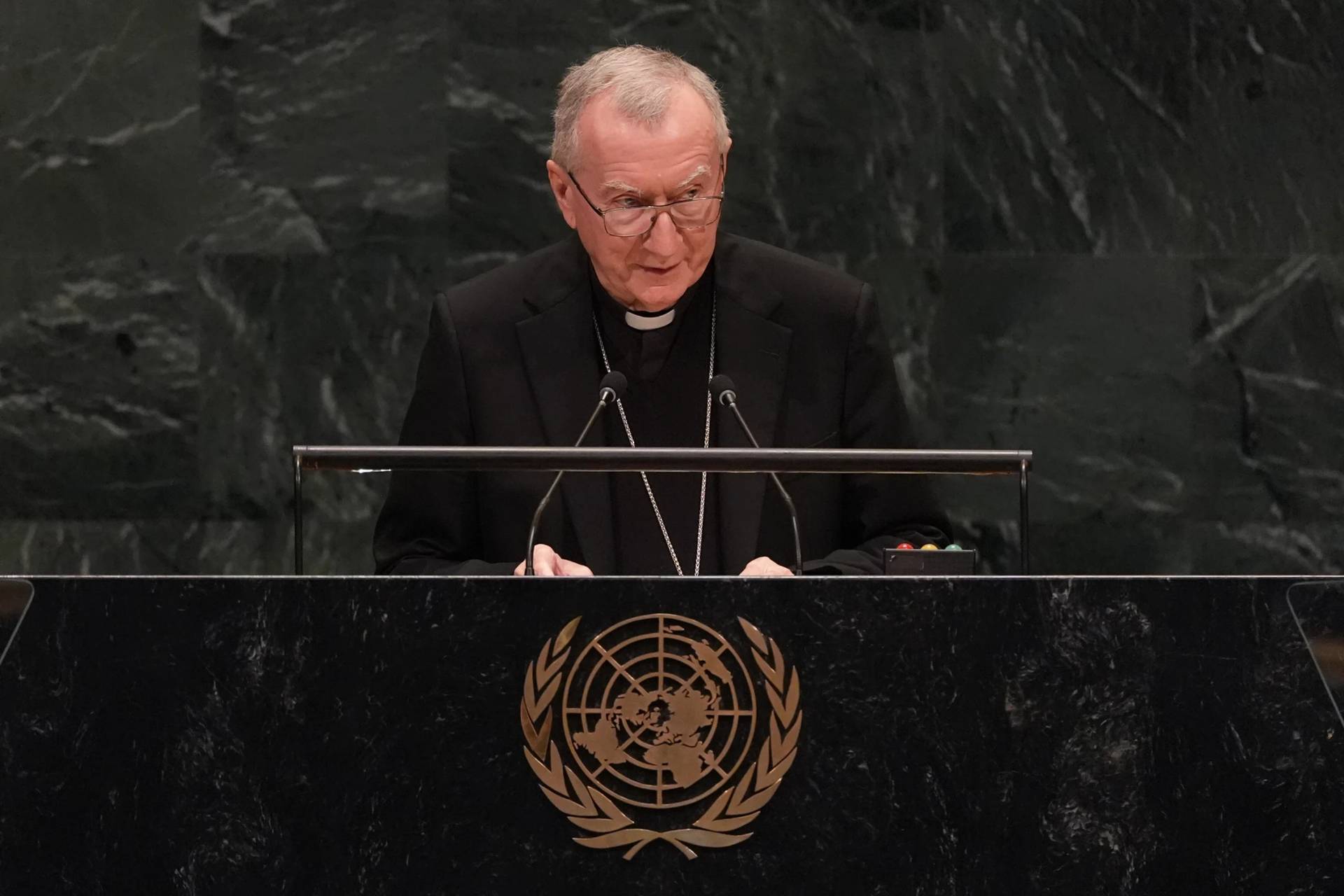
Leo’s address was nothing if not timely, to be sure, with direct confrontation of several hot-button issues and apt allusions to other brewing and simmering and boiling crises, and he delivered it almost entirely in English – a first for a pope and a frank acknowledgment of international diplomatic reality.

For the speech’s timeliness, consider only that Leo decried the “deplorable” allocation of public funds “to suppress life, rather than being invested to support mothers and families,” in the very week U.S. President Donald Trump called for “more flexib[ility]” from Republican lawmakers over a long-standing legislative block on federal funding for abortion in view of political compromise with Democrats over healthcare reform in Leo’s native country.

Reporters and analysts have noted and amply discussed the timeliness and trenchancy of Leo’s address on that point and several others. The penetrating human and geopolitical sagacity of the address, rooted in Leo’s thoroughly Augustinian cast of mind, is well worth careful attention as well.

“I am an Augustinian,” Pope Leo XIV said in his first greetings from the loggia above St. Peter’s Basilica on May 8 of last year, “a son of Saint Augustine.”

With those words, Leo XIV was not only acknowledging his formation in the spirituality of the Order of Saint Augustine – a mendicant society of clerics founded in the thirteenth century on the basis of a Rule first prepared by the great bishop of Hippo Regius in what was then Roman North Africa. He was also expressing something of how the depth and breadth of St. Augustine’s thinking about human nature and God’s provident action in history have molded and tempered his own.

St. Augustine became a bishop as the fourth century was turning into the fifth, during “a time of immense upheaval, profound sociopolitical disruption, cultural and ecclesiastical confusion, and creeping institutional rot,” as I put it in my recent book, Leo XIV: The New Pope and Catholic Reform.

The book, I should say, is not a biography (for that, readers want León XIV: Ciudadano del mundo, misionero del siglo XXI by Crux’s very own Elise Ann Allen, with the English edition available now for pre-order) – but a study of the papal office and the challenges facing the man who came into it less than a year ago, one that highlights the signs of Leo’s Augustinian cast of mind and traces the implications of having a fellow with such a cast of mind in the See of Peter.

The life and times of St. Augustine, Bishop and Doctor of the Church, are important not only because they may inform our understanding of Leo’s forma mentis, but also because Augustine’s times are eerily similar to our own. It is sobering to consider how they also proved to be the waning years of Roman power in the West.

“Although the context in which we live today is different from that of the fifth century,” Leo said, “some similarities remain highly relevant.”

“We are now, as then, in an era of widespread migratory movements; as then, we are living at a time of a profound readjustment of geopolitical balances and cultural paradigms,” Leo said, “as then, we are, in Pope Francis’s well-known expression, not in an era of change but in a change of era.”

The very election of the man we now know as Leo was epoch-making.

It isn’t quite right to say nobody had taken the odds on the man who became Leo XIV, but it is the case that a great many Church watchers – this one included – and Leo himself thought his election practically impossible.

Conventional wisdom had it that the election of un americano would risk concentrating and confusing the moral stature of the papal office with U.S. geopolitical power.

“Such a juxtaposition—in essence a combination—would harm both,” I explained in my book, “but especially the papacy.”

A remark widely attributed to the late Cardinal Francis George of Chicago had it that we would not see the election of a pope from the United States until the U.S. enters permanent decline.

“Would-be readers of the signs of the times,” I wrote in these pages in May (and expanded the consideration in the book), “will now be wondering whether we have witnessed the jettison of that homespun wisdom or the fulfilment of a prophecy, or perhaps both.”

St. Augustine became Bishop of Hippo at the very end of the fourth century, when the sack of Rome in 410 by the army of the erstwhile commander of barbarian mercenary forces in service to Rome, Alaric of the Visigoths, was roughly fifteen years away.

“Prompted by the tragic events of the sack of Rome in 410,” Leo told diplomats on Friday of last week, “Saint Augustine wrote the De Civitate Dei,” which we know in English as The City of God, “one of the most powerful of his theological, philosophical and literary works,” and also one of the foundational texts – arguably the foundational text – of the entire Western civilizational project.

“Certainly,” Leo noted in his Friday address, “our times are very distant from those events.”

“This is not simply a question of temporal distance,” Leo said, “but also of a different cultural awareness and a development of categories of thought.”

“However,” he continued, “we cannot overlook the fact that our own cultural sensibilities have drawn nourishment from that work, which, like all the classics, speaks to people of every generation.”

St. Augustine of Hippo was profoundly concerned with questions of social order and was at great pains to understand and articulate the role of the Church in relation to what we call today secular or political power. He was also concerned with the place and the role of Christians in society generally.

Saint Augustine, in short, had an abiding concern for peace in human affairs: For what it really is, for its conditions of possibility, for its limits and for its constraints.

“The City of God does not propose a political program,” Leo explained in his remarks, “Instead, it offers valuable reflections on fundamental issues concerning social and political life, such as the search for a more just and peaceful coexistence among peoples.”

“Augustine,” Leo continued, “also warns of the grave dangers to political life arising from false representations of history, excessive nationalism and the distortion of the ideal of the political leader.”

I noted in Leo XIV that Roman imperial order in the West would collapse well within a century of Augustine’s election as bishop (and here remind readers that Augustine himself died while the Vandal army was besieging his episcopal see of Hippo Regius), but when Augustine was elected, “imperial citizens were going about imperial life convinced of Rome’s inevitability.”

“It is more than a little dangerous to practice any reading of the tea leaves,” I quickly qualified, “but the Augustinian mind steeped in history cannot really fail to have the thought occur to it.”

If Pope Leo XIV’s address to the corps of diplomats accredited to the Holy See made one thing clear, it is that the new pope has a thoroughly Augustinian mind steeped in history.

Follow Chris Altieri on X: @craltieri