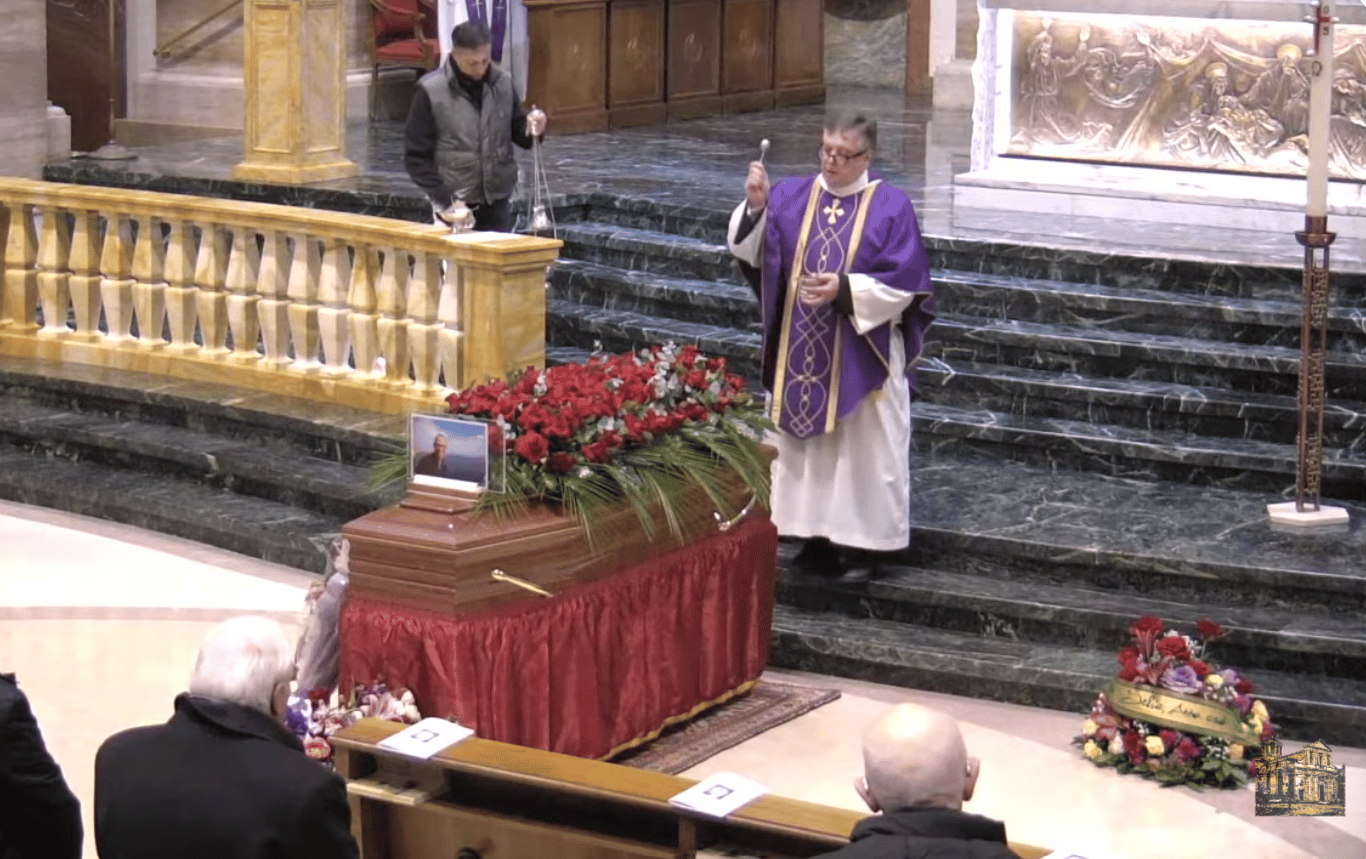
ROME – A funeral Mass was celebrated for John L. Allen Jr. on Monday in Sant’Eugenio basilica in Rome.
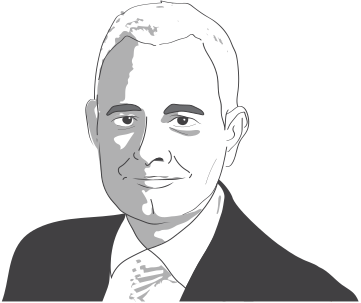
The legendary Vatican beat reporter and Church affairs analyst died Thursday, January 22, two days after his 61st birthday, following a lengthy – and by every account heroic – battle with cancer.
The principal celebrant was Father John Wauck, an American priest of Opus Dei and longtime friend of Allen, to whom Wauck had given the Anointing of the Sick only an hour or so before.
Eight priests concelebrated, among them Jesuit Father Federico Lombardi, the long-serving head of the Vatican press office, Vatican television service, and Vatican Radio.
A host of Vatican press corps journalists were among those in attendance, not only to pay final respects to a worthy colleague but to say goodbye – for now – to a friend, giving thanks to God for the gift of Allen’s life and confidently praying God meet him with mercy in eternity.
“I take great comfort,” said Wauck in his homily, “in the knowledge that John surrounded himself with so many people – starting with his wife Elise – with people who are more than capable of penning moving tributes to him, capturing his unique personality and achievements, so many talented friends and colleagues – many of you here – some of whom have already done so quite beautifully.”
Many of those tributes have been written, and some of them may be found on the website of Crux, but Wauck included one of his own, of a dinner party a few years ago, at which John named – to Wauck’s surprise – “The Long and Winding Road” by The Beatles as a favorite.
The iconic first words of the song are well known: “The long and winding road that leads to your door,” that in John Allen’s case surely somehow meant the road that led him to Elise, and “perhaps also the road that took him from Hays, Kansas,” town of two Oktoberfests, as Wauck noted, and home “to other one-of-a-kind Americans like Calamity Jane and Buffalo Bill,” and then to California, where Allen was a high school teacher, and to Rome where all roads are supposed to lead.
“And from here,” Wauck said, “all over the world – from Mongolia to Argentina and everywhere in between – on papal trips and research travels for books – and the petition, almost a prayer – that rises up in the heart” of the song: “Let me know the way.”
“I am the way and the truth and the life,” said Jesus to Thomas, his disciple, in the Gospel reading from John 14 (1-6).
“Now, here, today, and in the context of the words we have read from Scripture, the lyrics of that song take on a different meaning,” Wauck said, “suggesting a different road and a different kind of door.”
“The Lord is my shepherd,” congregants heard in the Responsorial Psalm, “there is nothing I shall want.”
“We are indeed the sheep of his flock,” said Wauck. “It is a comforting thought,” he said, “but we are much more than that to God.”
“The road of human life does not lead simply to a sheepfold for God’s creatures,” he said. “We have been called to something much higher. We are called to be God’s friends.”
Wauck noted the words of Jesus at the Last Supper: “I have called you friends.”
“They are the words of Jesus, of God Himself, and the words that follow show that Jesus even sees His redemptive sacrifice on the cross in these terms: ‘Greater love no man has than that he lay down his life for His friends’.”
“That’s what He sees Himself as doing,” Wauck said, “dying for friends.”
“I have called you friends,” Wauck said. “They are the words of Jesus,” he continued, “but I think, in our hearts, today we can all imagine John saying the same words now to all of us here: I have called you friends.”
It is not difficult to imagine Allen saying it as well to his readers, for whom he nurtured both high regard and deep affection.
Following the Mass, there was a gathering, at which many other stories were told and – in true John Allen spirit – delicious food was plentiful and libation flowed, all provided by friends, a testament to his bottomless capacity for friendship.
The reception was at the Allen residence in Rome, not far from the church where the funeral was celebrated, a minor basilica dedicated to Pope St. Eugene I, who reigned briefly during a tumultuous time in the middle of the seventh century.
It happens that the basilica of St. Eugene was also where the funeral of another Vatican press giant was celebrated: That of the great Joaquin Navarro-Valls, who directed the Vatican press office for more than two decades, from 1984-2006.
It is the sort of detail John liked to include in his stories.