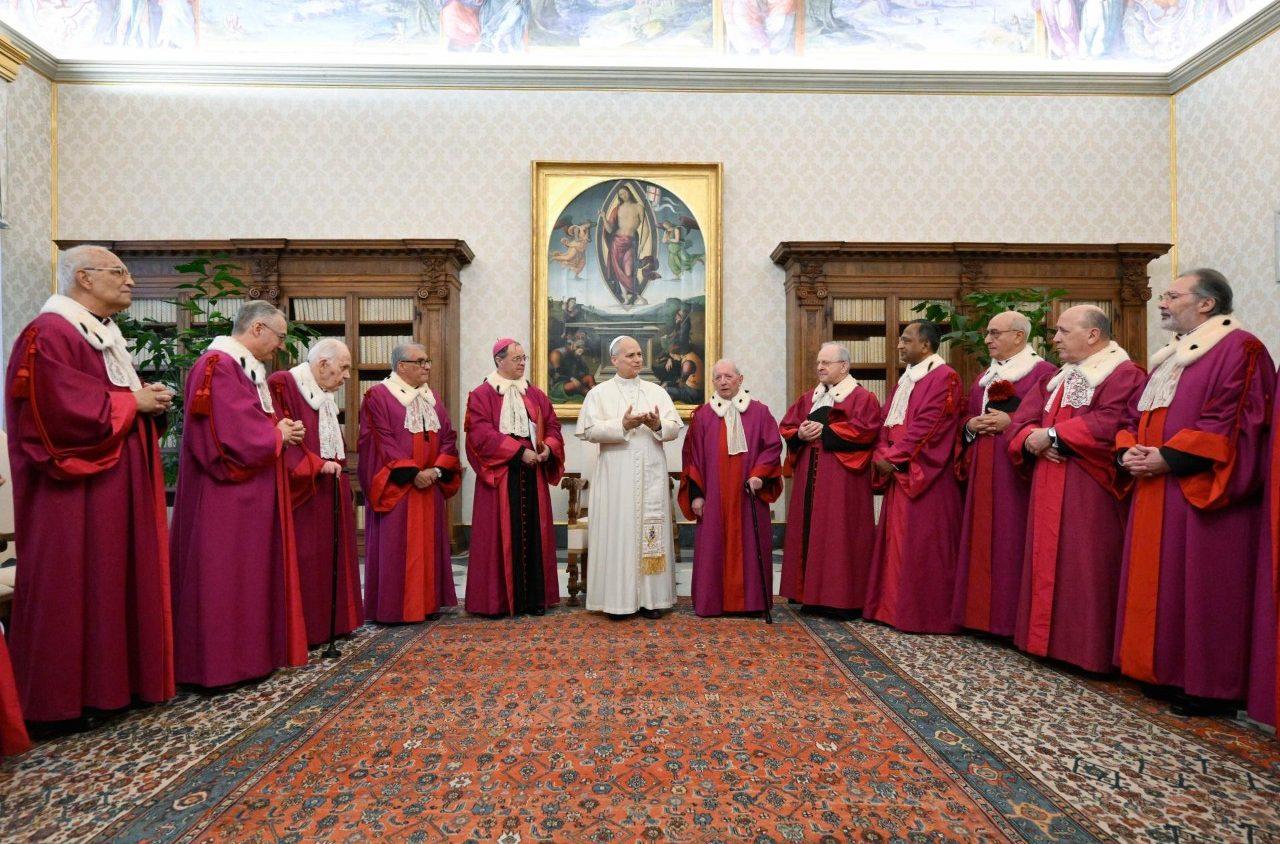
Speaking to members of the Apostolic Tribunal of the Roman Rota, Pope Leo XIV on Monday warned against “a dangerous relativization of truth” when it comes to the Church’s teachings on the indissolubility of the sacrament of marriage.
One of the main functions of the Roman Rota is dealing with the appeals of marital nullity cases in the Catholic Church. Unlike a divorce, which ends a marriage, a declaration of nullity – often called “annulments” – may be granted after a legal process determines a valid marriage did not actually take place.
If one of the parties to a presumed marriage had actually been previously married and had not obtained an annulment, for example, the Church will declare the second marriage null.
There are many other reasons for which a marriage may be null, all listed in the Church’s Code of Canon Law, and annulment cases can be more or less difficult to prove.
Leo on Monday told the members of the Rota – who are all priests – that he wanted to speak about the close connection between the “truth of justice” and the “virtue of charity.”
“These are not two opposing principles, nor are they values to be balanced according to purely pragmatic criteria, but two intrinsically united dimensions that find their deepest harmony in the very mystery of God, who is Love and Truth,” Pope Leo said.
He said this correlation requires constant and careful critical exegesis, “since, in the exercise of judicial activity, a dialectical tension often arises between the demands of objective truth and the concerns of charity.”
“Sometimes there is a risk that excessive identification with the oft troubled vicissitudes of the faithful may lead to a dangerous relativization of truth,” said the pontiff.
“In fact, misunderstood compassion, even if apparently motivated by pastoral zeal, risks obscuring the necessary dimension of ascertaining the truth proper to the judicial office. This can happen not only in cases of matrimonial nullity – where it could lead to pastoral decisions lacking a solid objective foundation – but also in any type of proceeding, undermining its rigour and fairness,” he added.
Early in his reign, Pope Francis eased the process of annulments in the local Church: Giving more power to bishops, making the process faster, and trying to make sure the faithful did not have to pay to receive a hearing.
Leo, however, told the judges of the Rota that his predecessor’s purpose in streamlining the nullity process was not to weaken the reality of the indissolubility of sacramental marriage.
He said the shorter process of marriage annulment before the diocesan bishop, “the prima facie nature of the ground for annulment that makes it possible must be judged very carefully, without forgetting that it must be the process itself, duly implemented, that confirms the existence of the annulment or determines the need to resort to the ordinary process.”
“It is therefore essential to continue to study and apply canon law on marriage with scientific rigor and fidelity to the Magisterium,” Pope Leo said.
He told the Roman Rota that aspects of canonical proceedings can be framed within the context of truth in charity.
“First of all, the actions of the various protagonists in the process must be entirely marked by a genuine desire to contribute to shedding light on the just sentence to be reached, with rigorous intellectual honesty, technical competence and an upright conscience,” he said.
Leo reminded the judges their main role is the search for truth, “which is not reduced to professional fulfilment, but is to be understood as a direct expression of moral responsibility.”
“This is motivated primarily by charity, but it goes beyond the demands of justice alone, serving as far as possible the integral good of persons, without distorting one’s function but exercising it with a full sense of ecclesiality,” he said.
“Canonical processes must inspire the trust that comes from professional seriousness, intense and thoughtful work, and a convinced dedication to what can and must be perceived as a true professional vocation. The faithful and the entire ecclesial community have a right to the proper and timely exercise of procedural functions, because it is a journey that affects consciences and lives,” the pope said.
Monday’s speech was the second time Pope Leo has spoken to the Roman Rota since his election.
On Nov. 21, 2025, the newly elected pontiff spoke to them after they held a day of studies.
Two months ago, Leo reminded the Holy See’s judges that human judgment on the nullity of marriage “cannot however be manipulated by false mercy.”
He told the Rota the Church should remember efforts to promote reconciliation between spouses are very important, “including, where possible, through the validation of the marriage.”
Follow Charles Collins on X: @CharlesinRome