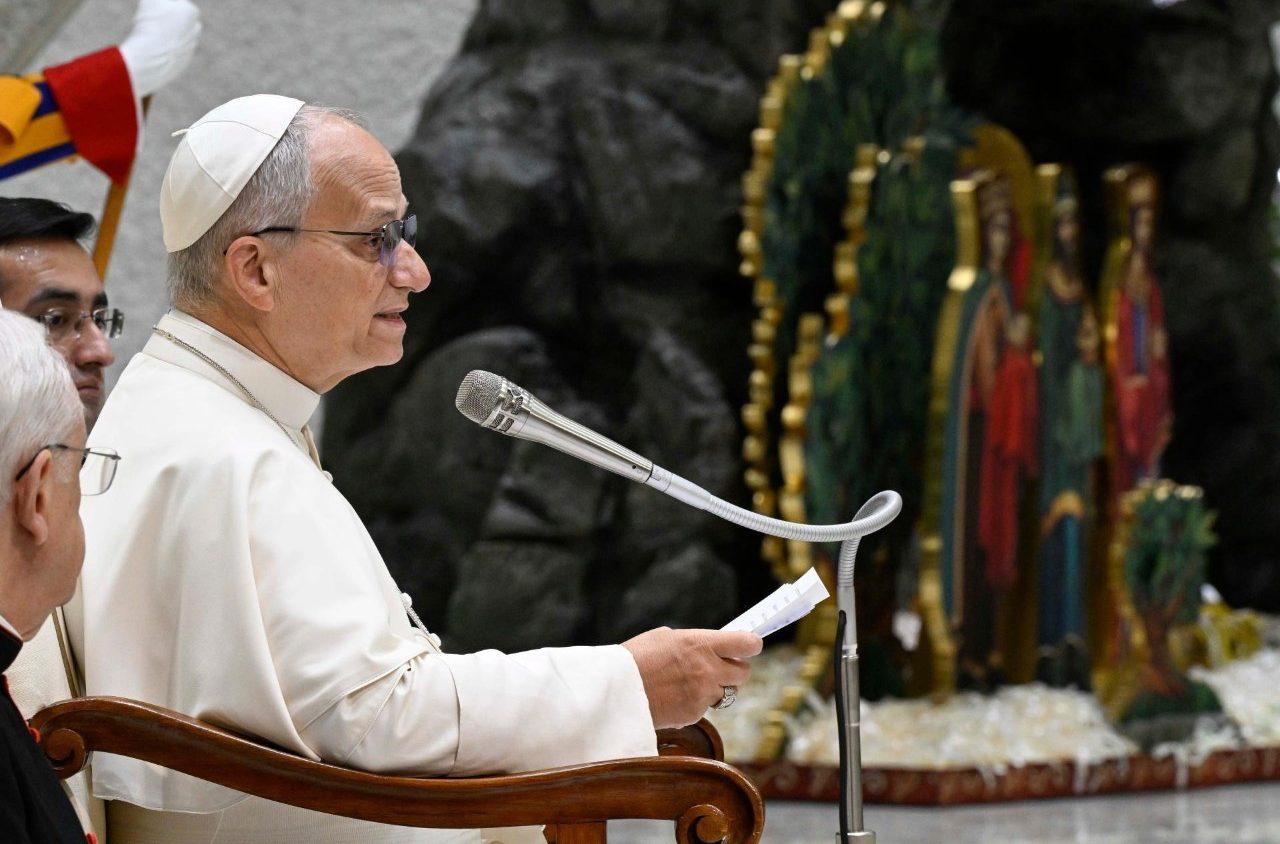
Speaking at his General Audience on Wednesday, Pope Leo XIV said the Vatican II ecumenical council has “prophetic and contemporary relevance.”
Leo noted the Jubilee Year that ended this week also marked the 60th anniversary of the closing of Vatican II, which occurred on1962-1965.
The Council was called by Pope St. John XXIII, who died in 1963, and concluded by his successor, Pope St. Paul VI.
Pope Leo was speaking in the Paul VI Audience Hall before beginning his first Extraordinary Consistory with the cardinals of the Church, which is taking place Jan. 7-8.
The pontiff said he was beginning a series of talks on Vatican II and will involve rereading the documents released during the council.
“Although the time that separates us from this event is not so long, it is equally true that the generation of bishops, theologians and believers of Vatican II is no longer with us,” Leo said.
“Therefore, while we hear the call not to let its prophecy fade, and to continue to seek ways and means to implement its insights, it will be important to get to know it again closely, and to do so not through ‘hearsay’ or interpretations that have been given, but by rereading its documents and reflecting on their content,” he explained.
“Indeed, it is the Magisterium that still constitutes the guiding star of the Church’s journey today,” the pontiff added.
Pope Leo remarked on the words of his predecessor Pope Benedict XVI, who said at the beginning of his reign in 2005, “as the years have passed, the Conciliar Documents have lost none of their timeliness; indeed, their teachings are proving particularly relevant to the new situation of the Church and the current globalized society.”
Leo noted that when Pope Saint John XXIII opened the Council on October 11, 1962, he spoke of it as “the dawn of a day of light” for the whole Church.
“The work of the numerous Fathers convened from the Churches of all continents did indeed pave the way for a new ecclesial season. After a rich biblical, theological and liturgical reflection spanning the twentieth century, Vatican Council II rediscovered the face of God as the Father who, in Christ, calls us to be his children; it looked at the Church in the light of Christ, light of nations, as a mystery of communion and sacrament of unity between God and his people; it initiated important liturgical reform, placing at its centre the mystery of salvation and the active and conscious participation of the entire People of God,” the pope told the pilgrims.
“At the same time, it helped us to open up to the world and to embrace the changes and challenges of the modern age in dialogue and co-responsibility, as a Church that wishes to open her arms to humanity, to echo the hopes and anxieties of peoples, and to collaborate in building a more just and fraternal society,” Leo said.
He added that rediscovering the Council helps the Church to “restore primacy to God, to what is essential: To a Church madly in love with its Lord and with all the men and women whom he loves,” a quote from Pope Francis, who died last year.
“As we approach the documents of Vatican Council II and rediscover their prophetic and contemporary relevance, we welcome the rich tradition of the life of the Church and, at the same time, we question ourselves about the present and renew our joy in running towards the world to bring it the Gospel of the kingdom of God, a kingdom of love, justice and peace,” Pope Leo said.
The article has been corrected.
Follow Charles Collins on Twitter: @CharlesinRome