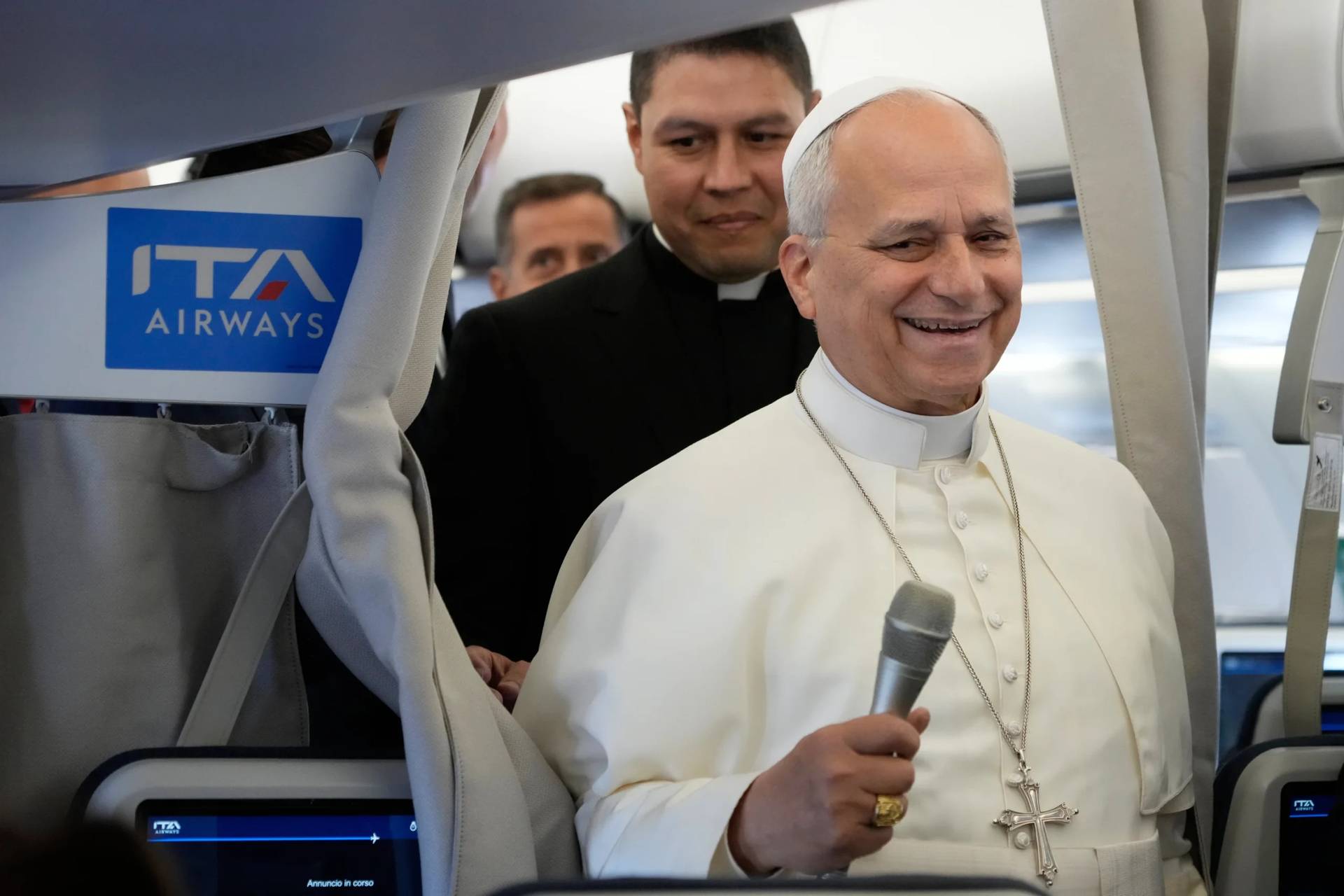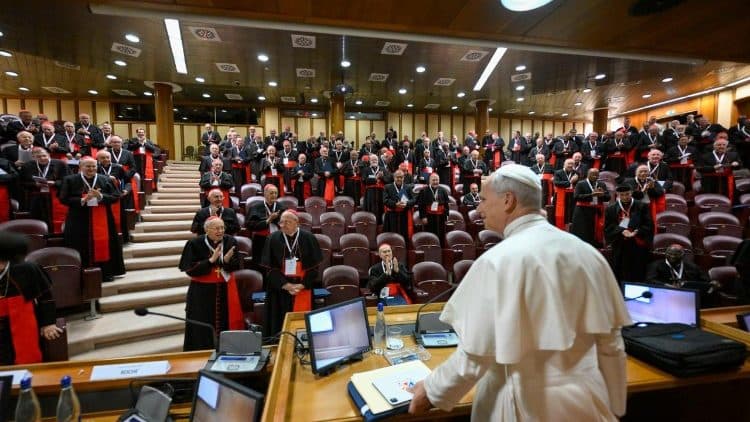
ROME – In arguably one of the most important meetings of his papacy so far, Pope Leo Thursday stressed the importance of striving for unity and told cardinals there was no room for private agendas.
Speaking during Mass at the start of Mass Jan. 8 for the second day of his first-ever consistory of cardinals, the pope noted that the cardinals came from across the world and “paused” from their activities to be together and be in God’s presence.
“We gather not to promote personal or group ‘agendas,’ but to entrust our plans and inspirations to a discernment that transcends us…and which comes only from the Lord,” he said.
For this reason, Leo said, it is important that during the Mass the cardinals “place each of our hopes and ideas upon the altar.” They must be offered to God, he said, “so that we may receive them back purified, enlightened, united and transformed by grace into one bread.”
In this sense, he underlined the importance of unity and communion, especially among them as cardinals.
“Our college, while rich in many skills and remarkable gifts, is not called primarily to be a mere group of experts, but a community of faith,” he said, saying it is only when these gifts are offered to God that they will “bear the greatest fruit according to his providence.”
God’s love, the pope said, is relational and is thus “the very source of that spirituality of communion” that the church must live and promote.
Pausing and coming together, then, “is first and foremost a profound act of love for God, for the Church and for the men and women of the whole world,” he said.
In this spirit, Pope Leo said the consistory was a time of prayer and silence, but also of facing and getting to know one another, and listening to one another.
“In our sharing, we become a voice for all those whom the Lord has entrusted to our pastoral care in many different parts of the world,” he said.
To discern God’s will accurately, Leo said the cardinals must be both generous and humble, aware that “we bring nothing that we have not first received as a gift or talent, which are not to be squandered, but invested with prudence and courage.”
He stressed the need for cooperation, saying, “This is the spirit in which we wish to work together: The spirit of those who desire that every member of the Mystical Body of Christ will cooperate in an orderly way for the good of all.”
Leo described humanity as a great crowd “hungry for goodness and peace,” and who are looking for relief.
It is normal to feel in adequate, he said, in “a world where satisfaction and hunger, abundance and suffering, and the struggle for survival together with a desperate existential emptiness continue to divide and wound individuals, communities and nations.”
However, the pope said Jesus gathers what is there and multiplies it, just as he did with the loaves and fish.
“This is something we can do together. We may not always find immediate solutions to the problems we face, yet in every place and circumstance, we will be able to help one another – and in particular, to help the Pope – to find the ‘five loaves and two fish’ that providence never fails to provide wherever his children ask for help,” he said.
Pope Leo opened a new phase of his pontificate Wednesday by inaugurating his first-ever consistory, not for the creation of new cardinals, but rather by asking the College of Cardinals around the world to advise him on key priorities for the next two years.
RELATED: Pope convenes cardinals and asks their priorities for 2 years
His agenda for the whirlwind two-day meeting originally included four topics: a discussion of Pope Francis’s 2013 apostolic exhortation Evangelii Gaudium outlining the missionary nature of the church; his 2022 document reforming the Roman Curia, Predicate Evangelium; Francis’s vision of “synodality”, and the liturgy.
However, instead of delving into all four – which would have represented a major challenge given the brief timeline – he asked the cardinals to select two topics to address during the Jan. 7-8 consistory as priorities for the next two years.
The topics selected were not the oftentimes divisive topics of the liturgy and curial reform, but rather the church as missionary and synodal.
In off-the-cuff remarks at the end of Wednesday’s first session, Leo said the meeting was not just for the cardinals, but offered the church and the world “a certain testimony of will, of desire, recognizing the value of coming together, of making the sacrifice of a journey…to come and be together and be able to seek together what the Holy Spirit wants for the Church today and tomorrow.”
“I think it is important that we work together, that we discern together, that we seek what the Spirit asks of us,” he said.
He urged cardinals to ask themselves whether there was really life in the church, saying he personally is convinced that that answer is yes, but that the question is important to ask regardless.
Likewise, he questioned whether there space in the church for what is emerging, and whether God’s love is what is guiding that.
“We cannot close ourselves off and say, ‘Everything is already done, finished; do as we have always done,’” the pope said, saying, “There truly is a path, and with the work of these days, we are walking together.”
Like Herod, who fearful of losing his power lies and manipulates to get what he wants, “fear blinds. The joy of the Gospel, however, frees,” he said.
Pope Leo said the consistory for him “is one of the many expressions in which we can truly experience the newness of the Church.”
“The Holy Spirit is alive and present among us too. How beautiful it is to be together in the boat! We are together,” he said.
While there might be some doubt or anxiety about the direction or outcome, “if we place our trust in the Lord, in his presence, we can do so much,” he said.
Referring to the topics the cardinals voted on to discuss, the church as missionary and synodal, Leo said that based on comments made thus far, “one theme cannot be separated from another.”
“Indeed, there is much we can explore together. But we want to be a Church that doesn’t only look at itself, that is missionary, that looks beyond, at others,” he said.
The Church’s raison d’être, he said, “is not for cardinals, bishops, or clergy. Its raison d’être is to proclaim the Gospel.”
In this sense, the pope said the topics of synod and synodality and of striving to be a missionary church, proclaiming the Gospel with Christ at the center, “this is our mission.”
He offered assurances that the other topics, liturgy and the reform of the curia, will not be forgotten, and “are very concrete, specific issues that we still need to explore,” and voiced hope that the cardinals would speak and express themselves freely during the discussion.
Follow Elise Ann Allen on X: @eliseannallen