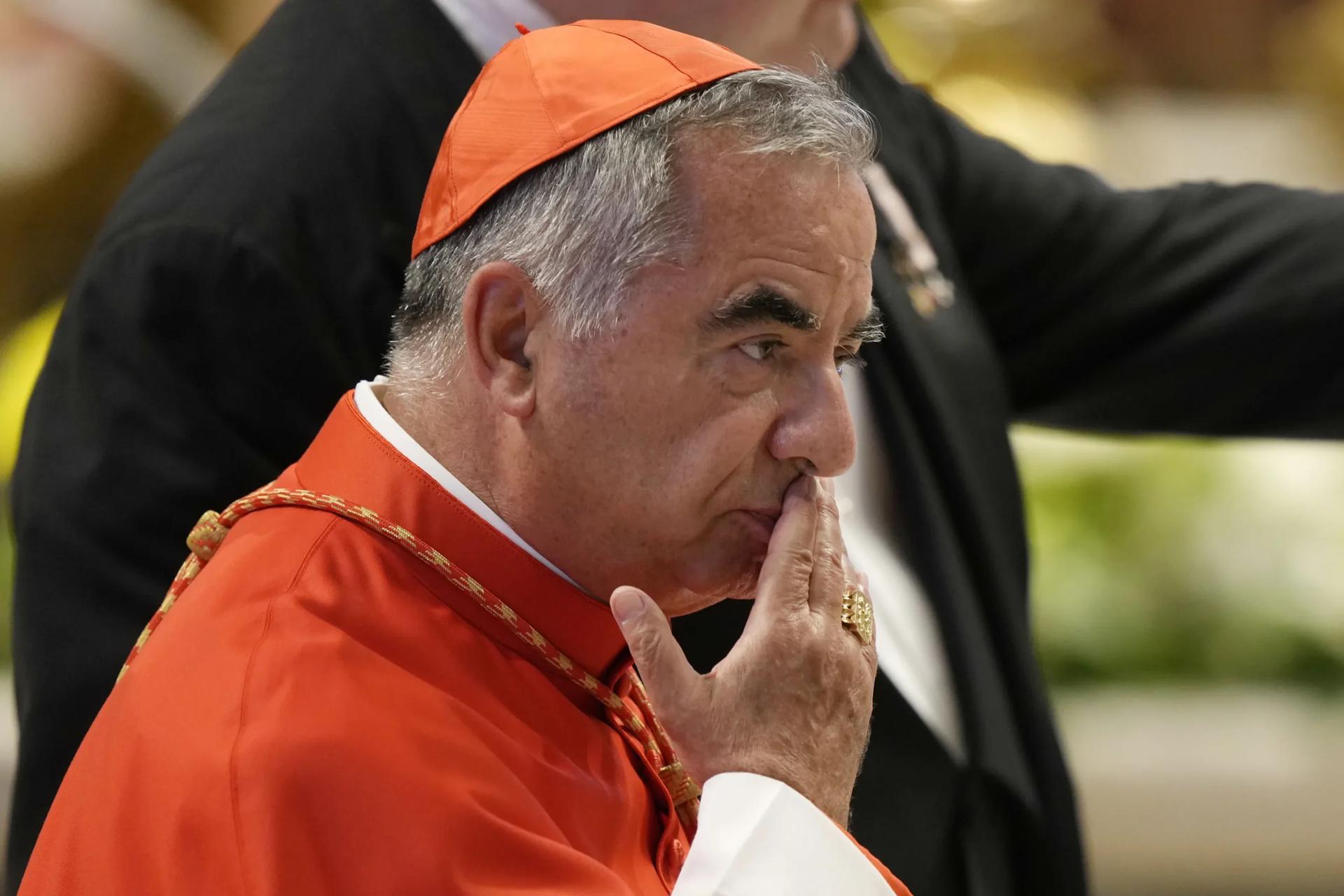
Vatican City’s highest appellate court has rejected an appeal from the city state’s chief prosecutor that sought to reopen the case against Cardinal Giovanni Angelo Becciu and other defendants, even after the prosecution secured convictions against nine separate defendants on charges of various financial crimes, in a maxi-trial that concluded in 2023.
A laconic statement from the press office of the Holy See announced the developments on Monday.
The original case turned on a failed $400 million real estate deal in London, in which the Holy See’s Secretariat of State purchased a former Harrod’s warehouse in the Chelsea neighborhood with a view to turning the property into luxury apartments.
The Vatican eventually sold the property at a $163 million loss to extricate itself from the affair.
At the time the ill-fated deal was in the works, Becciu was serving as the sostituto in the Secretariat of State – essentially the pope’s chief of staff – and Vatican prosecutors alleged that Becciu, other officials and advisors, and a pair of Italian financiers deliberately swindled the Vatican out of the money.
The defendants argued instead that it was the Vatican itself, represented by senior officials such as Cardinal Secretary of State Pietro Parolin and Archbishop Edgar Peña Parra – who succeeded Becciu as sostituto when Becciu went to lead the powerful Congregation for the Causes of Saints and received the red hat that comes with such a billet – blaming them for the series of poor business decisions which resulted in the losses.
Prosecutor Alessandro Diddi had asked the Court of Cassation of the Vatican City State to let him re-argue a central tenet of his case and prove that the financial crimes and acts of corruption for which he had already secured convictions at first-instance trial were actually part of a unified conspiracy involving the defendants.
Becciu and six other defendants have appealed their convictions, and the court hearing the appeals will now only consider whether to reduce the penalties, modify the convictions, or quash the convictions entirely.
A lower court of appeal had already dismissed Diddi’s request, and the higher court has confirmed that decision, removing pressure from defendants and – observers say – casting further shadow on Diddi, whose conduct throughout the protracted and Byzantine legal saga has been the subject of intense scrutiny and occasionally searing criticism.
A three-judge panel led by Spanish Archbishop Alejandro Arellano Cedillo is hearing the Becciu appeal. Arellano is the dean of the Roman Rota, the Vatican’s highest ordinary judicial tribunal in the Church’s canonical court system. The 63-year-old prelate and jurist is a member of the Workers of the Kingdom of Christ (Operarios del Reino de Cristo), a society of apostolic life founded in Mexico in 1963 and dedicated to cultivating vocations to the priesthood.
Becciu has consistently maintained his innocence and continues to do so now. For purposes of the appeal, the charges against him have been phrased as “embezzlement” and “fraud,” even though in the first trial the judges conceded there was no evidence Becciu ever profited personally from the disputed transactions.
In the original trial, Becciu was also charged on two other grounds, one involving transfers of funds from the Secretariat of State to a charity run by his brother in his native Sardinia, and another involving payments to soi-disant security consultant Cecilia Marogna, supposedly for the liberation of a Colombian religious woman kidnapped by jihadists in Mali, though at least some of those funds ended up buying luxury goods for Marogna.
The Secretariat of State and the Administration of the Patrimony of the Apostolic See – APSA, the sovereign asset manager of the Holy See – had constituted themselves civil parties in the case and continue nominally to participate in the appellate phase, but they did not appeal the first instance sentences.
*This story has been updated to clarify the role of the Secretariat of State and the APSA in the various phases of the trial.