ROME – In a bid to stop members of a breakaway traditionalist society from incurring excommunications through the illicit ordination of new bishops, the Vatican has offered a path forward based on theological dialogue.
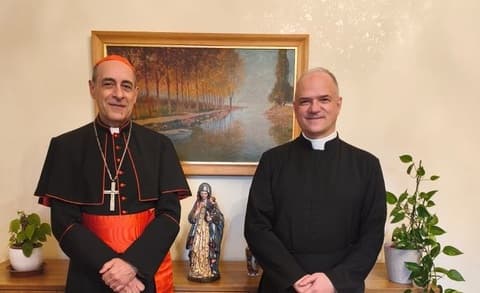
A Feb. 12 communique published by the Vatican’s Dicastery for the Doctrine of the Faith and signed by its prefect, Argentine Cardinal Victor Fernandez, said a meeting between Fernandez and the Superior General of the Society of Saint Pius X, Father Davide Pagliarani, took place earlier that day.
During that meeting, held with the pope’s approval, Fernandez clarified “certain points” addressed in previous written correspondence between the SSPX and the DDF from 2017-2019.
Archbishop Marcel Lefebvre founded the SSPX in 1970 to form priests as a response to what he described as errors that had arisen in the Church following the Second Vatican Council. Its relations with the Holy See were further strained in 1988 when Lefebvre and Bishop Antonio de Castro Mayer consecrated four bishops without the permission of Pope John Paul II.
The illicit consecration resulted in the excommunication of the six bishops. The excommunications of the surviving bishops were lifted in 2009 by Pope Benedict XVI amid ongoing negotiations to restore communion, however, he also clarified that doctrinal issues were still present and that until they were resolved, the SSPX had no canonical status in the Church and its ministers could not legitimately exercise any ministry.
In a sign of goodwill, Pope Francis during the Jubilee of Mercy extended to the priests of the SSPX the faculty to validly hear confessions and absolve penitents. He later extended this faculty until further notice.
Among the topics discussed during Thursday’s meeting was “the question of divine will regarding the plurality of religions,” according to the communique.
Fernandez also pitched the SSPX a structured theological dialogue, “with a very precise methodology,” that would delve into topics that have “not yet received sufficient clarification,” specifically those related to the Second Vatican Council.
These topics include “the difference between an act of faith and ‘religious submission of the mind and will’” (obsequium religiosum), and “the different degrees of adherence required by the various texts of the Second Vatican Council and its interpretation.”
Fernandez also offered to discuss “a series of topics” brought up by the SSPX in a letter dated Jan. 17, 2019.
The aim of this dialogue, the DDF said, is to identify “the minimum necessary requirements for full communion with the Catholic Church” and to identify a canonical structure for the SSPX should they be brought back into communion with the Catholic Church.
Previously, there had been proposals and even rumors of a decree to give them the status of a personal prelature – a structure defined by specific pastoral and missionary characteristics rather than geography, such as in the case of a diocese, with the only current example being Opus Dei.
However, Opus Dei has recently reformed its statutes after being asked to do so by Pope Francis, who appeared to sour on the idea of a prelature in the course of his papacy.
Fernandez, according to the communique, reminded Pagliarani during their meeting that the ordination of bishops without the pope’s approval “would imply a decisive rupture of ecclesial communion, with serious consequences for the Society as a whole.”
The canonical penalty for the illicit consecration of bishops is automatic excommunication.
“Therefore, the possibility of carrying out this dialogue presupposes that the Society suspends the decision regarding the announced episcopal ordinations,” the DDF said.
This warning from the Vatican comes after the SSPX announced Feb. 2 their intention to proceed with the consecration of new bishops, without Pope Leo’s approval, after the Vatican refused to comply with certain requests the society had made regarding “the particular need of the Society to ensure the continuation of the ministry of its bishops.”
Pagliarani will present Fernandez’s proposal for dialogue to the SSPX’s Superior Council, before providing an answer.
“In the event of a positive response, the steps, stages and procedures to be followed will be established by mutual agreement,” the DDF said, and asked the church to pray for this process in a spirit of “true ecclesial communion.”
Follow Elise Ann Allen on X: @eliseannallen