In a landmark move, the Catholic Church in Africa, has signed a major new Memorandum of Understanding with the African Union to tackle a diverse array of challenges on the continent.
Through the Symposium of Episcopal Conferences of Africa and Madagascar (SECAM), the Church has entered the agreement with Africa’s premier continental body for cooperation and development, solidarity, human and civil rights, and common defense.
The new agreement between SECAM and the AU is designed to tackle problems from fragile governance and armed conflict to climate vulnerability and global competition for critical minerals.
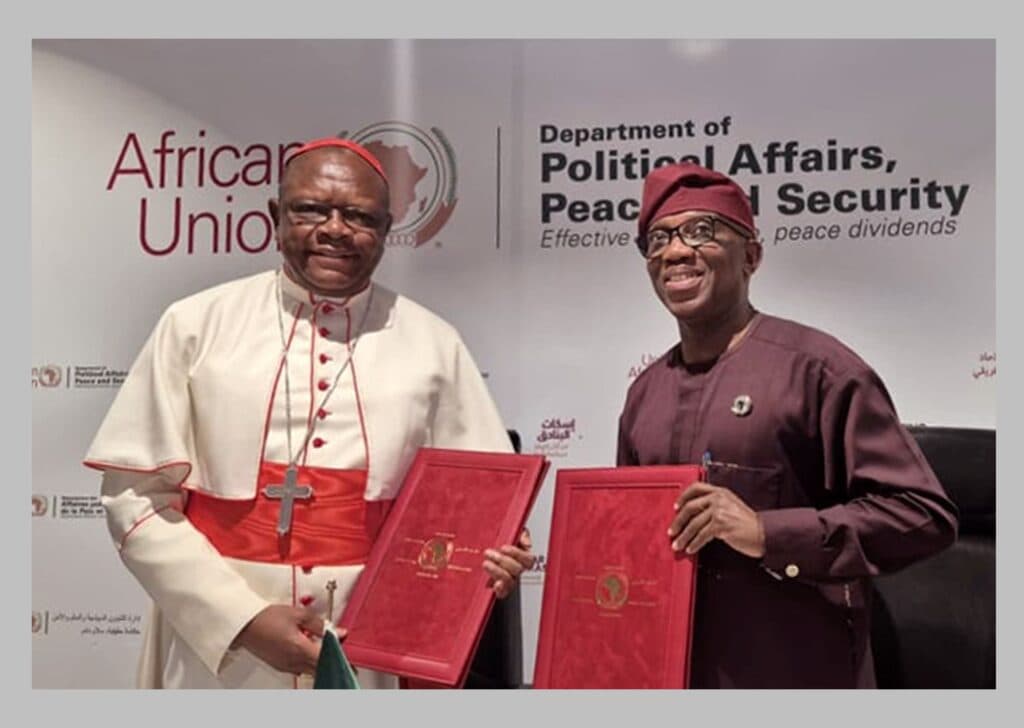
Signed on February 13, the new partnership moves significantly beyond a previous, more general framework first put in place in 2015. The new MoU establishes a structured and operational collaboration anchored within the AU’s Department of Political Affairs, Peace and Security.
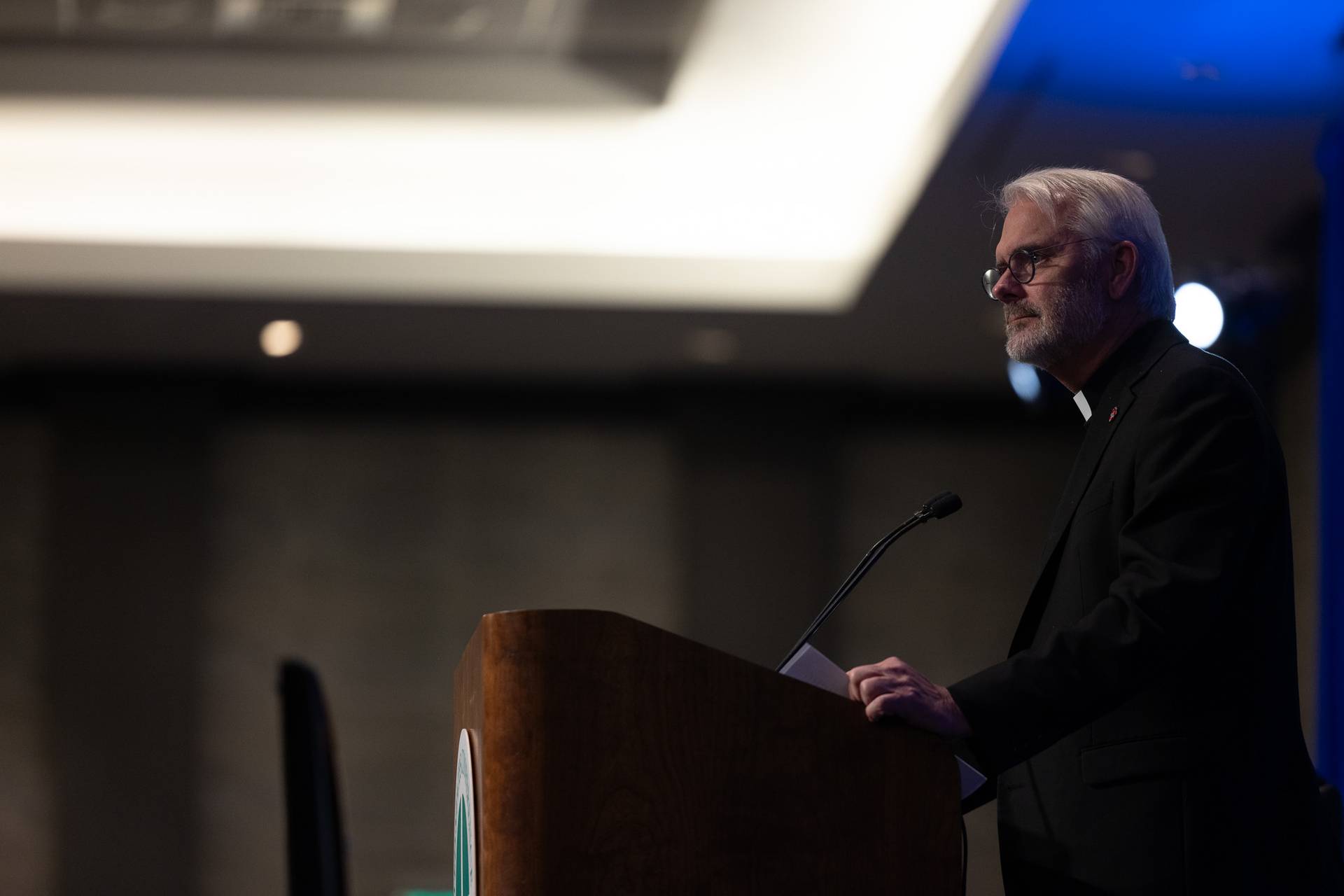
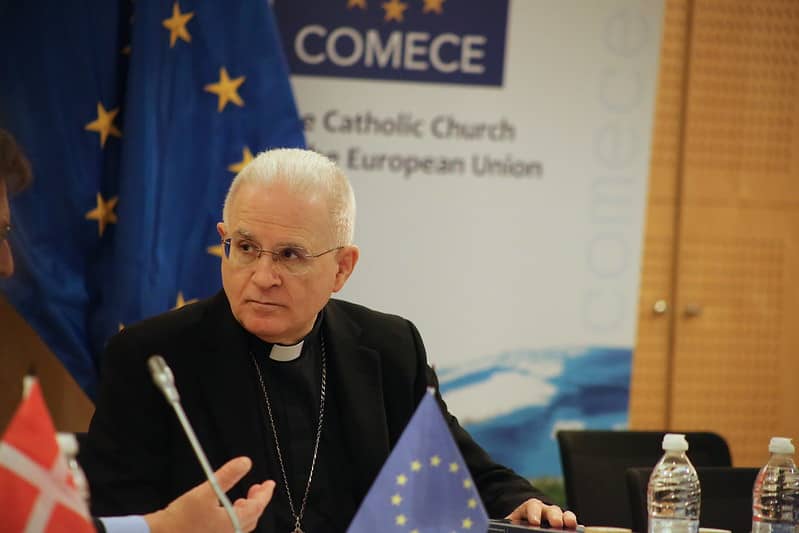
SECAM’s president, Cardinal Fridolin Ambongo of Kinshasa, signed for the Church.
In an exclusive interview with Crux, Ambongo says the new agreement isn’t a mere update of paperwork, but a kairos – a favorable and decisive moment – for the continent.
Ambongo says the enhanced partnership aims to inject the Church’s vast on-the-ground presence and moral authority directly into continental policy, ensuring that Africa’s pursuit of the ambitious “Agenda 2063” vision is not only political and economic, but fundamentally ethical and centered on the dignity of the human person.
The following Q&A has been edited for length and clarity.
Crux: Your Eminence, could you outline the main pillars of the Memorandum of Understanding (MoU) between SECAM and the African Union? What specific areas of collaboration does the MoU define?
Cardinal Fridolin Ambongo: It takes us from a general framework for cooperation, established in 2015, to a structured and strategic partnership, firmly anchored within the AU’s Department of Political Affairs, Peace and Security, focusing in particular on governance and conflict prevention.
The agreement is explicitly integrated into Agenda 2063, the African Union’s long-term vision for ‘the Africa we want’. It emphasizes governance, democracy, constitutional order, peacebuilding, reconciliation and social cohesion. At the same time, it allows us to collaborate with other departments of the AU Commission on issues such as humanitarian crises, migration, human trafficking, climate justice and the ethical management of natural resources.
It is important to note that this new memorandum of understanding introduces operational tools such as a joint action plan, with defined priorities, timelines and monitoring mechanisms. This initiative is therefore not limited to dialogue but involves structured engagement and measurable contributions. The Church’s mission in favor of integral human development will be able to unfold more decisively within the AU by making its specific contribution.
Crux: What is it that made it imperative to revise the initial MoU that guided collaboration between the Church and the AU?
SECAM has been formally collaborating institutionally with the African Union since 2015. However, the MoU signed at the time with the Department of Political Affairs needed to be updated to take into account the new legal guidelines of the AU Commission.
Beyond this legal framework, I consider the signing of this new memorandum to be a kairos, a favorable moment for our continent.
Africa is currently facing a convergence of challenges: fragile governance, unconstitutional regime changes, electoral tensions, the rise of religious extremism and jihadism, armed conflicts in regions such as the Sahel and the Great Lakes, demographic pressures, climate vulnerability and growing global competition for Africa’s strategic resources.
While the 2015 agreement brought recognition and goodwill, the current moment calls for a more structured, strategic and operational approach. The African Union has strengthened its governance architecture, particularly within the Department of Political Affairs, Peace and Security. It was therefore timely and appropriate to update our cooperation to reflect this new institutional reality.
The 2026 Memorandum of Understanding integrates SECAM into the AU’s conflict management and prevention frameworks.
It introduces a joint action plan, clearer legal provisions, defined review mechanisms and the possibility of seconding staff. These are not mere administrative details, but a sign of the maturing of our relationship. The African continent is at a turning point in a changing multipolar world.
To shape its own destiny, Africa’s transformation cannot be solely economic or political; it must also be ethical and centered on the human person. The Church, thanks to its continental presence and moral credibility, is particularly well placed to contribute to this dimension.
The formalization of this enhanced collaboration now ensures that Africa’s renewal incorporates the conscience, responsibility and dignity of the human person.
Crux: The Church has always been involved in development work in Africa. How does this partnership change or improve that work?
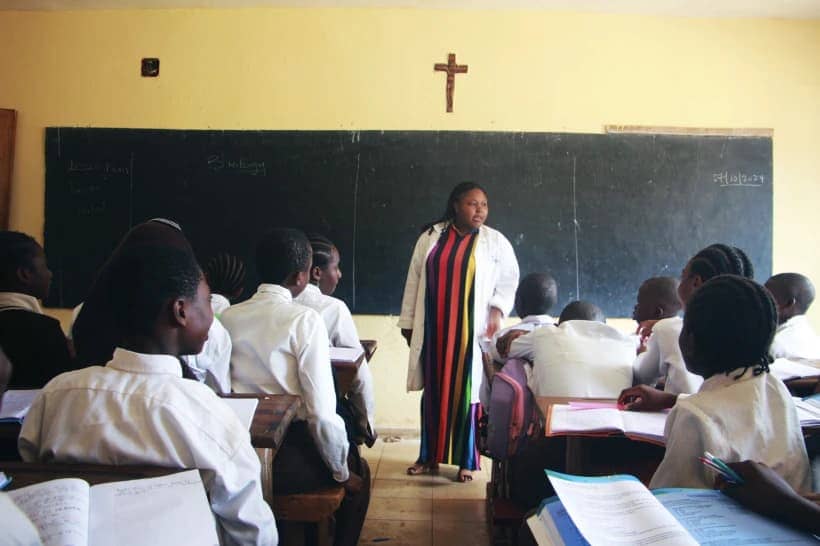
Cardinal Fridolin Ambongo: Indeed, the Church has long been active in the fields of education, health, scientific research, social advancement, conflict prevention, mediation and humanitarian aid. What is changing today is the level of institutional coordination and commitment.
Previously, much of our work was carried out in collaboration with public institutions of the States.
Today, thanks to structured consultation and a joint action plan, our experience can directly influence the development of continental policies. The realities in particular churches, listening to the grassroots and mediation efforts will no longer be isolated initiatives; they will be able to actively contribute to discussions on governance, peace frameworks and continental strategies.
The possibility of seconding staff provided for in the memorandum of understanding allows for deeper institutional integration, moving us from parallel efforts to a genuine strategic partnership.
Crux: In your experience, what is the biggest internal obstacle to Africa’s development today? And where do you see the greatest opportunity?
Cardinal Fridolin Ambongo: The biggest obstacle remains governance deficits. Weak institutions, corruption, lying as a mode of governance – lying is as natural as breathing – electoral violence, illicit financial flows and poor management of ethnic diversity are hindering development.
However, Africa’s greatest opportunity lies in its population, particularly its young people and women.
The continent is young, dynamic and creative.
If leadership becomes ethical and responsible, and if education and entrepreneurship are strengthened, Africa’s population growth can become an asset rather than a burden.
Development must be led by the people, as stated in Agenda 2063.
Crux: The Church has an unrivalled network that allows it to reach isolated communities. How does this influence this partnership?
Cardinal Fridolin Ambongo: The Catholic Church is present where the state is often absent: in villages, refugee camps and conflict zones. Our pastoral workers live among the people, listening to their fears, hopes, frustrations and aspirations. Diplomats in embassies or those from the African Union Commission do not have the same roots on the ground as our priests, religious and committed lay people.
This knowledge gained from the field is invaluable.
Thanks to this strengthened partnership, the realities experienced by communities can inform continental strategies on peace building, migration, governance and environmental management.
We provide concrete human experiences rather than abstract analyses.
Crux: The world is moving towards a multipolar order: How can Africa avoid becoming a pawn in global rivalries?
Cardinal Fridolin Ambongo: Africa must act with unity and strategic clarity. Agenda 2063 envisions Africa as a strong global player, which requires continental solidarity.
Fragmentation invites exploitation, while unity creates leverage. However, unity must be based on justice, transparency and service to the common good. Sovereignty only makes sense if it protects the dignity and well-being of the people.
Africa must negotiate partnerships from a position of coherence and moral confidence.
Crux: Let’s talk about critical minerals and the Democratic Republic of Congo: Do you think recent international agreements (particularly with the US using security guarantees as leverage to access Congo’s minerals) will benefit the Congolese people?
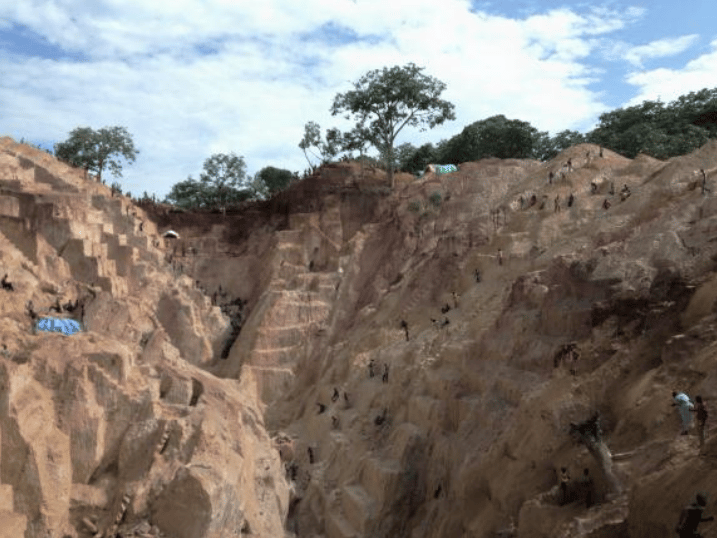
Cardinal Fridolin Ambongo: My country, the Democratic Republic of Congo, possesses immense mineral wealth that is essential to the global energy transition.
However, history teaches us to be cautious; Africa’s resources have too often enriched other countries, while local communities remain poor.
The opportunity exists, but it depends on transparent contracts, enforced environmental standards and the equitable sharing of profits with local populations.
The people must have a say.
Without the effective involvement of the people, without transparency to ensure a win-win partnership, the agreements you refer to will benefit an oligarchy, leaving the people abandoned to their sad fate.
Crux: What is the role of the Church in ensuring that resource-rich nations avoid the so-called ‘resource curse’ (i.e., the stark reality that resource-rich nations often have poorer development outcomes and greater struggles achieving and maintaining democratic order than countries with fewer natural resources)?
Cardinal Fridolin Ambongo: To avoid the ‘resource curse’ – to use your expression –we need responsible institutions, transparent contracts, regional cooperation and added value within Africa.
Extractive economies must evolve into transformative economies.
It is essential to empower citizens so that they do not remain passive spectators, leaving politicians alone to decide the future of their resources; they must be able to express themselves and deserve to be heard through mechanisms that promote inclusion in natural resource management policies.
The role of the Church is both prophetic and pastoral.
The Church advocates the primacy of the human person over systems, including those of the globalized economy. We defend communities, advocate for justice and remind leaders that development cannot sacrifice human dignity or creation.
Economic progress must serve the common good.
Crux: Agenda 2063 talks about ‘the Africa we want’. What does that look like beyond economic indicators?
Cardinal Fridolin Ambongo: The Africa we want is not defined solely by GDP.
It is a continent where elections do not lead to violence, where women and children are protected, where young people find decent jobs, and where diversity is a source of wealth rather than division, where no tribe monopolizes the country’s power and wealth.
True prosperity encompasses justice, peace, solidarity and moral renewal. Development must be holistic, otherwise it is incomplete.
Crux: Agenda 2063 is a secular policy document: How does the Church align itself with this document without compromising its prophetic voice?
Cardinal Fridolin Ambongo: That’s a very good question. The Church does not merge with political structures and does not withdraw from public life. Where there is convergence, such as on human dignity, peace and justice, we collaborate.
Where injustice appears, we speak out clearly.
The Lord Jesus himself told us: We are in the world but not of the world (cf. John 17:11, 14-16). The SECAM and the African Union serve the same peoples, each according to its own mission.
Agenda 2063 is not a “fifth gospel.” It is a human document that can be improved upon.
However, Catholic social doctrine finds points of convergence with the principles of good governance, sustainable development, environmental protection and human rights enshrined in Agenda 2063.
Our mission is to bring awareness to politics and to ensure that development remains centered on the human person and on peoples.