ROME – United States Ambassador to the Holy See Brian Burch, in an exclusive sit-down interview with Crux Now, said he sees the potential for a “Catholic Moment” in the U.S. given the high-profile Catholics in the current administration, with history’s first U.S.-born pope.
According to Ambassador Brian Burch, there is a new kind of conservativism in U.S. politics being shaped largely by prominent Catholic personalities including U.S. Vice President JD Vance and Secretary of State Marco Rubio, a “common good conservatism” which can help shape the future of the country.
RELATED: US immigration law ‘not rooted in hate or xenophobia,’ ambassador says
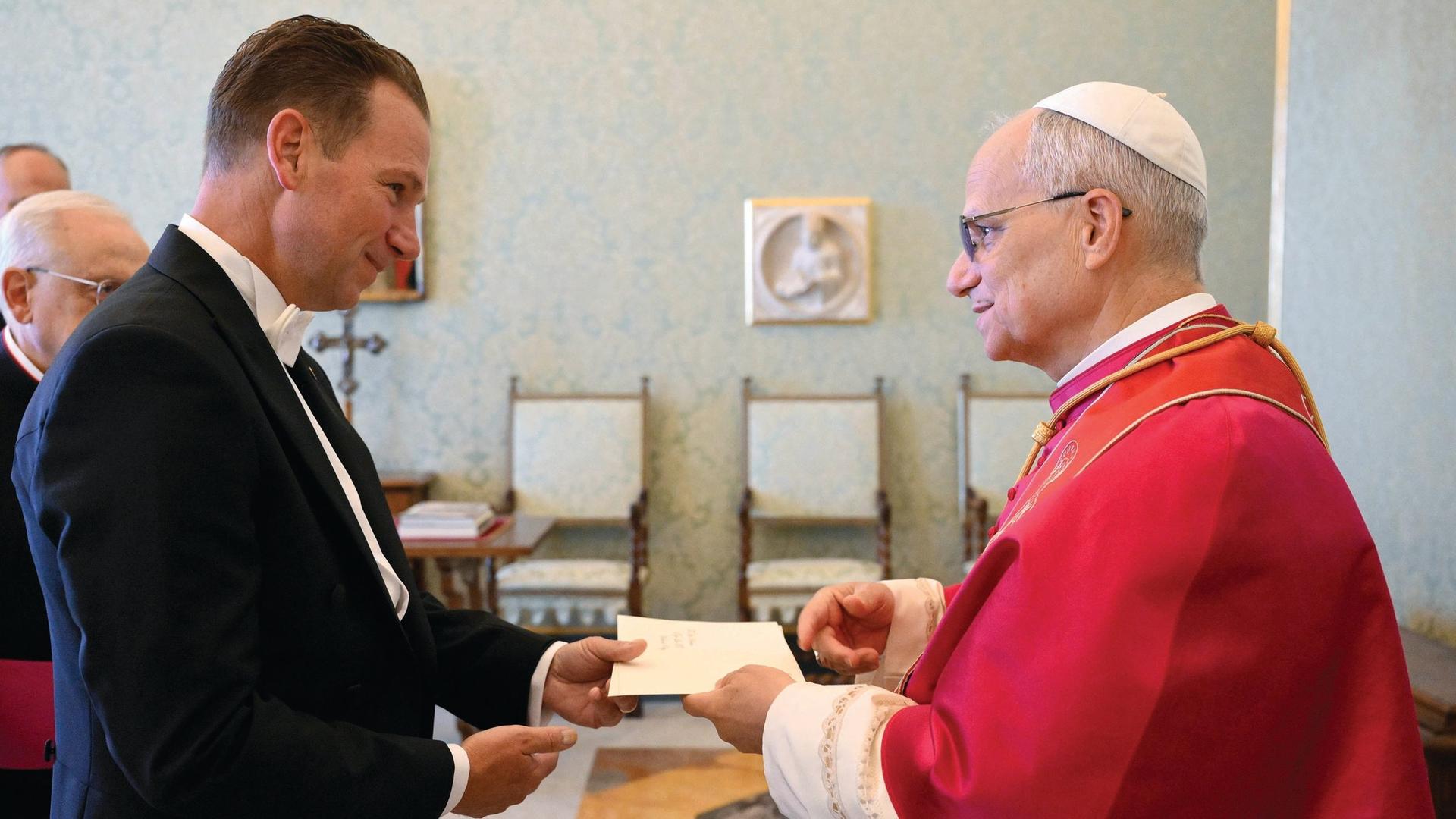
“There is a real moment, I think, and Pope Leo and I talked about this when I sat down with him to present my credentials,” Burch told Crux Now in a wide-ranging sit-down interview in his office at the U.S. Embassy to the Holy See.
President Donald Trump, he said, “deeply cares about and understands intuitively this Catholic view of the human person and of human communities.”
“I think this is represented in the vice president he chose, in the secretary of state he chose. They speak about this frequently,” he said.
Burch noted that Rubio in a speech at the Catholic University of America spoke about a “common good conservatism” as a new and upcoming type of conservative instinct that is bubbling up in U.S. politics and culture, and which is distinct from similar movements in the past.
“We have this political camp that I came from that sees old Republican politics as inadequate, certainly progressive ideology as incompatible, and a kind of third way that’s this common good conservatism that I think is deeply rooted in a lot of the principles found in Catholic social teaching and which I think will contribute to the possibilities of a ‘Catholic Moment’,” he said.
In his interview Burch also spoke about collaboration between the U.S. and the Holy See on issues such as religious freedom and artificial intelligence, a potential papal trip, celebrations for the U.S.’s 250th anniversary this year, and Pope Leo’s sports affinity.
Please read below for Part Two of Crux Now’s sit-down interview with U.S. Ambassador to the Holy See Brian Burch (Part One is here):
Crux Now: There are many areas where the Holy See and the United States do have a lot of common ground. The area of religious freedom, for example, parents’ rights in education, and artificial intelligence. What do you think are the strongest points of interaction and dialogue between the United States and the Holy See at this point?
Burch: I think any ambassador in this role inherits a set of issues where there has been a deep and abiding collaboration, and that includes global peace and security and religious freedom and human dignity writ large. Of course, we’ve talked about Russia-Ukraine, we talked about the Middle East, we talked about Venezuela. In many respects, I think the Holy See and the United States see the world very similarly in terms of, we’re not on different sides, we want to work towards a peaceful resolution, we believe in principles of justice, and we understand that there’s a moral order that ought to govern human action. We are a part of a Christian civilization that they help shape. We may not always agree on the best means, or rhetoric, or tools, but there is a deep shared commonality when it comes to the peace and security of the world in terms of the goal.
Religious freedom, as you point out. Archbishop [Paul] Gallagher in his recent UN speech pointed out that the Christians are the largest persecuted group in the world. The numbers are shocking and there are many places where that is especially felt like Nigeria, for example, or the church in Nicaragua, or various places where Catholics, Christian believers’ lives are being threatened.
There’s a bigger opportunity here within the realm of religious freedom. I’m going to play armchair theologian here with an Augustinian pope. Saint Augustine talks about the tranquility of order, peace as the tranquility of order, which is that peace is not simply the absence of conflict or coercion, but it’s actually the set of conditions that lead to broad flourishing. This is the kind of religious freedom, and this is the peace that the U.S. wants to help advance. It’s not simply not being threatened inside the walls of a church so that you can read the Bible. It’s to be able to live out one’s faith in the public square, within your community, within your family to have access to faith-based health care, to have access to a religious school, to be able to speak and to write and to share faith-informed opinions in the public square without fear of censorship or coercion.
This is religious freedom broadly understood. It’s not simply lack of coercion; it’s a set of conditions that will lead to broad flourishing as a believer. I think that that’s an important piece because I think sometimes religious freedom can shrink. I think rightly understood, at least in the tradition of both the Church and I think in the way that the United States is best understood, it’s that people of faith can not merely believe, but can thrive.
It’s widely acknowledged that [Pope] Leo chose his name with reference to his predecessor by the same name [Leo XIII]. There is a lot of expectation around what his first encyclical might include, and the fact that probably the most transformative thing that will happen during my time here is, what impact will AI have on our world? There perhaps be no bigger issue while I’m here than to help relate U.S. policy to the Church’s rich tradition around a rightly understood human anthropology and a set of ethical principles that need to guide innovation and technology that’s transforming our world.
The U.S. has a particular proposal for the world when it comes to AI. We have tech leadership, we have commercial interests, we have a set rule of law, we have a deep tradition of respect for speech, for freedom of religion, for privacy, for intellectual property. We have an opportunity to take advantage of all of the benefits that AI will bring the world, circumscribed by this ethical and human dimension that the Church contributes and which could be extraordinary and spectacular. There could be amazing leaps of innovation that could change the world in great ways.
There are also lots of risks. Some of the ethical and human questions that the Church will guide are extremely important. I think some of the threats that alternatives to the AI model that the U.S. is advancing that other parts of the world are proposing will threaten censorship, privacy, intellectual property, religious freedom, fundamental human rights, because of how transformative this technology could be. It’s very important that countries, and I’m going to call this a Western-civilization-modeled AI, an AI that’s worth pursuing and that’s good for the world, is going to have to incorporate some of those Western civilization ideas that Secretary [Rubio] spoke about in Munich.
You mentioned playing armchair theologian. You are Catholic, and the U.S. usually sends a Catholic to this assignment, but you are here with history’s first American pope when there are two other prominent Catholics serving in the current administration. Is this a ‘Catholic moment’ for the U.S.? How can this shape U.S.-Vatican relations at this point?
When I hear ‘Catholic Moment’ I think of Father Richard John Neuhaus and his book [The Catholic Moment: The Paradox of the Church in the Postmodern World, Harper Collins, 1987]. I wrote a far less erudite and interesting book, similarly titled, about Donald Trump and the ‘Catholic Moment’, in part because I believe the president and what he represented and his policies are not just compatible, but in many ways help advance a Catholic understanding of the world.
Now you have an American Pope, with a president who has a deep commitment to broad human flourishing and the common good, rightly understood. There is a real moment, I think, and Pope Leo and I talked about this when I sat down with him to present my credentials, that for all of the political noise and the accusations that surround the president – in a very real sense, this is a president who deeply cares about and understands intuitively this Catholic view of the human person and of human communities. I think this is represented in the vice president he chose, in the secretary of state he chose. They speak about this frequently.
What they say and how they carry out their work is informed by their Catholic faith, and they find the faith to be one not just of spiritual inspiration, but of rich intellectual and social teaching and to be deeply helpful to how they are doing their work.
There are different kinds of models for, let’s call, conservatism that are being advanced. Marco Rubio called it common good conservatism at the Catholic University of America, and we have this political camp that I came from that sees old Republican politics as inadequate, certainly progressive ideology as incompatible, and a kind of third way that’s this common good conservatism that I think is deeply rooted in a lot of the principles found in Catholic social teaching and which I think will contribute to the possibilities of a ‘Catholic Moment.’
Obvious question: the answer to this has flip-flopped like a pancake from one week to the next, but when will the U.S. get a papal trip?
Pope Leo said to me when I met with him that he wants to go to the U.S. Who wouldn’t? When he does go to U. S., it will be the largest gathering of Catholics in American history. It will be extraordinary. We’ve engaged in conversations about the possibility of a trip. I know he’s been invited by the United Nations to speak as well. There was some talk that he may go this year. I think if I had to make a guess, I think he’ll probably go next year sometime, that’s latest we’ve heard.
He’s already built that already that every pope has which is, it’s the pope, but also people just sense in him that, ‘he cares about me’. Just his disposition exudes that; he doesn’t have to even say anything. I think the other piece of it would be, we’re living in this moment in history where there is such deep thirst for real spiritual richness and the Church always thrives in the midst of moments where people say, ‘Who has the answers to eternal life? To whom shall we go?’
I ask people all this all the time, when did this all really start to pick up? I think it was really post-COVID when people had this kind of moment of reset. We stopped our routines, we had this time to do some more reflection and found this wanting for something more out of life. Often when people spend enough serious time asking the bigger questions, they get to religion again. Then once you get to the religion, you start to ask, to whom shall we go, right.
There are some other things we’re working on with respect to the Holy Father in the United States that we’ll probably be announcing fairly soon. It’s a big year for the U.S., ‘America 250’, our 250th anniversary. I know the Holy See, and this pope in particular, understands that wants to ways to acknowledge the significance of our anniversary.
This is the big curveball: This Pope is a sports fan, and this year, most of the World Cup is going to be played in the Americas. Are you going to have a watch party?
People have asked about this. We were joking, actually, at the diplomatic corps address. I went up to him when you get to greet him. I said some substantive things to him about some things we had going on, and he acknowledged a couple things we said back and forth. Then I said at the end, oh yeah, and one more thing, ‘go Bears!’ If you remember, the Chicago Bears were in the playoffs and I knew he was watching because anyone from Chicago – you might like Cubs or Sox, but everyone was watching the Bears this season because it was extraordinary and he really laughed out loud. He just laughed like it was so funny that after this kind of serious substance thing, which tells me he is a real sports fan.
Follow Elise Ann Allen on X: @eliseannallen