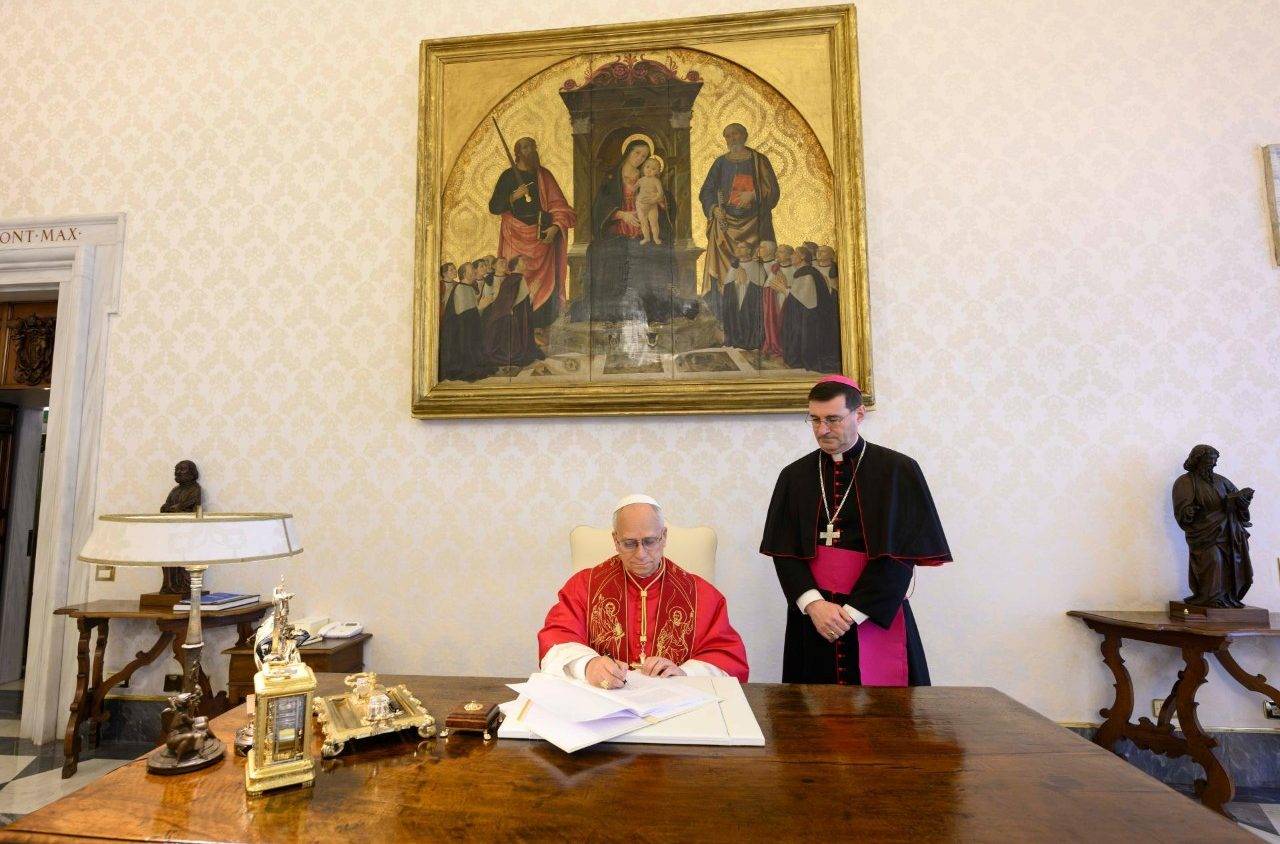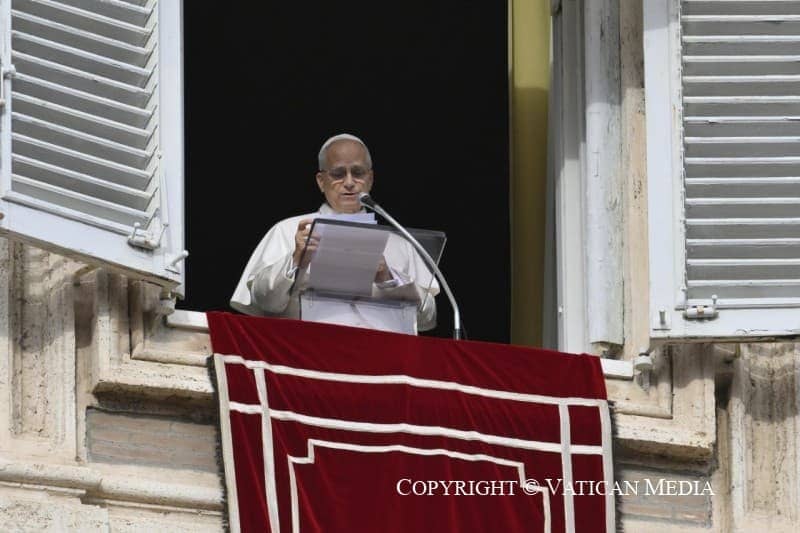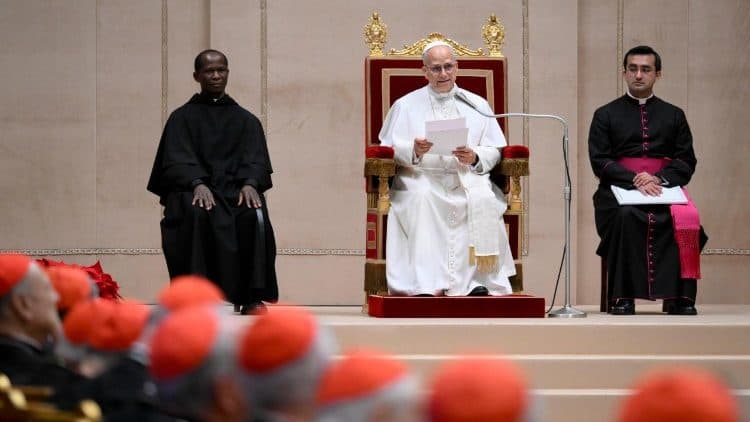
ROME – Pope Leo XIV Monday offered what might well be an X-ray into his consistory of cardinals next month, telling members of the Roman Curia that their job must be to reach out to local realities while promoting communion in a divided world.
Speaking during his first annual address to the Roman Curia Dec. 22, the pope noted that at times in the church’s central governing bureaucracy, “beneath an apparent calm, forces of division may be at play.”
“We can fall into the temptation of swinging between two opposite extremes: Uniformity that fails to value differences, or the exacerbation of differences and viewpoints instead of seeking communion,” he said.
As a result, interpersonal relationships, office dynamics, or even in addressing issues such as faith, liturgy, morality, and more, “there is a risk of falling into rigidity or ideology, with their consequent conflicts.”
“Yet we are the Church of Christ, his members, his body. We are brothers and sisters in him. And in Christ, though many and diverse, we are one: In Illo uno unum,” he said, referring to his own papal motto.
Pope Leo spoke during his traditional Christmas greeting with members of the Roman Curia – an event his predecessor Pope Francis often used as a time to critique the curia for errors and resistance, and to issue vocal calls for a change in mentality.
Francis in his first speech to the Roman Curia in 2013 famously called it an outdated, inward-looking institution afflicted with 15 different “illnesses” that he said needed to be cured if their work was to be affective.
While still flagging problematic trends inside his own system, Leo on Monday offered a softer approach, encouraging friendship and fraternity in order to accomplish the church’s mission of sharing the Gospel with the world.
Pope Leo focused his speech almost entirely on Pope Francis’s 2013 apostolic exhortation Evangelii Gaudium, “the Joy of the Gospel,” which will be one of four major talking points during his Jan. 7-8 extraordinary consistory of cardinals.
RELATED: Pope Leo’s first consistory to be both a landmark and a challenge
Leo acknowledged Francis’s death earlier this year, saying his “prophetic voice, pastoral style and rich magisterium have marked the Church’s journey in recent years, encouraging us above all to place God’s mercy at the center, to give renewed impetus to evangelization, and to be a joyful Church, welcoming to all and attentive to the poorest.”
Leo then dove into a reflection on what Evangelii Gaudium had to say about the church’s mission in the modern world and its role in rebuilding a sense of communion.
Speaking as a missionary himself, Leo said the church’s nature “is outward-looking, turned toward the world, missionary.”
Evangelii Gaudium offers a fresh impetus to the church to reconnect with its missionary dynamic, he said, saying Jesus’s command to his disciples to “go and make disciples of all nations” is still relevant today.
Jesus’s command, he said, “echoes in the changing scenarios and ever new challenges to the Church’s mission of evangelization, and all of us are called to take part in this new missionary ‘going forth.’”
“This missionary character flows from the fact that God himself first set out toward us and, in Christ, came in search of us,” he said, saying Christmas is a reminder that Jesus’s own mission consists of coming into the world “to meet us.”
In this sense, Jesus’s mission continues through the church, and “becomes a criterion for discernment in our lives, in our journey of faith, in ecclesial practices, and also in the service we carry out in the Roman Curia.”
“Structures must not weigh down or slow the progress of the Gospel or hinder the dynamism of evangelization; instead, we must make them more mission-oriented,” the pope said.
Leo said the curia, like the rest of the baptized, is called to co-responsibility and cooperation in Jesus’s own mission, and thus “must be animated by this spirit and foster pastoral solicitude in service to the particular Churches and their pastors.”
“We need an ever more missionary Roman Curia, in which institutions, offices and tasks are conceived in light of today’s major ecclesial, pastoral and social challenges, and not merely to ensure ordinary administration,” he said.
Pope Leo said Christmas, in addition to an opportunity to reflect on the church’s mission, is also a time to reflect on its purpose, which is to foster communion.
“Christmas reminds us that Jesus came to reveal the true face of God as Father, so that we might all become his children and therefore brothers and sisters to one another,” he said.
God’s love for humanity, expressed in his “liberating actions and preaching,” enables believers to be “a sign of a new humanity – no longer founded on selfishness and individualism, but on mutual love and solidarity,” he said.
Leo said this has both ad intra and ad extra elements.
Communion, he said, is an urgent ad intra priority “because communion in the Church always remains a challenge that calls us to conversion.”
The curia has a special call to be builders of Christ’s communion, the pope said, saying this communion must take shape “in a synodal Church where all cooperate in the same mission, each according to his or her charism and role.”
This communion, he said, is not the result of words and documents, but rather gestures and attitudes that play out in daily life, including the work environment.
He quoted Saint Augustine, who said that, “In all human affairs, nothing is truly cherished without a friend.” However, he noted that Agustine almost bitterly added, “But how seldom in this life is such a person found whose spirit and conduct may be trusted with full confidence?”
Leo said this bitterness can also affect the Christian community, and curial life, “when, after many years of service in the Curia, we observe with disappointment that certain dynamics – linked to the exercise of power, the desire to prevail, or the pursuit of personal interests – are slow to change.”
Some might ask whether it is truly possible to be friends or to find genuine friendship with other members of the Roman Curia,” he said, pointing to a dynamic that countless curial workers and officials have lamented over many decades.
“Amid daily toil, it is a grace to find trustworthy friends, where masks fall away, no one is used or sidelined, genuine support is offered, and each person’s worth and competence are respected, preventing resentment and dissatisfaction,” he said.
These relationships require a personal conversion in order to foster a spirit of true and loving fraternity, he said.
Pope Leo said this sense of communion must also be translated into the ad extra, or external, dynamic in a world marred by division, conflict, and violence, “where we also witness a growth in aggression and anger, often exploited by both the digital sphere and politics.”
Against this backdrop, Christmas, he said, “brings the gift of peace and invites us to become its prophetic sign in a human and cultural context that is too fragmented.”
The curia, which Francis sought to internationalize, must plant seeds of friendship and fraternity in itself in order to do the same among different peoples, religions and cultures, Leo said.
Being true to the church’s mission and obtaining true communion are possible if Christ is put at the center, Leo said, saying the jubilee year is a reminder “that he alone is the hope that does not disappoint.”
He noted that the jubilee coincided with the 1700th anniversary of the Council of Nicaea and the 60th anniversary of the close of the Second Vatican Council.
Together, these anniversaries bring the church back to the roots of the faith while also propelling it to engage with the modern world, “remaining attentive to the joys, hopes, griefs and anxieties of the people of our time.”
“Let us remember this also in our curial service: The work of each is important for the whole, and the witness of a Christian life, expressed in communion, is the first and greatest service we can offer,” he said.
Leo closed his speech asking that God would grant the curia “his own humility, his compassion and his love, so that we may become his disciples and witnesses each day.”
Follow Elise Ann Allen on X: @eliseannallen