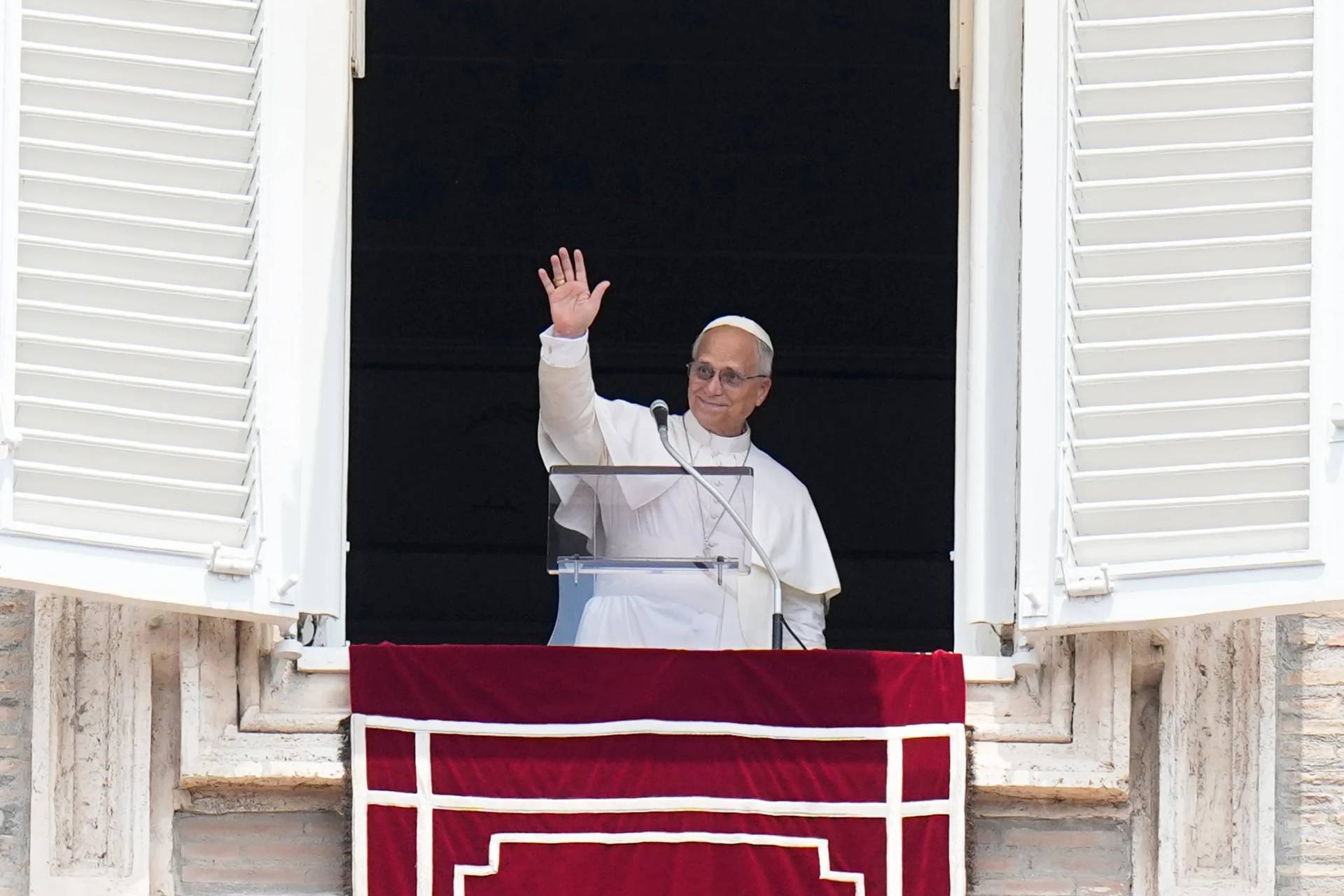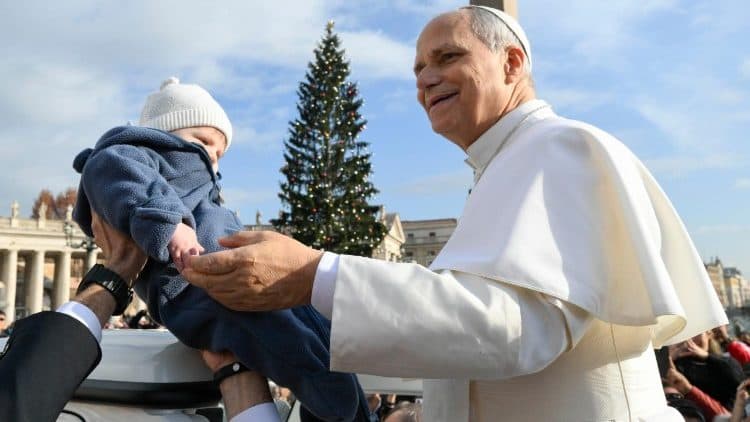
ROME – Pope Leo Wednesday condemned an attitude of activism focused solely on profit which he said puts human lives and the environment at risk, ultimately leaving those perpetuating the cycle unhappy.
Speaking to attendees of his Dec. 17 general audience, the pope said the most important aspect of a person is not the list of their many activities, but their heart.
“The heart is the symbol of all our humanity, the sum of our thoughts, feelings and desires, the invisible center of ourselves,” he said, quoting Jesus in the Gospel of Matthew when he says, “For where your treasure is, there will your heart be also.”
“It is therefore in the heart that true treasure is kept, not in earthly safes, not in large financial investments, which today more than ever before are out of control and unjustly concentrated at the bloody price of millions of human lives and the devastation of God’s creation,” he said.
Leo stressed the importance of reflecting on this point, because amid the frenzy of life’s rapid pace and endless activities, “there is an increasing risk of dispersion, sometimes of despair, of meaninglessness, even in apparently successful people.”
Pope Leo, who made the remarks to pilgrims gathered in St. Peter’s Square for his weekly public audience, has criticized global financial inequalities before, such as bloated pay packages for tech elites and a widening income gap between CEOs and their employees.
In his only exclusive sit-down interview as pope to date, given as part of the Spanish-language biography of him, León XIV: ciudadano del mundo, misionero del siglo XXI, Leo spoke about the crisis of polarization in society, and its relation to a devaluing of human life.
“The value of human life, of the family, and the value of society. If we lose the sense of those values, what matters anymore?” he said in the interview, given to Crux’s Elise Ann Allen.
To this end, the pope pointed to “the continuously wider gap between the income levels of the working class and the money that the wealthiest receive,” noting that “CEOs that 60 years ago might have been making four to six times more than what the workers are receiving, the last figure I saw, it’s 600 times more than what average workers are receiving.”
Leo said in the conversation, held in July, that just days before he’d read that Elon Musk was on track to be the first trillionaire in the world.
“What does that mean and what’s that about? If that is the only thing that has value anymore, then we’re in big trouble,” he said.
Hearing this sort of condemnation and concern is no surprise coming from Leo, who is deeply committed to issues of social justice, and who said that he chose his papal name in honor of his predecessor, Leo XIII, who reigned during the Industrial Revolution, and thinking of workers whose livelihoods will increasingly be impacted by the “revolution” of artificial intelligence that the world is undergoing.
Along those lines, the pope in Wednesday’s audience noted that the modern world is characterized by “constant movement” and an increasingly accelerating speed “in order to achieve optimal results in a wide variety of fields.”
Reflecting on Jesus’s resurrection from the dead as part of his ongoing jubilee cycle of catechesis, he said that once humanity shares in Jesus’s victory over death, there will be rest.
“We will not be inactive, but we will enter into God’s repose, which is peace and joy,” he said, saying humanity can get a taste of this now by slowing down and focusing on what matters.
Human beings are increasingly absorbed by a slew of activities and responsibilities that ultimately fail to satisfy, he said, saying Jesus also spent his life in action, giving of himself until the end.
Yet Leo cautioned that “too much doing, instead of giving us fulfilment, becomes a vortex that overwhelms us, takes away our serenity, and prevents us from living to the fullest what is truly important in our lives.”
“We then feel tired and dissatisfied: time seems to be wasted on a thousand practical things that do not, however, resolve the ultimate meaning of our existence,” he said, encouraging humanity to pause and focus on the movements of the heart.
This is important, he said, because “we are not machines, we have a heart; indeed, we can say that we are a heart.”
Referring to Saint Agustine’s famed observation about God that, “our hearts are restless until they rest in you,” Pope Leo said this restlessness is a sign “that our heart does not move by chance, in a disordered way, without a purpose or a destination.”
Rather, the heart, he said, “is oriented towards its ultimate destination, the return home.”
“The authentic approach of the heart does not consist in possessing the goods of this world, but in achieving what can fill it completely; namely, the love of God, or rather, God who is love,” the pope said, saying this love by nature must be shared with others.
God’s love on earth “can only be found by loving the neighbor we meet along the way: brothers and sisters in flesh and blood, whose presence stirs and questions our heart, calling it to open up and give itself,” he said.
Leo said that focusing on others often requires “us to slow down, to look them in the eye, sometimes to change our plans, perhaps even to change direction.”
Being attentive to other and their needs opens the human heart further to love and fills it with a joy “that never disappoints,” he said.
“No one can live without a meaning that goes beyond the contingent, beyond what passes away. The human heart cannot live without hope, without knowing that it is made for fullness, not for want,” he said.
Pope Leo closed his audience assuring pilgrims that, “The restless heart will not be disappointed, if it enters into the dynamism of the love for which it was created…in Christ it will continue to triumph in every death of daily life. This is Christian hope.”
Follow Elise Ann Allen on X: @eliseannallen