BEIRUT – On his second day in Lebanon, Pope Leo hailed the country as an example of tolerance and urged Christian and interfaith leaders to continue working to maintain a peaceful coexistence in a region where religions tensions are often acute.
Speaking to ecumenical and interfaith leaders during a Dec. 12 speech in Martyrs’ Square in Beirut, which sits next to a mosque, the pope told Lebanese faith leaders that, “In an ever more interconnected world, you are called to be builders of peace.”
They are called, he said, “to confront intolerance, overcome violence, and banish exclusion, illuminating the path toward justice and concord for all, through the witness of your faith.”
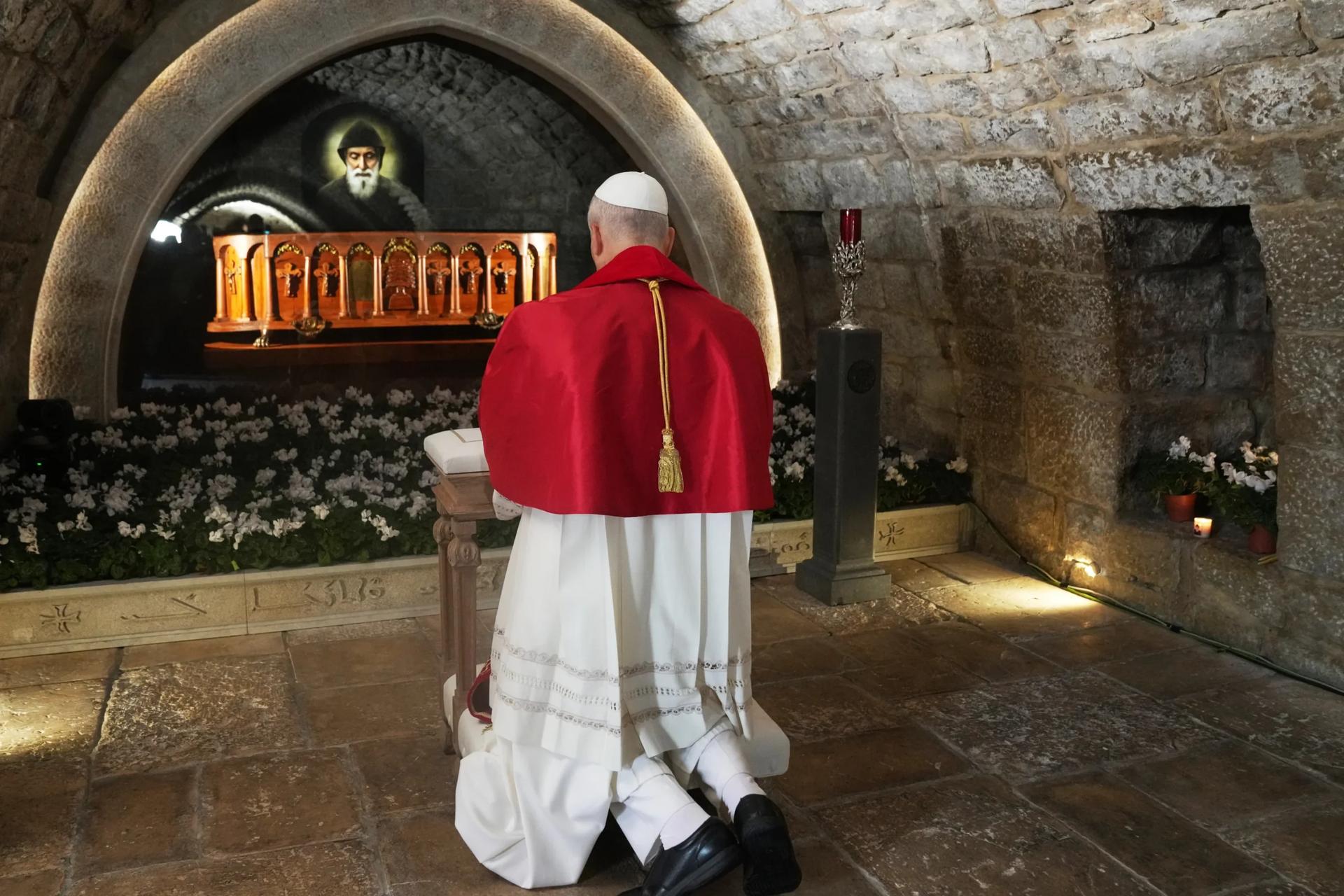
Leo met with the Christian and interfaith leaders after paying a visit that morning to the tomb of Saint Charbel Maklūf, a beloved and highly revered figure in Lebanese Christianity.
Afterward he met with the bishops, clergy and religious serving in Lebanon, urging them to work for peace and promote works of solidarity in a diverse nation and region, before holding a private lunch with the patriarchs of various Christian churches in the country.
Pope Leo after arriving to his ecumenical and interfaith meeting was greeted by Syriac Catholic Patriarch Youssef III Younan of Antioch, who greeted the pope as not only the head of the Catholic Church, but “a brother to all of us in humanity.”
“We pray and hope, beyond all hope, that this visit will help establish the peace and stability to which our countries of the Near East aspire above all, especially Lebanon,” he said.
Younan noted that the papal visit to Lebanon coincided with the 1700th anniversary of the Council of Nicaea – which the pontiff observed in an ecumenical prayer in moder-day Iznik during a visit to Turkey prior to his arrival in Beirut – as well as the 60th anniversary of the Second Vatican Council declaration Nostra Aetate, encouraging interfaith and ecumenical dialogue.
“Our peoples above all, yearn for political stability, constructive peace, and genuine human fraternity among all citizens,” he said
He voiced hope that the papal visit would encourage Lebanese religious leaders “to strengthen our unwavering commitment to living together in a spirit of sincere interreligious dialogue, telling the truth with charity and mutual respect, while remaining faithful to our roots in our homelands.”
“We commit ourselves to walking together, always inspired by the hope that never disappoints, to become builders of true peace in Lebanon and in all the countries of the Middle East,” he said.
Pope Leo in his own remarks quoted Pope Benedict XVI’s post-synodal apostolic exhortation Ecclesia in Medio Oriente, signed by him in Beirut during his visit in 2012.
In it, Benedict said that “the Church’s universal mission calls her to dialogue with followers of other religions.”
“In the Middle East, this dialogue draws on the deep spiritual and historical connections between Christians, Jews, and Muslims. It is a dialogue guided not by political or social interests, but by profound theological truths rooted in faith,” he said.
Leo prayed that every prayer, hymn and bell that tolls in Lebanon would give glory to God and would at the same time represent “a heartfelt prayer for the divine gift of peace.”
Given the struggles the Middle East has had in maintaining peace, it has at times been seen “with a sense of trepidation and disheartenment, in the face of such complex and longstanding conflicts.”
“Yet, in the midst of these struggles, a sense of hopefulness and encouragement can be found when we focus on what unites us: our common humanity, and our belief in a God of love and mercy,” he said.
While peaceful coexistence can seem like a distant dream, the Lebanese people with their different religious confessions, serve as “a powerful reminder that fear, distrust and prejudice do not have the final word, and that unity, reconciliation, and peace are possible,” the pope said.
Leo pointed to the 60th anniversary of Nostra Aetate, saying it opened “a new horizon” of encounter and respect between Catholics and those of other religions.
“True dialogue and collaboration is rooted in love – the only foundation for peace, justice, and reconciliation,” he said, saying this dialogue must involve “all people of goodwill, reject prejudice, discrimination and persecution, and affirm the equal dignity of every human being.”
Pope Leo praised Lebanon’s deep biblical roots, saying it remains a place of humility, trust and perseverance which can “overcome all barriers and meet God’s boundless love that embraces every human heart.”
He pointed to the image of an olive tree, found commonly in Lebanon and much of the Middle East, noting that it is revered by Christianity, Judaism, and Islam as a symbol of reconciliation and peace.
“Its long life and remarkable ability to flourish even in the harshest environments symbolize endurance and hope, reflecting the steadfast commitment required to nurture peaceful coexistence,” he said.
Following the celebration, Leo joined the other religious leaders present in planting an olive tree as a sign of their common commitment to peace.
“From this tree flows oil that heals – a balm for physical and spiritual wounds – manifesting the boundless compassion of God for all who suffer,” he said.
The pope closed his speech praying that Our Lady of Lebanon would “guide each of you, so that in your homeland, across the Middle East, and throughout the world, the gift of reconciliation and peaceful coexistence may flow forth ‘like the streams flowing from Lebanon’, bringing hope and unity to all.”
Follow Elise Ann Allen on X: @eliseannallen