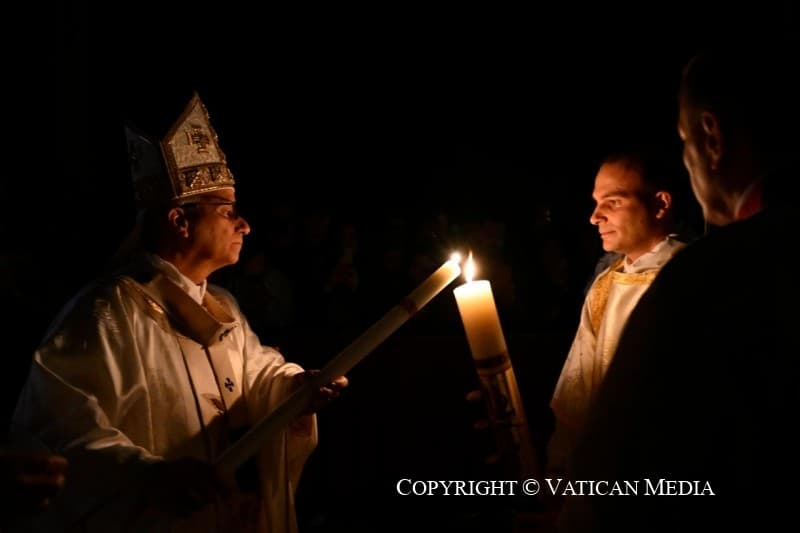
ROME – Pope Leo XIV officially inaugurated the Easter season Saturday, celebrating the Easter vigil Mass in St. Peter’s Basilica and reflecting on Jesus’s resurrection from the dead as an act of love that can overcome and transform the evils of humanity, including war.
Reflecting on the Gospel reading, in which Mary Magdalene and another Mary come to Jesus’s tomb only to find it empty, the pope in his April 4 homily said “even today there are tombs to be opened.”
“Often the stones sealing them are so heavy and so closely guarded that they seem to be immovable,” he said.
Some of these modern-day stones are internal, and include “mistrust, fear, selfishness and resentment,” he said, whereas others are external, and “sever the bonds between us through war, injustice and the isolation of peoples and nations.”
“Let us not allow ourselves to be paralyzed by them,” Leo said, noting how many holy men and women over centuries, with God’s help, have rolled these metaphorical stones away, even “at the cost of their lives.”
This is not an unattainable aspiration for modern-day Christians, he said, urging the faithful to be inspired by the example of the saints that came before them, and to “make their commitment our own, so that the Easter gifts of harmony and peace may grow and flourish everywhere and always throughout the world.”
During the vigil Mass, which began at 9p.m. in Rome, Leo also brought 10 people into the Catholic Church, conferring the sacraments of baptism and confirmation.
He will celebrate Mass Easter morning before delivering the traditional Urbi et Orbi blessing, to the city and to the world, which is usually only given at Christmas and Easter, and which traditionally carries a call for peace in conflict zones around the world.
So far, the pope’s Holy Week liturgies have been filled with calls for peace and clear condemnations of those who wage war. During Mass on Palm Sunday, he criticized those who use faith to justify war, saying God, “rejects them” and that their hands “are full of blood.”
Similarly, during Holy Thursday’s Chrism Mass he decried abuses of power and focused on the nature of the Christian mission in the world, saying it is counter to the “imperialist occupation of the world,” without mentioning any specific group.
His Good Friday Via Crucis meditations, written by a Franciscan friar, cautioned against the misuse of power to wage war and destruction, and said those in positions of responsibility will have to answer for their actions before God.
They also expressed solidarity and compassion with various marginalized and suffering groups, including migrants, victims of war and human trafficking, prisoners, including political prisoners, and children who have been exploited or deported.
In his homily during Saturday’s vigil Mass, Leo quoted the opening Exultet of the liturgy, saying, “The sanctifying power of this night dispels wickedness, washes faults away, restores innocence to the fallen… drives out hatred, fosters concord and brings down the mighty.”
Pointing to the candles lit at the beginning of the Mass, he said it represents the light of Christ, which “unites us in the Church as lights for the world.”
Christ’s victory over suffering and death through his own sacrifice is the greatest of the Church’s celebrations, he said, adding, “Is there a greater act of charity? A more complete gift?”
“The risen One is the same creator of the universe who, just as he brought us into existence out of nothing at the dawn of history, also gave his life for us on the Cross to show us his boundless love,” he said.
Leo then recalled the biblical readings and psalms proclaimed during the Mass, saying they are a reminder of God’s great love and mercy, even when humanity is at its worst.
“Even when, through sin, humanity failed to live up to that plan, the Lord did not abandon us, but revealed his merciful face to us in an even more surprising way – through forgiveness,” he said.
The commemoration of Jesus’s rising at Easter, throughout the vigil, he said, “has its roots even in the place where humanity’s first failure took place, and extends across the centuries as a path of reconciliation and grace.”
From Abraham to Moses and beyond, he said, “we have seen how God responds to the hardness of sin – which divides and kills – with the power of love, which unites and restores life.”
Turning to the Gospel account of Jesus’s resurrection, Leo noted that the women who went to Jesus’s tomb overcame fear and grief to do so, expecting to find it sealed and guarded still.
“This is what sin is: a heavy barrier that closes us off and separates us from God, seeking to kill his words of hope within us,” he said. The women, however, in going to the tomb, “thanks to their faith and love, became the first witnesses of the Resurrection.”
“Man can kill the body, but the life of the God of love is eternal life, which transcends death and which no tomb can imprison,” he said.
Pope Leo said this is the same message and the encounter that Christ is offering to the modern world, inviting Christians to bear witness to his resurrection “by ‘singing’ with our lives the ‘Alleluia’ that we proclaim with our lips.”
“Just as the women rushed to tell the disciples,” Leo said, “we too should desire to set out tonight from this Basilica to bring to all the good news that Jesus has risen and that having risen with him, through his power, we too can give life to a new world of peace and unity.”
Follow Elise Ann Allen on X: @eliseannallen