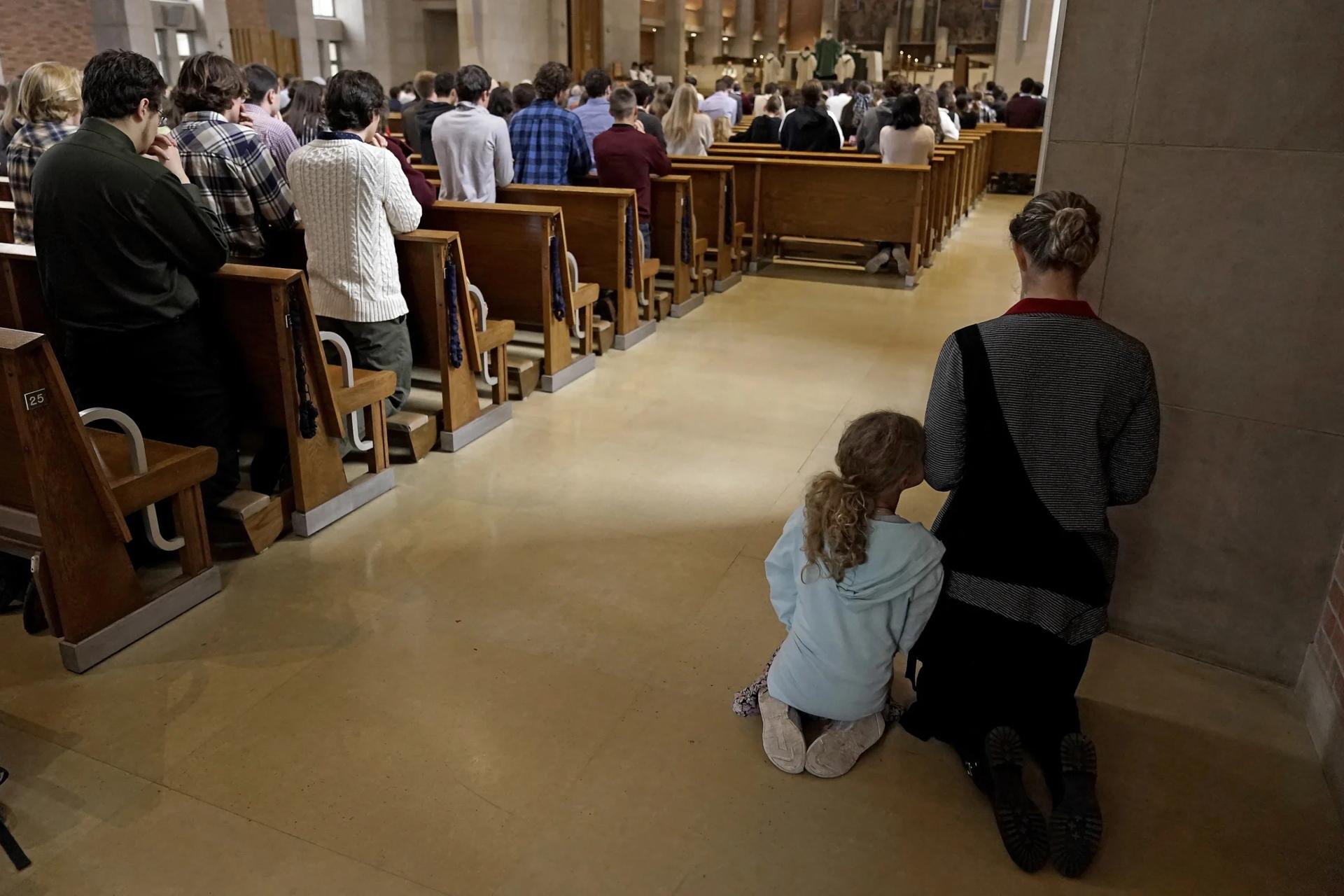
In the weeks leading up to Easter, dioceses and media outlets latched onto the high numbers of people set to become fully initiated into the faith in certain places to declare a sort of “Catholic revival,” which, according to one expert, isn’t exactly happening.
“For example, I’ve heard how the Archdiocese of Newark has doubled their numbers in the last couple of years, but if you actually look at the numbers they’re adding an extra 500 converts this year versus last year to a 1.3 million person diocese — that’s a drop in the bucket in the grand scheme of things,” Ryan Burge, professor of practice at the Washington University in St. Louis John C. Danforth Center on Religion and Politics, told Crux Now.
Those 500 extra people officially joining the faith in the Archdiocese of Newark this year compared to last (about 1,700 vs. about 1,200) equates to a 30 percent increase. Other dioceses that saw tremendous growth year over year include the Diocese of Norwich, Connecticut (119 percent); the Diocese of Pittsburgh (108 percent), the Diocese of Gaylord, Michigan (100 percent), and the Archdiocese of Los Angeles (139 percent).
Those figures come from the prayer app Hallow, which compiled data on the number of people becoming fully initiated into the faith this Easter from more than 140 dioceses. Alongside those areas of growth are also areas of decline, minimal growth, or stagnation, including the Diocese of Fargo, North Dakota (-29 percent), the Diocese of Reno, Nevada (-21 percent); the Diocese of Springfield, Massachusetts (-33 percent), the Archdiocese of Kansas City in Kansas (5 percent), and the Diocese of Lexington (-2 percent), the data shows.
In all, Hallow found a 38 percent increase in people officially joining the faith in 2026 compared to 2025. It’s unclear exactly how many people that is, but it’s unlikely to meet the figures Burge said are needed year over year for a true revival of Catholicism to take place.
The United States Conference of Catholic Bishops declined a Crux Now request for comment on the national figures and trends of Catholicism nationwide, noting they don’t collect the data.
“We need to be very clear about how big the Catholic Church is — the number from 2020 was 62 million people. So, to see the Catholic Church actually grow in a substantial way you need to be seeing half a million to a million converts each year,” Burge said, noting also the demographic challenges that exist.
“In order for Catholicism to grow the inflows have to exceed the outflows,” he explained. “So you also have to consider that Catholics are old. Especially white Catholic dioceses in America are going to face a demographic crisis going forward because Baby Boomers are a huge chunk of American Catholicism, and they’re going by the tens of thousands a day in years to come.”
Burge is also the author of the “The American Religious Landscape,” and runs the “Graphs about Religion” Substack. He also noted the share of Millennials and Gen Z who are “nones” — people with no religion — as an impediment to any sort of substantial growth.
The share of Millennials who are non-religious is close to 40 percent, and the share of Gen Z who are non-religious is probably 40-42 percent,” he explained. “So, in order for the overall number to not rise from 30 percent you would need to see those two generations numbers drop to 30 percent, which would require 25 million new Millennials and Gen Z finding faith in the next 20 years. … That’s not happened in the last 150 years in American history.”
Burge acknowledged that after decades of decline the number of religious Americans has remained largely the same since 2020. Still, he assured that religion will decline in the future unless “something radically changes.” Asked about the stagnation over the last six years, he said the number of marginally religious people — Easter and Christmas Catholics, for example — has declined, leaving faiths with people who are actually religious — they go to church, read the Bible, and are faithful in their practices.
“The way I’d describe it is that American religion had a lot of loose topsoil on the top, easy to scoop away, and those scoops scooped away a lot of those marginally attached people and every scoop after that it’s harder and harder as it gets more complicated,” Burge explained. “Then you kind of get to the point where you hit bedrock, and I think we’ve sort of gotten close to bedrock of American religion right now, which is probably somewhere between 60 percent of Americans are Christian, 30 percent are non-religious, and the rest are from another faith group.”
Regardless of how the numbers shake out, he also predicted an even more divided future.
“The future is basically more divided than ever,” Burge said. “The nones are going to be more liberal, the religious people are going to be more conservative, and there are a lot of people who want to go to church, want to be a part of the community, who are going to feel exceedingly unwelcome because they’re not all the way in, they don’t believe everything … and they’re going to feel like the loudest voices in the room either believe what we believe or don’t show up.”