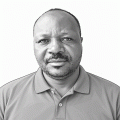
YAOUNDÉ, Cameroon – Bishop Matthew Hassan Kukah of Sokoto state in Nigeria has told Crux that claims of a Christian genocide in Nigeria have been escalated by the Trump administration.
“The genocide stuff has been escalated by the Trump administration,” Kukah said.
“This is what they used to muscle their way in, but I no longer want to be dragged into this. It is a distraction. My position is simple: By whatever name, stop the killings,” the bishop told Crux.
The Nigerian prelate has been under severe criticism over statements he made which many interpreted as a denial of what many have called genocide against Nigeria’s Christians.
Speaking at the Vatican on October 21 during the launch of Aid to the Church in Need’s Religious Freedom in the World Report 2025, which effectively spotlights Nigeria as one of the worst places to live in for a Christian, Kukah challenged the idea that Christians were being targeted for elimination.
He offered a broader diagnosis, attributing the suffering of Nigerians to widespread insecurity and government weakness.
“If we were dealing with outright persecution of Christians on grounds of identity, both myself and my small flock would not exist,” Kukah stated, citing his ability to travel freely without incident in his home diocese of Sokoto, a predominantly Muslim region in northwestern Nigeria.
“By whatever names we choose, the fact is that Nigerians are dying unacceptable deaths across the country. In many cases, they are targeted because of their beliefs but also because of their ethnicity. We are in the cusp of a weak state with a clear lack of capacity to arrest the descent into anarchy,” he said.
The bishop reiterated and expanded upon these views weeks later, speaking on Nov. 28, at the 46th Supreme Convention of the Knights of St. Mulumba in Kaduna. There, he directly disputed claims that genocide against Christians is taking place.
“People say there is genocide in Nigeria,” he said.
“My argument is that it is not accurate to claim there is genocide or martyrdom in Nigeria,” he added, noting that Muslims are also frequently killed by extremist groups.
The bishop further questioned the data used to support claims of genocide, casting doubt on widely circulated figures.
“They are saying that 1,200 churches are burnt in Nigeria every year, and I ask myself, in which Nigeria? Interestingly, nobody approached the Catholic Church to get accurate data,” he argued.
“We do not know where these figures came from. All those talking about persecution; has anyone ever called to ask, ‘Bishop Kukah, what is the situation?’ The data being circulated cleverly avoids the Catholic Church because they know Catholics do not indulge in hearsay,” the bishop added.
These remarks sparked a flow of criticism, with Emeka Umeabalasi, the Director of the NGO, International Society for Civil Liberties and the Rule of Law, Intersociety accusing the prelate of “speaking on behalf of the Federal government.”
Douglas Burton, Managing Editor of Truth Nigeria told Crux that Kukah’s “integrity as a truth teller is over. And we at TruthNigeria lament it, because for years, he spoke otherwise.”
“The evidence of targeted Christian violence is incontrovertible,” he said.
Statistics from the International Society for Civil Liberties and Rule of Law (Intersociety) reveal that since 2010, 185,000 people have been killed, including an estimated 125,000 Christians and 60,000 nonviolent Muslims.
The report further details the widespread destruction of religious infrastructure, with 19,100 churches burned to the ground and 1,100 entire Christian communities seized and occupied by jihadist forces, which the group alleges are backed or protected by elements of the government.
According to Intersociety’s board chairman, Emeka Umeagbalasi, the violence has triggered a massive humanitarian crisis, forcing an estimated 15 million people—mostly Christians from their homes.
The statistics also reveal that faith leaders have been specifically targeted, with 600 clerics reported abducted and dozens more killed or having vanished within the reporting period.
Kukah has expressed regret over the comments associated with him, insisting that he has never doubted that Christians are being persecuted in Nigeria, although genocide would be too strong a word to define what’s going on in the country.
In a statement sent to Crux, Kukah says he is “sincerely sorry” to be associated with “representations” stemming from “the pain of my brothers and sisters within the body of Christ.”
The bishop stated he was “baffled” by the claims and offered a sincere apology to those who were hurt.
“I am sincerely sorry to be associated with representations that understandably are a source of great pain and mental anguish to so many of my brothers and sisters within the body of Christ,” Kukah wrote. “So, for the record, I did not say that Christians are not persecuted in Nigeria! Nothing could be further from the truth.”
The bishop emphasized his long history of speaking out against the violence, insisting that by any name, “the bloodshed needs to end as soon as yesterday because our common humanity is at stake.” He called on the Nigerian government and its security agencies to fulfill their “urgent responsibility to bring the perpetrators to account.”
While apologizing for the “unnecessary distraction,” the bishop urged Nigerians not to retreat from the struggle for peace and justice. He called for a collective effort to “regain our humanity” and focus on the “ultimate prize, peace for our country, Justice for those injured, and reconciliation for our people.”
“This is a struggle that I have committed most of my pastoral and intellectual life to,” Kukah concluded, adding, “It is a struggle in which I pray that, by clinging to the old rugged cross, we can one day exchange it for a crown.”