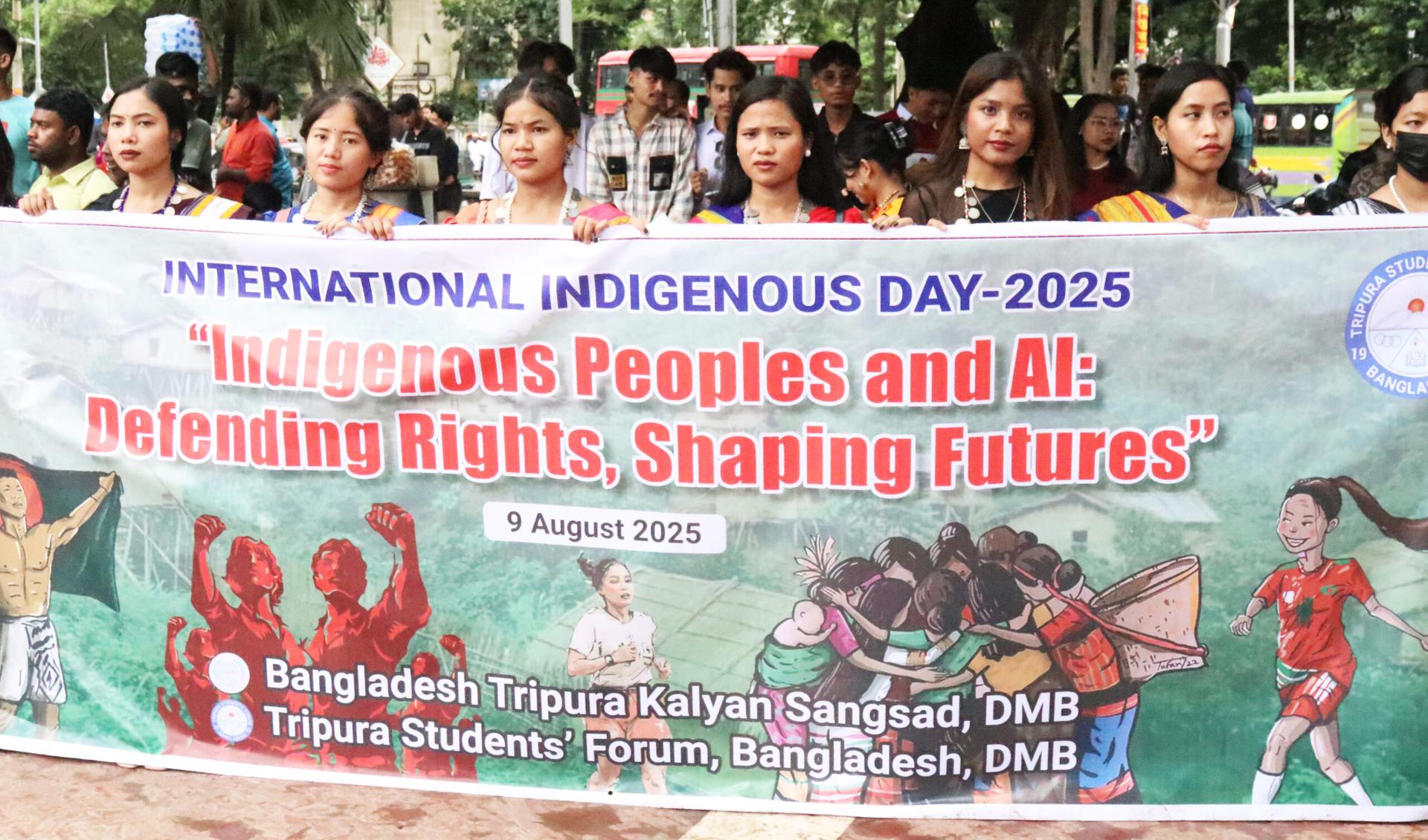
DHAKA – A report by Transparency International Bangladesh (TIB) has found that indigenous people in Bangladesh are not getting the expected number of opportunities in the government’s social safety net programs.
The average rate of eligible indigenous people applying and being selected for the country’s five main social safety net programs is only 19.7 percent—that is, only one in every five eligible indigenous people is enrolled.
The Bangladesh chapter of the German-based organization, which monitors corruption in development and political affiliations, released a research paper titled “Inclusion of indigenous Communities in Social Safety Net Programs: Challenges of Good Governance and Pathways for Improvement,” on December 2.
The study says that indigenous people make up 52.1 percent of the applicants for the Bangladesh government’s five programs for old-age allowance, but only 21.2 percent are selected; 33.3 percent applied for widow and husband abandoned allowance, 12 percent were selected; 57.5 percent applied for disability allowance/scholarship and 31.6 percent were selected; 30.5 percent applied for mother-child support allowance and 21.5 percent were selected.
“One of the conditions for establishing peace in any region is to reduce inequality and establish fairness. The information that has come out of the study shows that fairness has not been ensured there. As a result, instability and dissatisfaction are natural,” said Dr. Iftekharuzzaman, the executive director of TIB.
“Transparency, accountability, good governance, corruption and irregularities – all of them have emerged as a worrying picture. There are such problems in other communities in the country as well, which have taken an institutional form for a long time. This is even more important in the case of indigenous people, because they are even marginalized within the marginalized,” he added.
According to the 2022 census, there are 1,650,159 people from ethnic minorities in Bangladesh, of whom 824,751 are men and 825,408 are women.
However, activists protecting the human rights of ethnic minorities claim that this number should not be less than three million.
The total population of Bangladesh is 180 million and of this, the number of Christians is about 600,000, but half of them are indigenous people.
Sanjeeb Drong, secretary of the Bangladesh Indigenous Forum, said the indigenous people of Bangladesh are deprived of all kinds of government facilities, not just social security.
“Indigenous people are deprived of any opportunities, they are also subjected to various types of oppression. They are even deprived of their land rights.” Drong. a Garo indigenous and Catholic, told Crux.
He said the civil society of the country must come forward to solve this problem and the state must be more humane to indigenous people.
The Catholic Church of Bangladesh has led the way in the struggle for the rights of indigenous peoples at various times and continues to do so. The Catholic Church has stood by them directly and indirectly in the areas of land rights for indigenous peoples and justice for oppressed indigenous peoples.
Indigenous peoples are first and foremost human beings and it is our responsibility to stand by them as human beings, said Father Joseph Gomes.
Gomes is a member of the Justice and Peace Commission of the indigenous-dominated Sylhet diocese of Bangladesh and a member of the Oblate Fathers’ Justice, Peace, and Integrity of Creation (JPIC) movement.
He supported the new study.
“In our family, we pay special attention to those members who are a little weak or backward in education. Similarly, since the indigenous people of Bangladesh are backward in education, health and wealth, the government needs to pay special attention to them. But the reality is that those who are majority and more powerful are taking these government benefits,” he told Crux.
Referring to the indigenous people of his area, Gomes said they are deprived of government benefits, and “the powerful are also trying to take away the agricultural land they have.”
“Therefore, this situation will not improve without being humane towards the indigenous people,” he said.