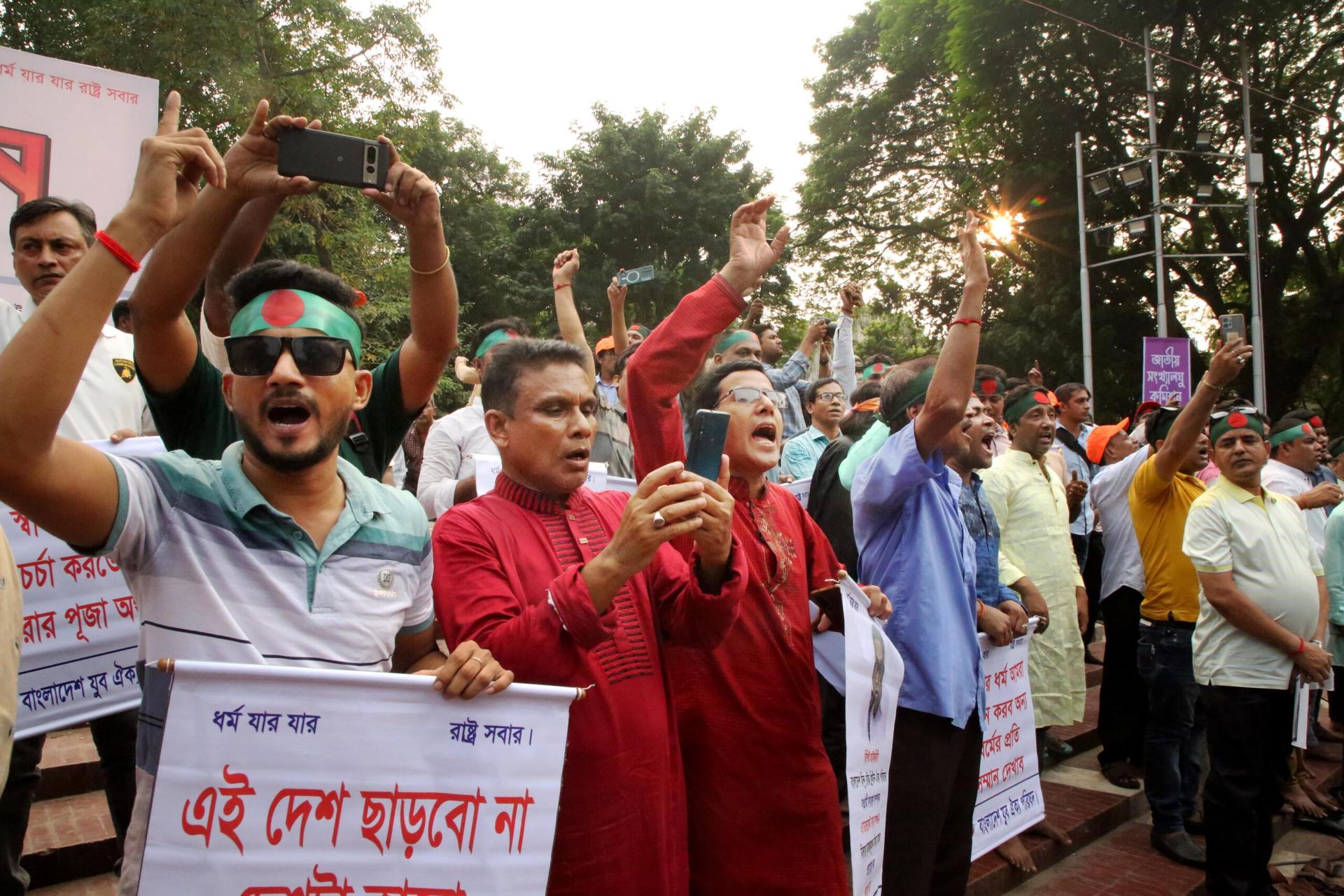
DHAKA – Christians and other minority communities are in fear over the upcoming national elections in Bangladesh, and they are even hesitant to vote in Muslim-majority south Asian nation.
On Jan. 29, leaders of the Bangladesh Hindu Buddhist Christian Unity Council, an umbrella organization of minority communities, announced this concern and security assurance through a press conference at the National Press Club in the capital, Dhaka.
On Feb. 12, the national elections in Bangladesh will be held, and the leaders expressed this concern by citing the statistics of attacks on minority communities before and after the last national elections, as well as the attacks on minorities after the fall of the Awami League government in 2024.
The written statement mentioned that the ongoing communal violence, like last year, continues. As far as the information collected till January 27, 2026, the day before yesterday, it is seen that a total of 42 incidents has taken place so far. Among these, 11 were murders, 1 rape, 9 attacks on temples and churches, 21 attacks and looting of houses and businesses, land grabbing and other incidents.
“There are still many challenges in holding an inclusive election with the spontaneous participation of all, regardless of race, religion, tribe and caste. Because hate speech by communal groups, hatred and violence against dissenters due to differences in religious beliefs are not only destroying communal harmony, such provocative statements are also inflicting religious attacks on religious and ethnic minorities and marginalized communities. As a result, a terrible fear and apprehension is being created among minority men and women, adolescents and children,” said Manindra Kumar Nath, the organization’s acting secretary, in a statement.
He said that in this year’s national parliament election, yes and no votes have been added in the name of referendum.
Where the basic principle of running the state has been declared excluding secularism. For which the government and the Election Commission are directly campaigning, which we think is sad and unfortunate and completely biased. We also think that the non-communal, secular, non-discriminatory constitution of Bangladesh, based on the hopes and aspirations of 75 million people and the dreams of three million martyrs during the Liberation War 1971, is facing challenges today. We believe that this will become an obstacle to the minority community getting equal rights as citizens of Bangladesh. In this situation, it is a big challenge for the minority community to go to the polling station safely and vote according to their own preferences.
“We have conveyed the concerns of the minority community and the government must take action to address these concerns, but unfortunately, the government has not taken any visible steps for the safety of the minorities yet,” Nirmol Rozario, a Catholic and president of the Hindu Buddhist Christian Unity Council, told Crux.
“I also express my doubts about whether the minorities will be able to go to the polling stations if the persecution of minorities continues like this,” he added.
According to the organization, from January to December 2025 the total number of communal violence cases is 522, including 61 murders, 28 cases of torture/rape/gang rape of women, 95 cases of attacks on places of worship.
It also spoke about the vandalism of idols, looting and arson, 21 cases of land grabbing, and 102 cases of attacks, vandalism, looting and arson on houses and businesses.
The organization said there were 38 cases of kidnapping-extortion-torture, 47 cases of attacks-threats to death-torture, 36 cases of torture and arrest on charges of alleged blasphemy, 66 cases of forcible occupation of houses, land and businesses, and 29 other crimes.
The office of interim government Chief Advisor Professor Muhammad Yunus, in a Facebook post on Jan. 19, claimed that based on the progress of investigations across the country, a total of 645 incidents has been uncovered in 2025, of which 71 incidents have a communal element. The remaining 574 incidents are claimed to be non-communal.
“From the post of the Chief Advisor on 71 communal incidents, it can be seen that no other incident except the incidents that took place in the courtyards of temples and places of worship is communal,” said Manindra Kumar Nath.
Nath criticized this change in the context of communal attacks, saying, “There is no justification for the idea that only attacks on temples and places of worship are communal attacks.”
Holy Cross Father Hubert Gomes, secretary of the Justice and Peace Commission of the Bangladesh Catholic Bishops’ Conference, still expressed uncertainty about what will happen during the election.
“The law-and-order situation in the country is not yet stable; in this situation everyone is just worried about the elections,” he said.
“The minority community is always at risk,” said Gomes.
Past elections have not given minorities a good experience. Often, both the winning and losing parties have blamed the minorities and attacked them. In that case, the government should provide maximum security, the priest said..
In Bangladesh, which has a population of 180 million, less than one percent are Christians and 8 percent are Hindus.