MANILA, Philippines – Six months after meeting President Rodrigo Duterte for the first time in late 2017, Archbishop Gabriele Giordano Caccia faced a defining challenge as papal nuncio to the Philippines.
The response from the 68-year-old Italian diplomat would ultimately illustrate the quiet diplomacy he now brings to the United States, where he is set to represent Pope Leo XIV — the first U.S.-born pope — before U.S. President Donald Trump.
In the Philippines, Caccia’s baptism of fire arrived on June 22, 2018, when the Filipino strongman publicly called God “stupid.”
Duterte’s remarks, delivered at a summit in his hometown of Davao City, alarmed the nation’s bishops and priests. By then, three Catholic priests had been killed in less than seven months: Church leaders feared that Duterte’s tirades could embolden further violence against the clergy.
Caccia, who began his Philippine assignment on Dec. 6, 2017, had already traveled 180 km north of Manila to bless the remains of two of the three slain clergymen. One was an activist priest shot while driving on Dec. 4, 2017, while another was killed while preparing for Mass on June 10, 2018.
Yet, as a Vatican diplomat since 1991, Caccia did not publicly condemn Duterte. Instead, he leaned into dialogue, inviting the president to the celebration of Pope’s Day at the Apostolic Nunciature just a week after the “stupid God” remark.
While Duterte skipped the event, he sent spokesperson Harry Roque for a private, hour-long, “no-holds-barred” meeting with Caccia.
By the next day, Roque announced an agreement: Church and state would “work together for the benefit of the people.”
A week later, as agreed by Roque and Caccia, Duterte held a 30-minute meeting with the president of the bishops’ conference, Archbishop Romulo Valles of Davao. Duterte, who had known Valles from his days as mayor of Davao, promised to stop criticizing the Church — at least for a moment.
A day later, however, Duterte was back at it, threatening to kill churchmen who used religion as a platform to criticize him.
Though Duterte’s truce was short-lived, Caccia remained true to his mandate from Pope Francis.
“The clear instruction from the Pope then was to support the bishops,” said an aide who worked closely with the nuncio, in an interview with Crux Now.
“While he did not publicly criticize President Duterte — because he was a diplomat — his doors were always open to bishops, priests, and religious and laypersons who were at the forefront of addressing the issues raised by the administration’s policies, assuring them of the Holy Father’s support and fatherly concern,” Caccia’s former aide said.
Caccia’s influence extended to the diplomatic community. As dean of the diplomatic corps, a traditional role of papal nuncios in this Catholic-majority country, he actively convened ambassadors who were uncertain how to navigate the Duterte administration. He promptly brought the ambassadors’ concerns to the Department of Foreign Affairs.
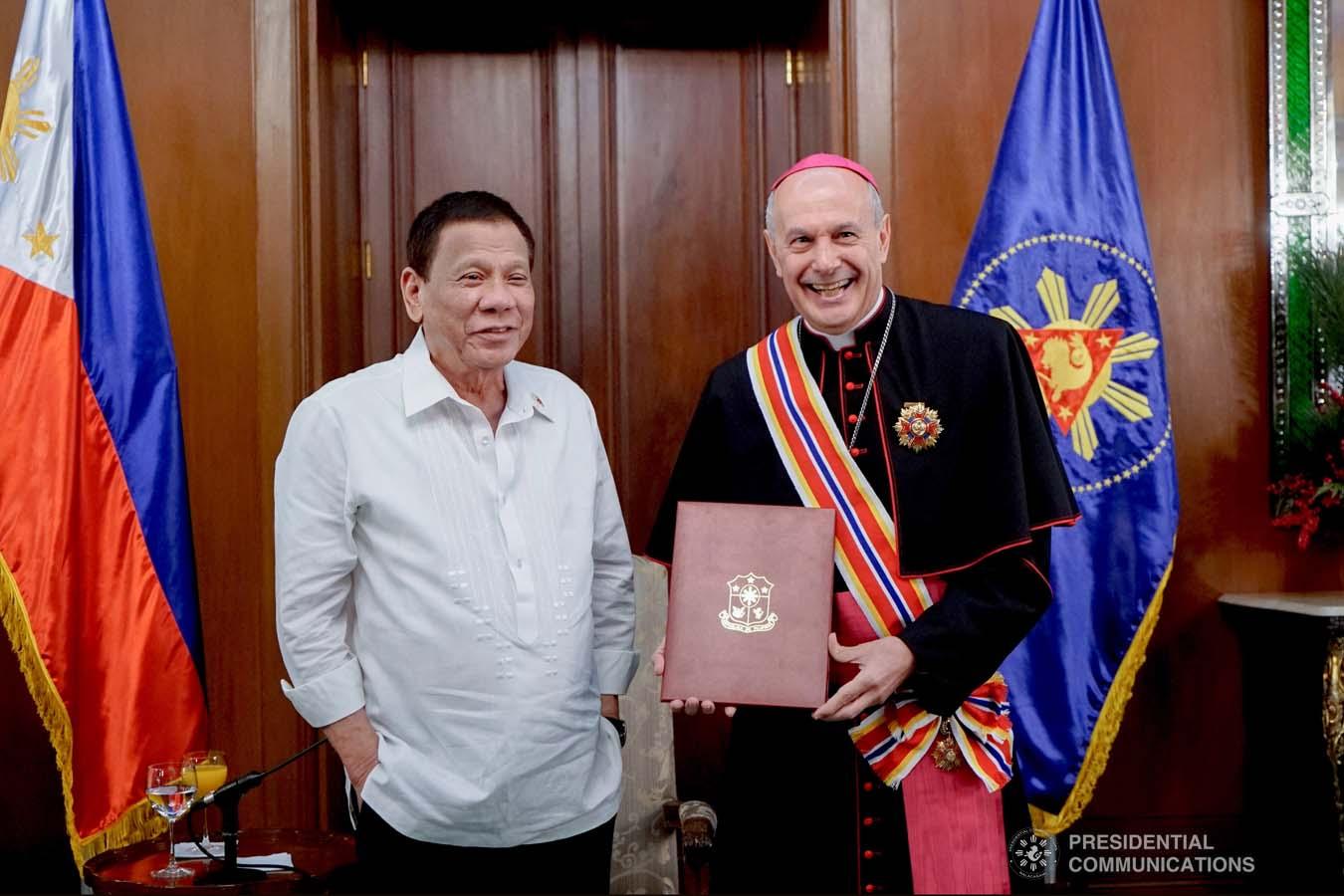
Caccia’s steady support and warm approach endeared him to Filipinos and earned him the Order of Sikatuna with the Rank of Datu, the highest recognition the Philippine government grants to ambassadors. It was Duterte himself who gave this award on Dec. 11, 2019, when Caccia was about to leave for his next assignment as envoy to the United Nations.
Yet, behind his diplomacy, Caccia was above all a pastor.
Divine Word Father Flavie Villanueva, a staunch critic of Duterte’s drug war, recalled meeting Caccia twice during the nuncio’s two years in Manila.
During their first meeting, Villanueva and a fellow drug war critic, Jesuit Father Albert Alejo, briefed Caccia about the country’s situation. Caccia promised to relay their briefing to Francis.
During their second meeting, Villanueva had already been receiving death threats from Duterte supporters. He and his provincial superior sought an audience with the nuncio, who shed the “intimidating aura” of high-ranking diplomats.
Villanueva cried in front of the nuncio, as the attacks against him felt “overwhelming.” But the nuncio offered help and ended their meeting with a “father’s embrace,” the 55-year-old priest told Crux Now.
“You could run here when you feel threatened and you have nowhere else to go,” Caccia told Villanueva. “You have a place here at the nunciature, where you can find refuge.”
Cardinal Pablo Virgilio David, who was then the vice president of the Catholic Bishops’ Conference of the Philippines (CBCP), confirmed Caccia’s support for Filipino bishops.
Caccia “tended to stay much longer” during the CBCP’s biannual plenary assemblies in Manila, according to the cardinal. He also reserved a consultation room in the plenary venue for bishops who needed his advice. “The other nuncios had not done that before,” David said.
In an interview with Crux Now, David added: “During our plenary assemblies, he made it a point to encourage us to stand our ground, to keep a moral high ground in the midst of what was perceived back then as the persecution of the Church.”
The Filipino cardinal therefore said he “was really very happy” that Leo named Caccia as nuncio to the US, where the Catholic Church is polarized “because of politics.” He also noted that one of the former nuncios to the US, the now-excommunicated archbishop Carlo Maria Viganò, openly opposed Pope Francis’s program of papacy.
David, who was elevated to the cardinalate by Francis in Dec. 2024, described Caccia as “a real Pope Francis guy.”
The nuncio is “not imperious,” is a “very humble presence,” and is “very deferential to the bishops,” David said, adding that he “was very synodal in that sense, very consultative.” Caccia also echoes the late pontiff’s call “for the shepherds to smell like their sheep” and to preach mercy and compassion, especially for the vulnerable.
Caccia, in fact, personally called bishops on their birthdays, and still sends birthday greetings to his former Manila staff via WhatsApp.
He also made parish visits unannounced. His office would even call parish priests near the nunciature to ask whether they could accommodate the nuncio for Christmas Eve Mass or the Easter Vigil. Caccia “preferred to celebrate these liturgies in ordinary parish communities rather than in his private chapel at the nunciature,” his former aide said.
Father Reginald Malicdem, former secretary of Cardinal Luis Antonio Tagle in Manila, said Caccia “is very simple, preaches simple but profound homilies, and was able to fill in many vacant dioceses during his term.” His former aide said that “more bishops were appointed during his two-year stint than during the six-year term of his predecessor.”
A veteran Church worker said Caccia “was really a pastor more than a dignitary.”
“I think this is a good time to have a nuncio in America like Archbishop Gabriele Caccia. The nuncios have a very, very important role to play, especially in the nomination of new bishops,” said David.
When asked what he wished Caccia would tell Trump, David said he presupposes that Caccia “would be consistent with the messages of the Pope,” who has called for a ceasefire in the US-Israel war on Iran.
“Most likely, he would keep drumming up the message of the Pope that nobody wins in a war,” the Filipino cardinal said.