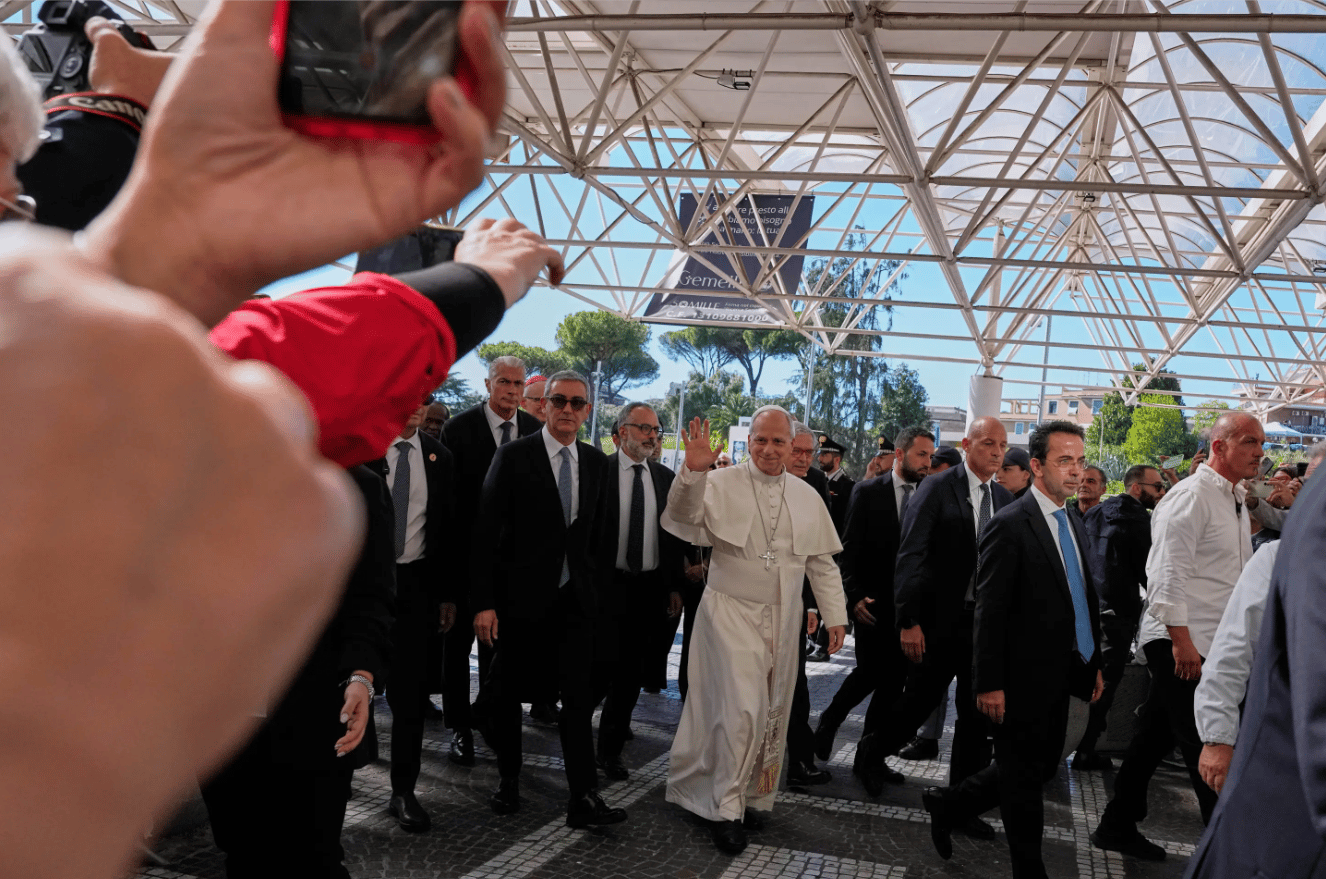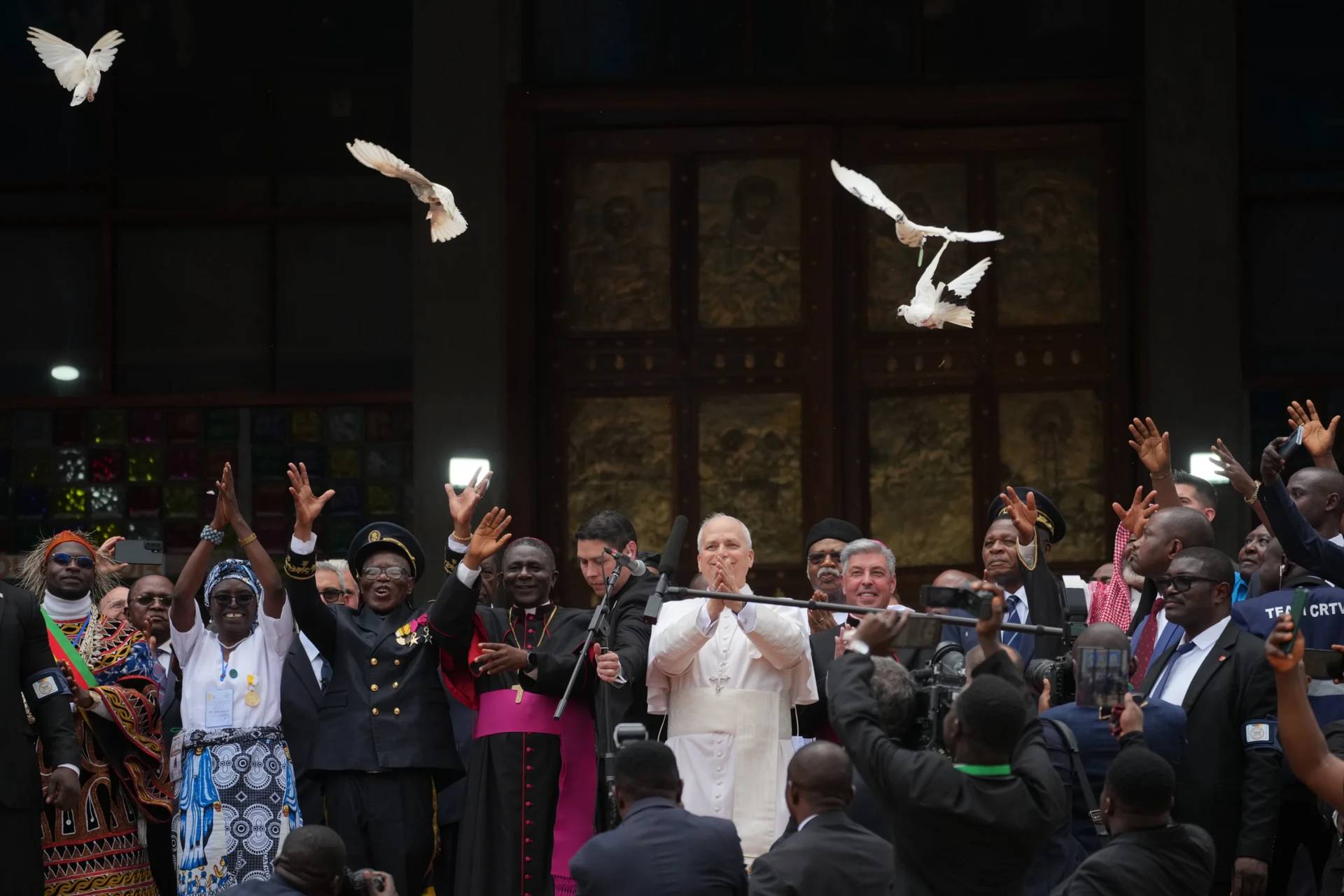
YAOUNDE – Pope Leo the XIV arrived in Cameroon on Wednesday with a stinging message against war and corruption, saying peacemaking efforts must be based on the Christian concept of love of neighbor, including in diplomacy.
In light of Cameroon’s ongoing armed conflict, the pope, in his April 15 speech to national authorities and the diplomatic corps in Cameroon, repeated his call “to reject the logic of violence and war, and to embrace a peace founded on love and justice.”
“A peace that is unarmed, that is, not based on fear, threats or weapons, and at the same time disarming, because it is capable of resolving conflicts, opening hearts and generating trust, empathy and hope,” he said.
Peace, the pope said, “cannot be reduced to a slogan: It must be embodied in a way of life that renounces all forms of violence, both personally and institutionally.”
This, he said, is an appeal he repeated and which he hopes “contributes to the efforts for an authentic peace, prioritizing it over any partisan interest.”
“Peace, in fact, cannot be decreed: it must be embraced and lived,” he said, saying the quest for peace must be a collective effort.
In this sense, Leo insisted that “It is everyone’s responsibility, beginning with civil authorities.”
“To govern means to love one’s own country as well as neighboring countries; the commandment ‘love your neighbor as yourself’ is equally applicable to international relations!” he said.
Against a hostile backdrop
Pope Leo spoke after arriving in the Cameroonian capital of Yaoundé earlier that afternoon, and amid a flurry of criticism from U.S. President Donald Trump and now Vice President JD Vance, who in recent remarks said the pope ought to “be careful” when talking about theology.
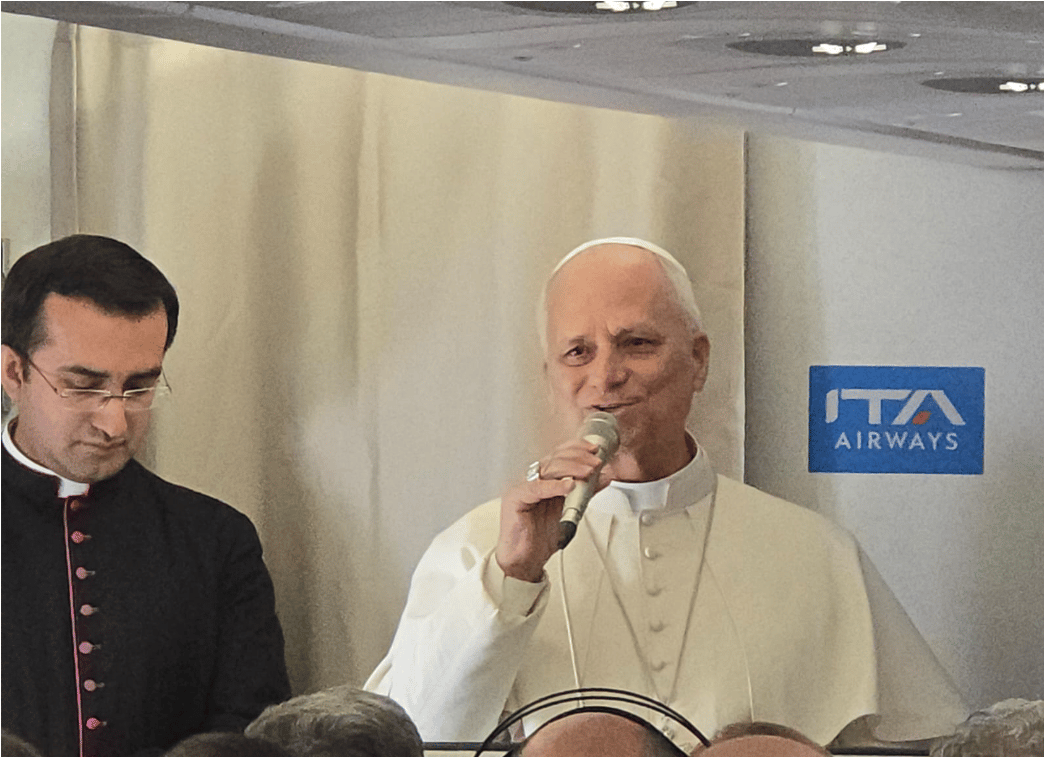
RELATED: En route to Africa, pope says, ‘I don’t fear Trump administration’
During a Turning Point USA event in Athens, Georgia, Vance challenged the pope’s critique of U.S. foreign policy, specifically its war with Iran, saying, “Was God on the side of the Americans who liberated France from the Nazis? Was God on the side of the Americans who liberated Holocaust camps and liberated those innocent people…who had survived the Holocaust?”
“I certainly think the answer is yes,” Vance said, saying that while he and the pontiff can disagree on matters of morality such as abortion immigration, “it’s very, very important for the pope to be careful when he talks about matters of theology.”
“If you’re going to opine on matters of theology, you’ve got to be careful. You’ve got to make sure it’s anchored in the truth, and that’s one of the things that I try to do,” he said.
The pope’s remarks on love of neighbor at the level of international relations also comes after last year’s tiff between Pope Francis and Vance over the ordo amoris, meaning the order in which love of neighbor ought to be applied.
Vance argued that the term, a theological principle developed by St. Thomas Aquinas and St. Augustine, ought to be applied first to those closest, in defense of the U.S.’s staunch anti-migrant policy.
Francis at the time responded with a letter to U.S. bishops saying the ordo amoris applies to everyone, without distinction – a stance that then-Cardinal Robert Prevost supported publicly on social media, saying God doesn’t ask Christians to “rank” their love of others.
Against violence and injustice in Cameroon
Pope Leo’s message so far during his April 13-23 visit to Africa has been one of peace and reconciliation.
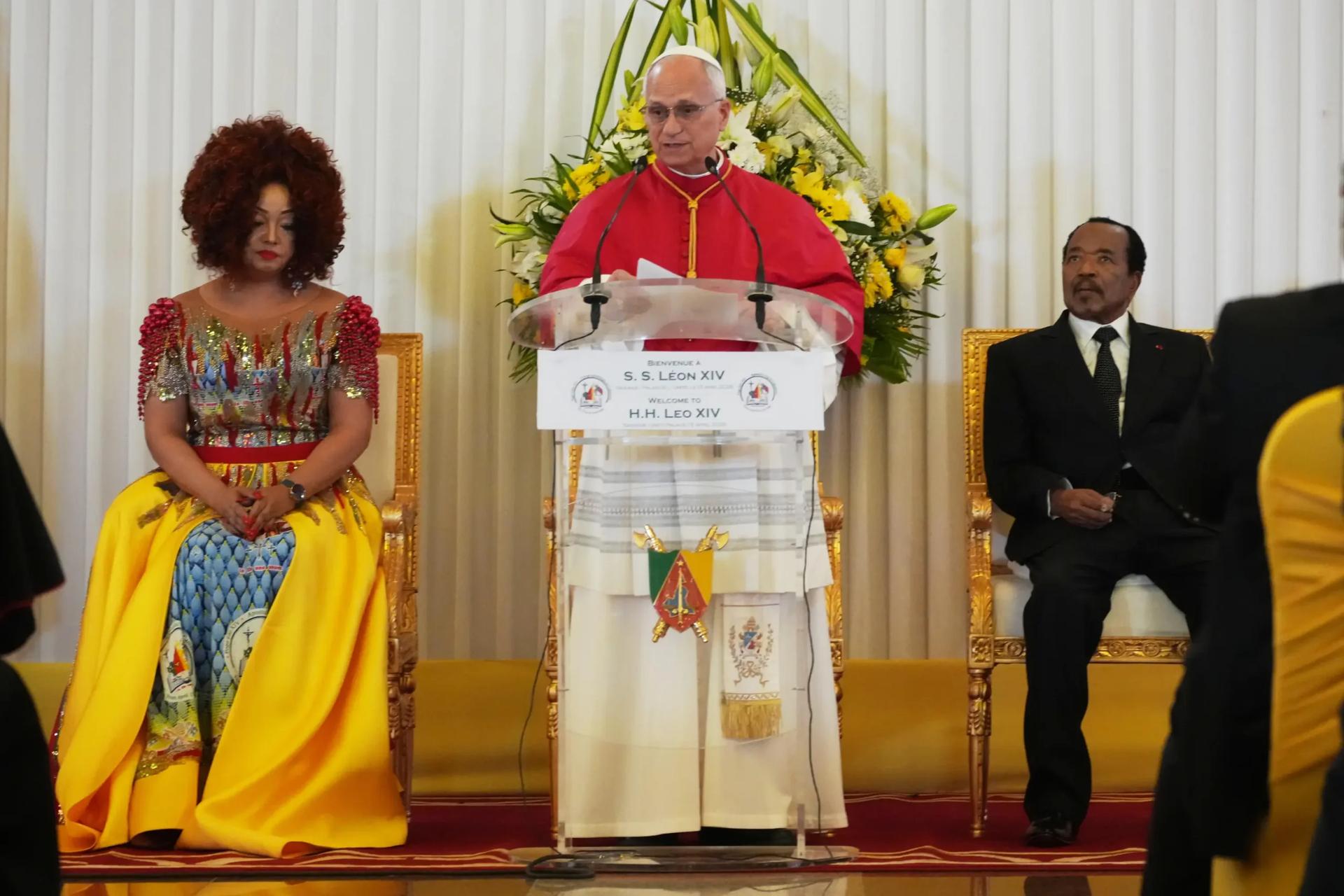
Plans for the venue of his speech to national authorities and members of the diplomatic corps in Yaoundé changed at the last minute, moving from a large congress center in Yaoundé to the Presidential Palace.
Originally, Cameroonian Prime Minister Joseph Dion Ngute was scheduled to address the pope and national authorities following the pope’s private meeting with President Paul Biya. However, those plans changed before Leo’s departure from Algeria, and Biya himself delivered the speech at the meeting with authorities and diplomats.
In his speech, Pope Leo said he came to Cameroon “as a shepherd and as a servant of dialogue, fraternity and peace…to encourage each of you to keep moving forward with enthusiasm and perseverance in building the common good.”
“We are living, in fact, at a time when hopelessness is rampant and a sense of powerlessness tends to paralyze the renewal so deeply desired by peoples,” he said, adding that there is a collective hunger and thirst for justice among the people.
He referred to previous papal visits, including those of Saint John Paul II and Benedict XVI, and wondered aloud how much progress had been made in the path of hope, justice and reconciliation.
Related: Pope Leo in Cameroon will face violent conflict, corruption
In a message directly to national leadership, Leo quoted Saint Augustine, whom he, as history’s first Augustinian pope, commemorated in Algeria the day before, saying, “Those who rule serve those whom they seem to command.”
“They rule not from a love of power, but from a sense of the duty they owe to others – not because they are proud of authority, but because they love mercy,” he said, adding that those in governance must conduct themselves “with a clear mind and an upright conscience, to the common good of all people in the nation.”
“This includes dedication to both the majority of the population and the minorities, as well as their mutual harmony,” he said, directly referencing the violent conflict ravaging Cameroon between the French-speaking majority and the English-speaking minority.
Pointing to the fact that Cameroon has been torn by violent conflict in its Northwest, Southwest, and Far North regions for years, where thousands have been killed or displaced, the pope repeated his call to diplomats in January to “reject the logic of violence and war.”
He urged those in political leadership to “embrace a peace founded on love and justice. A peace that is unarmed, that is, not based on fear, threats or weapons, and at the same time disarming, because it is capable of resolving conflicts, opening hearts and generating trust, empathy and hope.”
Peace, he said, is not a mere slogan but “must be embodied in a way of life that renounces all forms of violence, both personally and institutionally.”
This, the pope said, is an appeal he repeated and hopes contributes “to the efforts for an authentic peace, prioritizing it over any partisan interest.”
“Peace, in fact, cannot be decreed: it must be embraced and lived,” he said, adding that the quest for peace must be a collective effort. “It is everyone’s responsibility, beginning with civil authorities.”
To govern, he said, “means to love one’s own country as well as neighboring countries; the commandment ‘love your neighbor as yourself’ is equally applicable to international relations!”
Citizens must be heard and valued if lasting solutions to societal problems are to be found, he said.
In this sense, civil society can be “a vital force for national cohesion,” the pope said, saying Cameroon “is ready for this transition!”
“Civil society also contributes to shaping consciences, promoting a culture of dialogue and fostering respect for differences,” he said.
Leo, who, in the past, while prior general of his order, supported campaigns run by women religious against female genital mutilation in Africa, offered a word of support to women on the continent and called for their inclusion in leadership.
Women, he said, “are often, unfortunately, the first victims of prejudice and violence, yet they are tireless peacemakers.”
“Their commitment to education, mediation and the rebuilding of the social fabric is unparalleled and serves to curb corruption and abuses of power,” he said, saying. “their voice must be fully recognized in decision-making processes.”
The pope also issued a stinging condemnation of corruption, for which Cameroon is notorious, saying “transparency in the management of public resources and respect for the rule of law are essential to restoring trust.”
“Just and credible institutions become pillars of stability,” he said, adding that public authorities are called to serve as bridges, never as sources of division, even when insecurity seems prevalent.
A former missionary who served in Peru during the controversial term of Alberto Fujimori, accused of various human rights abuses, and who supported the establishment of Peru’s Truth and Reconciliation Commission to investigate alleged human rights abuses under Fujimori, Leo also called for the respect of human rights in Cameroon.
“Security is a priority, but it must always be exercised with respect for human rights, combining rigor and magnanimity, with particular attention to the most vulnerable,” he said.
“Authentic peace arises when everyone feels protected, heard and respected, when the law serves as a secure safeguard against the whims of the rich and powerful,” he said.
National leadership ought to be carried out in collaboration with state agencies and in service of the people, especially the poor, the pope said, saying these can only be accomplished “by carrying out your institutional and professional responsibilities with integrity and upright conduct.”
“In for peace and justice to prevail, the chains of corruption – which disfigure authority and strip it of its credibility – must be broken,” Pope Leo said.
If this is to happen, “hearts must be set free from an idolatrous thirst for profit,” he said, saying, true profit “comes from integral human development, that is, the balanced growth of all the aspects that make life on this earth a blessing.”
Cameroon possesses the human and cultural resources to overcome its trials and move toward a future of stability, free of conflict, he said, stressing the importance of dialogue, justice and integral development.
He underlined the role of youth, lamenting high levels of unemployment and exclusion as underlying causes of the choice for violence.
In this sense, he underscored the importance of investing in education and entrepreneurship as “a strategic choice for peace” and as a brain drain for the African continent.
“It is the only way to curb the outflow of wonderful talent to other parts of the world. It is also the only way to combat the scourges of drugs, prostitution and apathy, which are devastating too many young lives in an increasingly dramatic way,” he said.
Touting Cameroon’s deep spiritual roots, Leo said that “When they are not twisted by the poison of fundamentalism, religious traditions inspire prophets of peace, justice, forgiveness and solidarity.”
“By fostering interreligious dialogue and involving religious leaders in initiatives of mediation and reconciliation, politics and diplomacy can draw upon moral forces capable of easing tensions, preventing extremism and promoting a culture of mutual esteem and respect,” he said.
Pope Leo highlighted the Church’s contributions to healthcare and education, saying the Church wishes to collaborate with national authorities to promote human dignity and reconciliation.
Leo closed his speech by asking God to bless Cameroon and its leaders and to guide civil society.
He asked that God would “enlighten the work of the Diplomatic Corps and grant the entire Cameroonian people – Christians and non-Christians, political leaders and citizens – the grace to welcome the Kingdom of God and so build together a future of justice and peace.”
Meeting the disadvantaged
Following his meeting with national authorities and diplomats, the pope then paid a brief visit to the Ngul Zamba orphanage in Yaoundé, where he underlined the importance of belonging to God’s family.
“It is living as brothers and sisters gathered around him that makes you strong, helps you to carry life’s burdens together and allows you to experience true joy,” he said.
“In a world often marked by indifference and selfishness, this home reminds us that we are the ones who need to look after our brothers and sisters, and that, in God’s great family, no one is ever a stranger or forgotten, no matter how small he or she may be,” he said.
Noting that many of the children have faced situations of great suffering, loss, fear and abandonment, the pope told the children that “are bearers of a promise.”
“Wherever there is misery, suffering or injustice, God is present; and he knows each of your faces and is very close to you,” he said, noting that Jesus in the Gospels is especially close to children and those facing hardship.
“Know that he looks upon each one of you today with that same affection,” Leo said, and thanked those who run the orphanage, saying they offer “a beautiful testimony of love.”
Through their patience and dedication, the staff, he said, offers “much more than mere material support: you offer these children a presence, a listening ear, a family and a future.”
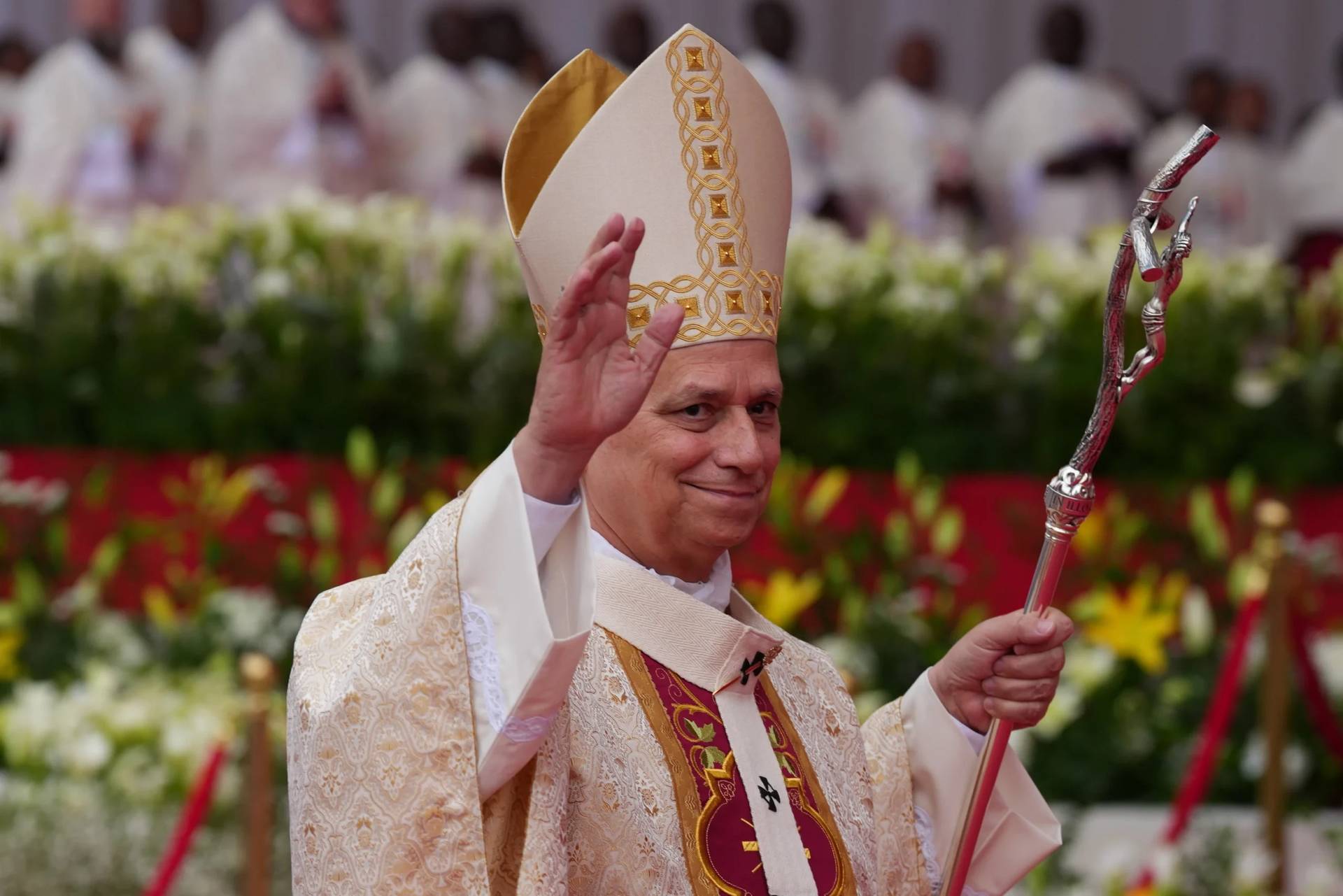
On Thursday, Pope Leo will visit the conflict-ridden city of Bamenda, an English-speaking city at the heart of the country’s ongoing armed conflict, where he will lead a vigil for peace and celebrate Mass for the local community.
Follow Elise Ann Allen on X: @eliseannallen