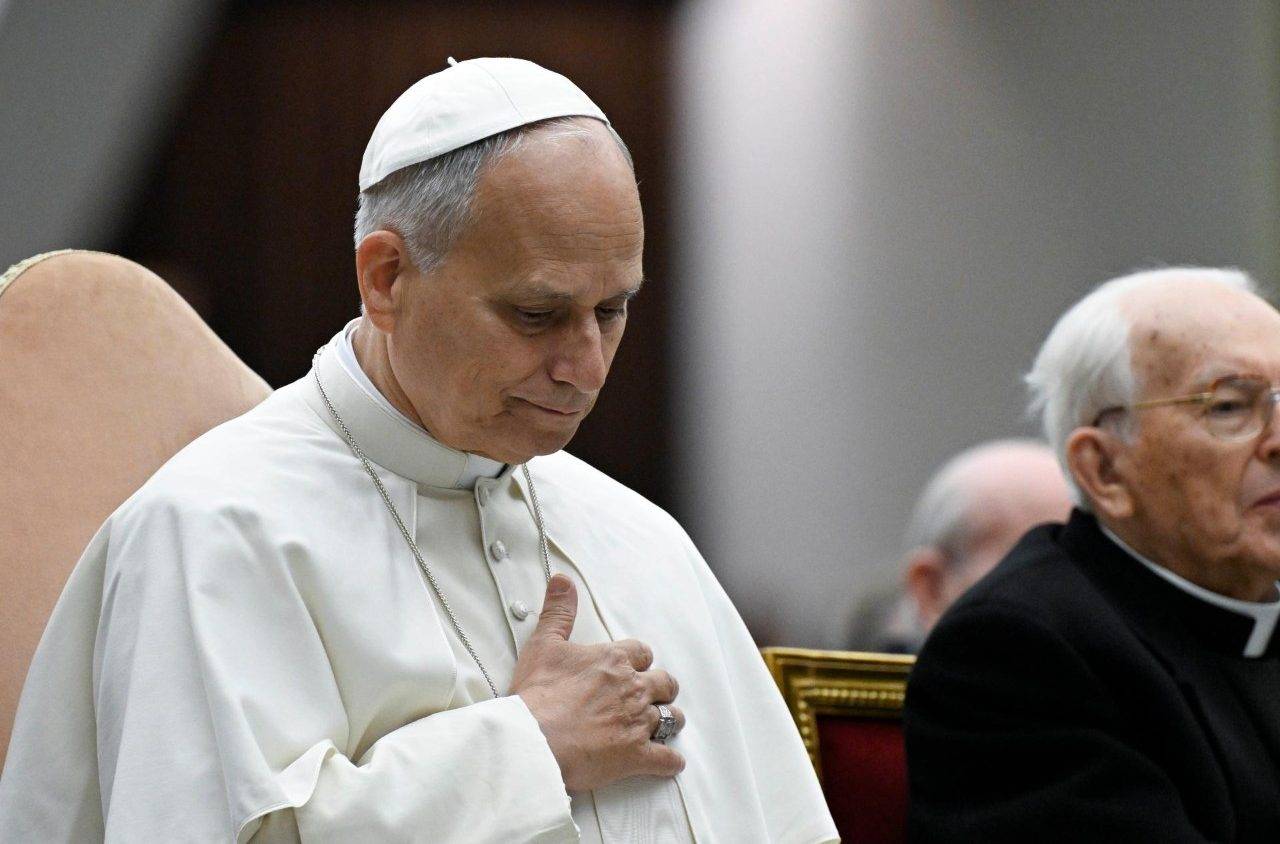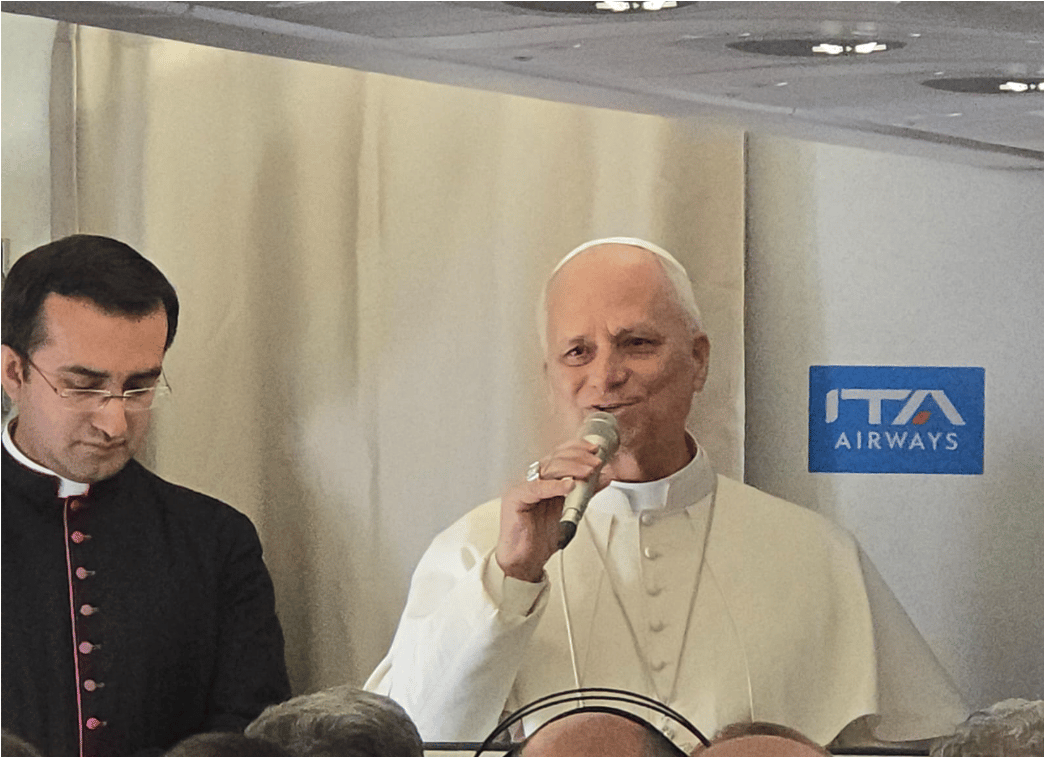
ON BOARD THE PAPAL PLANE – On his return flight from Malambo to Rome on Wednesday, Pope Leo XIV condemned the state executions taking place in Iran and defended the Holy See’s engagement of authoritarian regimes as necessary for improving social conditions.
He repeated his call for peaceful dialogue and also fielded a question about LGBTQ+ issues, saying the topic causes division and that the church’s unity should not depend on matters of sexuality, but issues he said are more important, such as justice, equality, and religious freedom.
Speaking during his April 23 ITA Airways flight, the pope when asked about Iran’s execution of opposition members and its bloody crackdown on national protests against its authoritarian regime, which has reportedly resulted in thousands of deaths, said, “I condemn all actions that are unjust.”
“I condemn the taking of peoples’ lives, I condemn capital punishment. I believe that human life is to be respected and that all people, from conception to natural [death], their lives should be respected and protected,” he said.
When a nation or a governing regime makes decisions that that “take away the lives of other people unjustly, then that is obviously something that should be condemned,” he said.
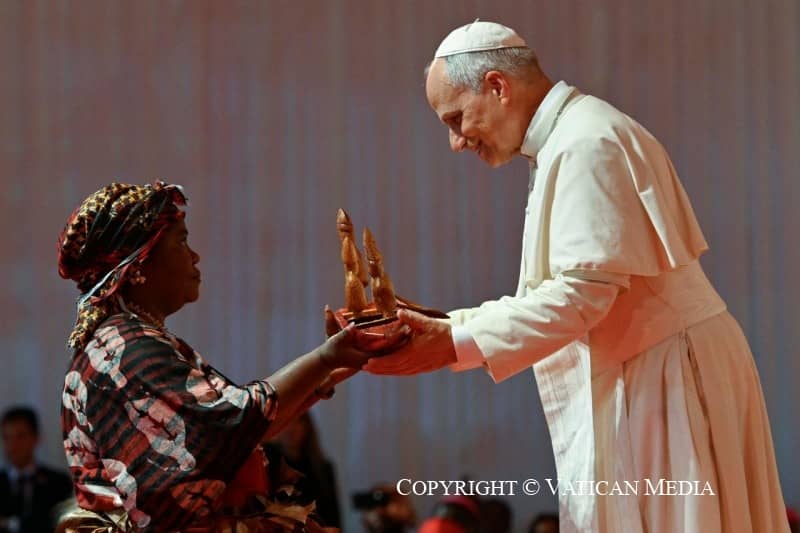
Pope Leo wrapped up a dizzying 11-day tour of Africa on Wednesday, having visited Algeria, Cameroon, Angola, and Equatorial Guinea.
One narrative that has accompanied the pontiff throughout his four-nation odyssey has been the critique that his visit to Cameroon, Angola, and Equatorial Guinea, in particular, could lend legitimacy to the authoritarian leadership governing each country.
In Cameroon, he met with President Paul Biya, at 93 the world’s oldest head of state, who has held office since 1982. While in Angola, he met President João Lourenço, who in 2017 took over from José Eduardo dos Santos, who had been in office for a whopping 38 years after being elected in 1979.
Leo in Equatorial Guinea also met with its president, Teodoro Obiang Nguema Mbasogo, 83, who is Catholic and has held office since 1982, making him either the world’s second-longest-serving head of state after Biya or the longest-serving head of state, depending on whether his rule is dated from 1979, when he was head of the country’s ruling military council.
In response to these criticisms, Leo said that the presence of the pope in any country, “as with any head of state, can be interpreted in different ways.”
“It can be interpreted and has been interpreted by some as, ‘ah, the pope or the church is saying it’s okay that they live like that.’ Others may say things differently,” he said.
Stressing that every papal visit, while having political aspects, is primarily a “visit to the people.”
At the political level, he underlined “the great value that the system of the Holy See continues, at times with great sacrifice, to continue to maintain diplomatic relations with countries throughout the world.”
“Sometimes we have diplomatic relationships with countries that have authoritarian leaders,” he said, saying that even in these cases, there is an opportunity to engage at the diplomatic level.
Despite calls for more firm statements from some, “We don’t always make great proclamations criticizing, judging, or condemning,” he said, saying “there’s an awful lot of work that goes on behind the scenes to promote justice, to promote humanitarian causes, to look for at times situations where there might be political prisoners and finding a way for them to be freed, situations of hunger, of sickness, etc.”
By maintaining a stance of neutrality and seeking ways to maintain a positive diplomatic relationship with countries around the world, “we’re actually trying to find a way to apply the Gospel to concrete situations so the lives of people can be improved,” Leo said.
“People will interpret the rest of it as they will, but I think it’s important for us to look for the best way that we can to try and help the people of any given country,” he said.
In terms of current peace negotiations in Iran, as a tenuous ceasefire risks collapsing any day, thrusting the world into a deeper economic crisis, Pope Leo said there is a need to promote “a new attitude, a new culture of peace.”
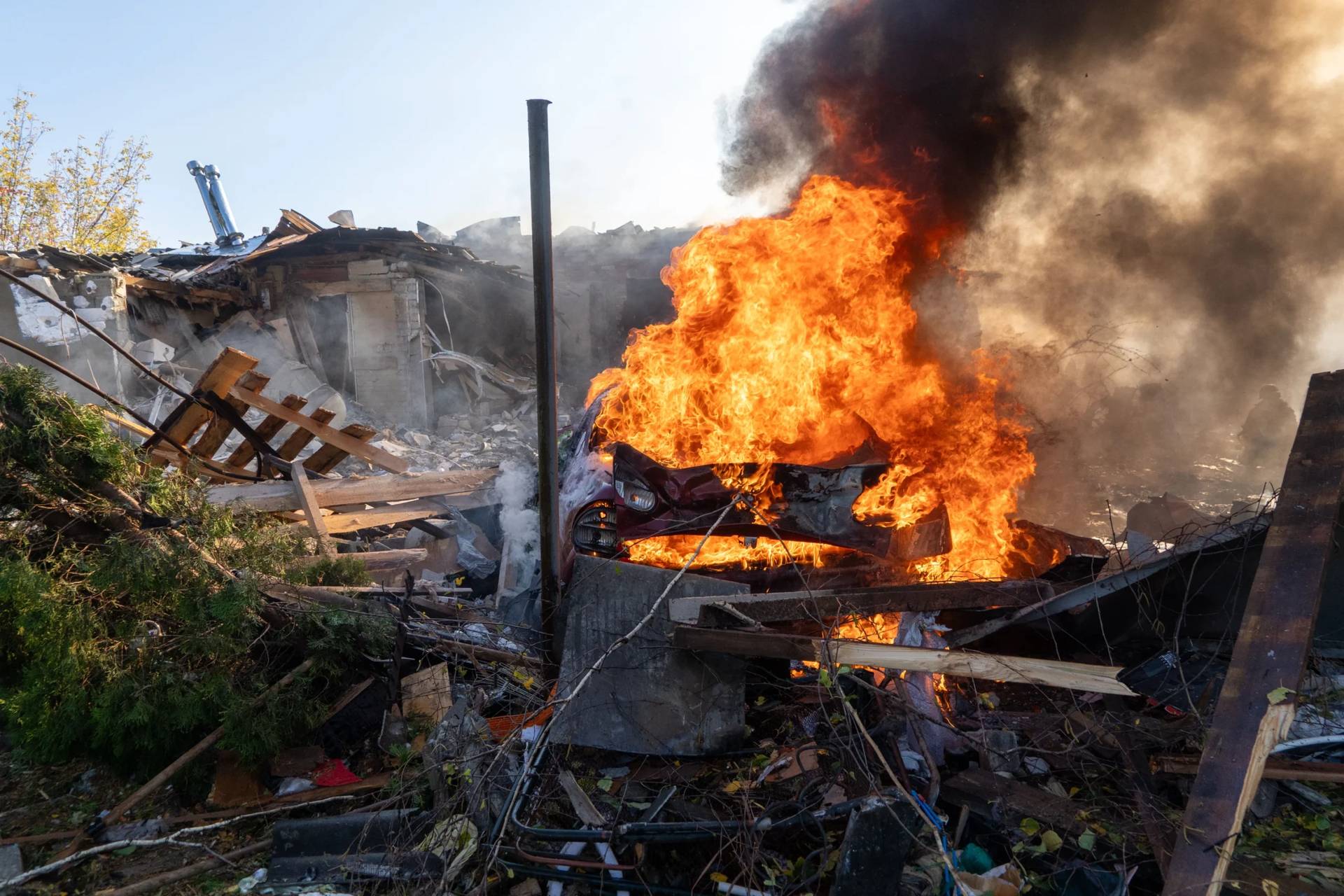
“Many times, when we evaluate certain situations, immediately the response is, we must go in with violence, with war, attacking,” he said, noting that the result of this approach has been “that many innocent people have died.”
Whether there is a regime change in Iran or not, he said, “the question is how to promote the values in which we believe without the deaths of so many innocents.”
Leo said the issue of the Iran war is “very complicated,” and that the ultimate result of the back-and-forth of negotiations is unclear.
“It has created this chaotic, critical situation for the global economy, but there is also an entire people in Iran, innocent people who are suffering because of this war,” he said, and urged “the continuation of dialogue for peace.”
To this end, he voiced his hope that all parties involved would “seek and put all their efforts into seeking peace.”
“It’s very important that the innocent are protected, because it has not been the case in different places,” he said.
Illustrating the devastating impact of war, the pope said he carries with him a picture of a child, a young boy, who greeted him upon his arrival in Lebanon holding a sign that said, “welcome Pope Leo.” That child, he said, was killed on the first day that Israel and the United States launched their new military operation in Iran.
“There are so many human situations, and I think we must have the ability to think in this way,” he said, insisting that as a pastor, “I cannot be in favor of war. I want to encourage everyone to seek responses that come from a culture of peace and not hatred or division.”
Pope Leo also touched on the thorny issue of migration, which he said is “very complicated” and is a “global phenomenon,” not isolated to just Europe or the United States.
In terms of how to respond to the challenge of global migration, Leo posed a question, asking, “what would the global north do to help the global south, or those countries where youth today don’t see a future?”
“They all have this dream of going north, but many times, the north doesn’t have a response on how to offer the possibility. Many suffer human trafficking; trafficking also happens in migration,” he said.
Leo said countries have a right to enact laws to manage their borders, and that he is not in favor of people coming in “with no organization, creating situations oftentimes more unjust in the places they come than in those that they left.”
“Having said this, I ask what will we do in the richest countries to change the situation in the poorest countries?” he said, and suggested that large, wealthy, multinational companies make investments in poorer nations such as the ones he visited, so the people live in better conditions.
“Africa for many people is considered a place where you can come to take out minerals, take out its riches, for the enrichment of others in other countries,” he said.
He suggested that “at the global level we must work much harder to promote greater justice and equality in the development of these countries of Africa so that they don’t need to migrate to Spain, etc.”
Pope Leo also underlined the importance of treating migrants with respect, saying, “we must treat human beings in a humanitarian way, not in a way worse than that which, in many cases, we treat pets at home or like animals, etc.”
“This is a big challenge,” he said, saying, “when people arrive, they are human beings and they deserve the respect that every human beings merit for their human dignity.”
Asked about the LGBTQ+ issue and the apparent decision of Cardinal Reinhard Marx of Munich and Freising to approve guidelines for the blessing of same-sex couples in his diocese, Leo called the topic divisive and said there are more important issues at stake.
“I think it’s very important to understand that the unity or division of the church should not revolve around sexual matters,” he said, saying, “we tend to think that when the church is talking about morality, that the only issue of morality is sexual.”
Leo voiced his belief that “there are much greater and more important issues, such as justice, equality, the freedom of men and women, freedom of religion, that would all take priority over that particular issue.”
He said the Holy See has already made it clear to the German bishops that there should be no formalized blessing of same-sex couples, beyond Pope Francis’s allowance for the blessing of them as individuals, in the sense that “all people receive blessings.”
“When a priest gives a blessing at the end of Mass, when the pope gives a blessing at the end of a large celebration like such we had today, they are blessings of all people,” he said.
Francis’s common expression “tutti, tutti, tutti,” meaning “everyone, everyone, everyone,” Pope Leo said, “is an expression of the church’s belief that all are welcome, all are invited.”
“All are invited to follow Jesus, and all are invited to look for conversion in their lives,” he said, saying, “To go beyond that today, I think that the topic can cause more disunity than unity, and we should look for ways to build our unity on Jesus Christ and what Jesus Christ teaches. So that’s how I would respond to that question.”
Speaking specifically of his visit to Equatorial Guinea, the last stop on his busy itinerary, the pope called it “a blessing,” and a chance to meet with and encourage the people.
“Many times, the interest is rather political, what does the pope say about this or that topic, why doesn’t he judge the government in one country or another, and there are certainly many things to say” in this regard, he said.
Leo said he spoke about issues of justice, “and there are topics there, but that is not the first word.”
“The trip is meant to be interpreted above all as an expression of wanting to announce the Gospel, to proclaim the message of Jesus Christ, which is thus a way of drawing near to the people in their happiness, in the depth of their faith, but also in their suffering,” he said.
He touched on the debate about his choice to meet with the authoritarian leadership of each country, saying many times “it’s necessary to make comments or to find how to encourage the same people to assume responsibility for their lives.”
“It’s important also to speak with the heads of state to perhaps encourage a change of mentality or a greater opening to think about the good of the people; a possibility to look at issues such as the distribution of the goods of a country,” he said.
Pope Leo said “we did a bit of everything” in the meetings he had, but that his main goal was, and is in all of his trips, “to encounter the people with this enthusiasm.”
“I am very happy with the whole trip, but living, accompanying and walking the people of Equatorial Guinea was truly a blessing,” saying that, despite some heavy rains, it was a “sign of sharing as a universal church what we celebrate in our faith.”
Follow Elise Ann Allen on X: @eliseannallen