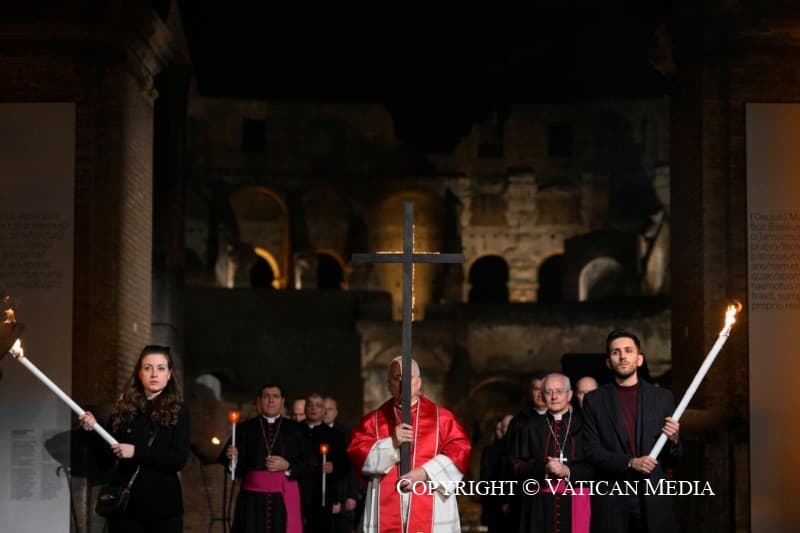
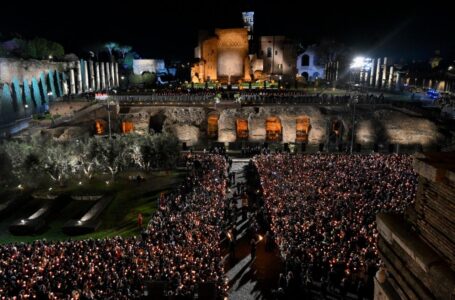
ROME – Pope Leo XIV led the traditional Via Crucis devotion on Good Friday, carrying the cross himself the whole way at the Colosseum in Rome, as a running reflection was offered on the meaning of real power as rooted in humility and service, rather than force or dominance.
The meditation for the first station of the fourteen stations of the traditional Lenten Way of the Cross said that Jesus in his condemnation to death “unmasked every human presumption of power.”
“Even today, there are those who believe their authority is limitless, thinking they may use or abuse it at their whim,” it said, pointing to Saint Francis of Assisi as a reminder that “every person in authority will have to answer to God for the way they exercise their power.”
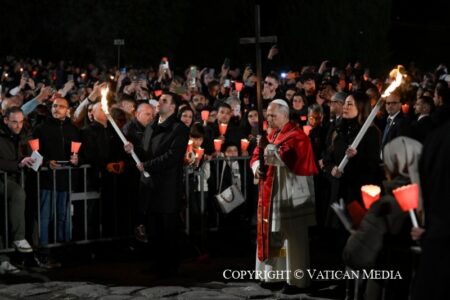
This power, it said, includes “the power to judge; the power to start or end a war; the power to instill violence or peace; the power to fuel the desire for revenge or for reconciliation; the power to use the economy to oppress people or to liberate them from misery; the power to trample on human dignity or to uphold it; and the power to promote and defend life, or reject and stifle it.”
Likewise, each person is asked by God to give an account for the power they exercise in their daily lives, the meditation said, quoting Jesus in scripture, who said, “Make good use of the power given to you, and remember that whatever you do to another human being, especially to the small and vulnerable, you do unto me. And it is to me that you will one day give an account.”
The meditation closed with a prayer that Jesus would remind humanity that he identifies with “every person who is judged,” and that Christians would not be guided by prejudice, realizing instead that “power consists in love: That mercy triumphs over judgment: That the good must be chosen even when it comes at a cost.”
The last pontiff to carry the Cross for the entire fourteen-station procession was Pope St. John Paul II, who did so from 1979 through 1994, and in 1995 began carrying the Cross only for portions of the devotion.
Both Benedict XVI and Francis led portions of the procession during their pontificates, until frailty and ill health prevented them. This year was the first time in three decades that a pope carried the Cross for the entire procession.
Meditations for this year’s Via Crucis were written by Franciscan Father Francesco Patton, former Custos of the Holy Land, and focused on the distinction between human and divine power, contrasting humanity’s lust for dominance with Jesus’s humility and sense of service and self-sacrifice.
Noting that this year marks the 800th anniversary of St. Francis of Assisi’s death, Patton said the prayer is not just for the pious and those looking for quiet reflection, but is a demonstration that faith, hope and charity must be conveyed in a chaotic and noisy world.
In his meditations, Patton underlined Jesus’s humility, in being unafraid to embrace the cross, but also in falling to the ground.
“Though you are God, you divested yourself of your glory to become man. Rich as you were, you became poor,” he said, asking God to help Christians “choose a life of humble service rather than seeking prominence and dominance.”
Reflecting on Jesus’s encounter with his mother Mary, Patton lamented that, like Mary who watched her son die, “too many mothers…see their children arrested, tortured, condemned and killed.”
“Grant us a maternal heart, that we may understand and share in the suffering of others, and learn, in this way too, what it truly means to love,” he said.
Patton prayed, in reflecting on Simon of Cyrene helping Jesus carry his cross, for those who volunteers who assist people in “extreme situations,” providing food, medicine, education “and justice” to those in situations of difficulty.
Contemplating Veronica’s act of wiping Jesus’s face, Patton prayed that Christians today would, like Veronica, be also capable of wiping Jesus’s face, “still covered with dust and blood, still disfigured by every act that tramples upon the dignity of the human person.”
He prayed that Jesus would help humanity recognize his image “in every person condemned by prejudice; In the poor deprived of their dignity; In women who are victims of trafficking and enslavement; (and) In children whose childhood has been stolen and whose future has been compromised.”
Highlighting Jesus’s humility by falling a second time, Patton said that when Jesus allowed himself to fall, he did so “in order to lift us up from our own falls.”
“You do so to raise up those who are crushed to the ground by injustice, by falsehood, by every form of exploitation and violence, and by the misery produced by an economy that seeks individual profit rather than the common good,” he said.
Patton also stressed Jesus’s closeness to humanity in times of weakness, saying, “there is no fall of our own in which you are not beside us…Your love, forgiveness and mercy are infinitely greater than our frailty.”
During the eighth station, when Jesus meets the women of Jerusalem, Patton offered a lengthy reflection on the role of women, noting that women are present “wherever there is suffering or need,” whether it be a hospital or nursing home, centers for the disabled, foster care and orphanages, and schools and clinics in remote mission lands.
Women, he said, are often the ones “tending to the wounded and comforting survivors in war zones and areas of conflict.”
“For centuries, they have wept for themselves and for their children, children taken away and imprisoned during protests, deported by policies devoid of compassion, shipwrecked on desperate journeys of hope, killed in war zones, and wiped out in death camps,” he said.
He prayed that God would give humanity a compassionate heart and the ability to be sympathetic to the suffering of others, rather than remaining indifferent.
In that station Patton prayed that God would give humanity the gift of tears, “To weep over the devastation of war; To weep for massacres and genocides; To weep with mothers and wives; To weep over the cynicism of the powerful; To weep over our own indifference.”
When Jesus is stripped of his garments in the tenth station, Patton said this act was an attempt “to humiliate” him and strip him of his dignity.
“This violation is repeated time and again even today: when authoritarian regimes force prisoners to remain half-naked in bare cells or courtyards; when torturers tear away not only clothing but also skin and flesh; when authorities permit forms of surveillance and intrusion that disregard human dignity,” he said.
It is also repeated, he said, “when rapists and abusers reduce their victims to mere objects; when the entertainment industry exploits nudity for the sake of profit; when the media exposes individuals to public opinion; and even when we ourselves, through our curiosity, fail to respect the modesty, intimacy and privacy of others.”
He prayed that those who fail to recognize the dignity of others and treat them humanly would be reminded that in doing so, “our own dignity is diminished” and “we ourselves become less human.”
Reflecting on Jesus being nailed to the cross, Patton said he was treated like a criminal but given the title of royalty, thus demonstrating “what true power is.”
“Not the power of those who believe they can dispose of the lives of others by putting them to death, but the power of those who can truly conquer death by giving life, and who can give life even by accepting death,” he said.
True power, he said, is not that of those “who use force and violence to impose themselves,” but it is father “that of those who are capable of taking upon themselves the evil of humanity…and destroying it with the power of love that is manifest in forgiveness.”
“You do not resort to the supposed power of armies, but to the apparent powerlessness of love,” Patton said, saying if Christians must also “learn to forgive for love of you and to bear the difficulties of life in peace, because it is not love of power that conquers, but the power of love.”
Patton in the meditation for the thirteenth station, when Jesus is taken down from the cross, said the act is one compassion and is a recognition of Jesus’s human dignity.
“There should never be bodies left unclaimed or unburied. Mothers, relatives and friends of the condemned should never be forced to abase themselves before authorities in order to recover the battered remains of their loved ones,” he said.
Even in death, the body retains its dignity and therefore “must not be desecrated, hidden, destroyed, withheld or denied a proper burial,” he said, saying this is also true of convicted criminals.
He prayed that Jesus would teach humanity to have compassion so that “we may feel the suffering of prisoners; That we may stand in solidarity with political prisoners; That we may understand the anguish of the families of hostages; That we may mourn those who have died beneath the rubble; That we may show respect for all the dead.”
The meditations closed with a word of thanks to Jesus in reflecting on the fourteenth station, when Jesus is laid in the tomb, for having “bestowed upon us a firm foundation for our hope of eternal life.”
Follow Elise Ann Allen on X: @eliseannallen