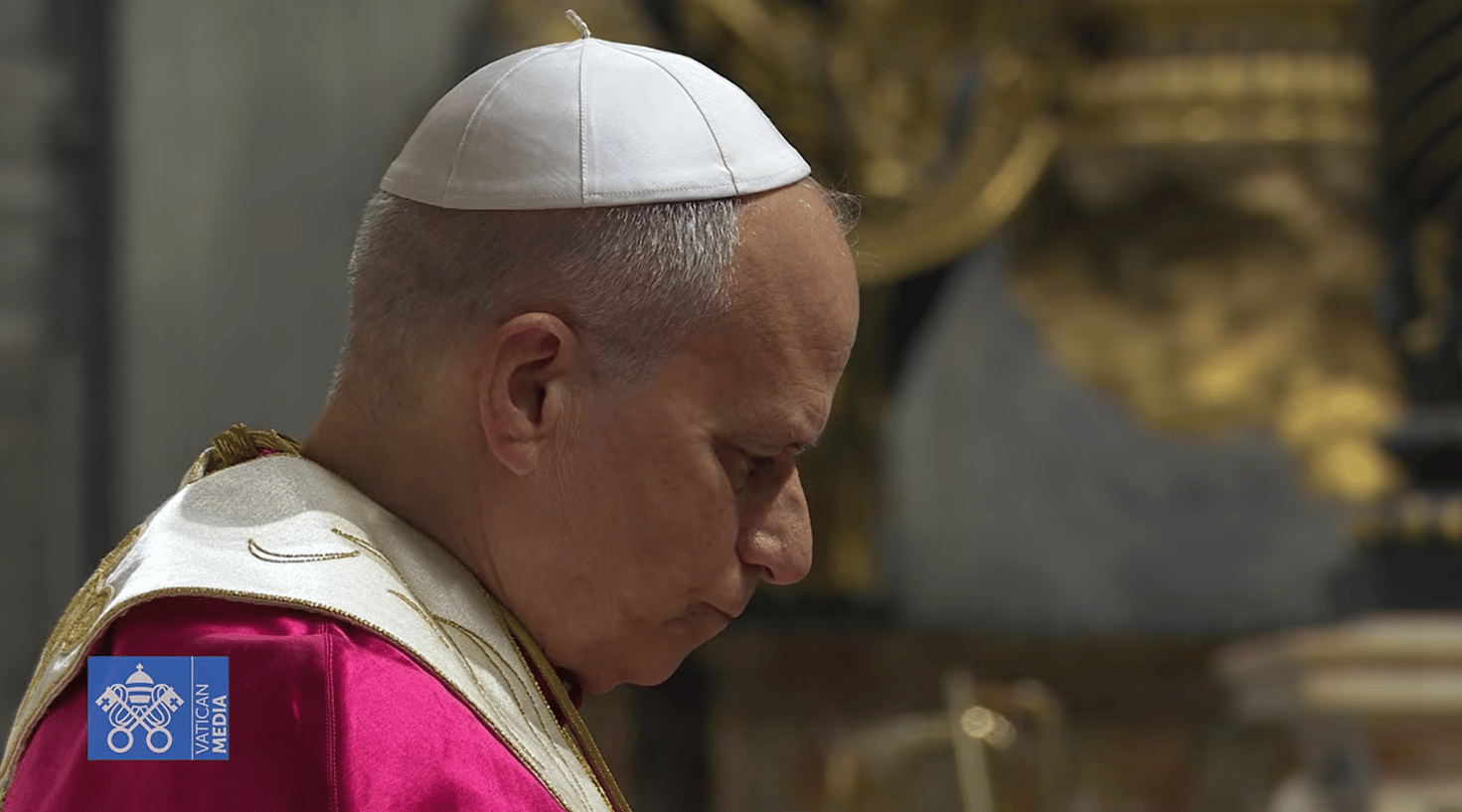
ROME – In what will likely be seen as a rebuke of United States foreign policy, Pope Leo during a prayer vigil for peace on Saturday condemned both a logic of war and what he said were “continuous violations of international law.”
In his address for the April 11 event, the pope said the church’s role is to promote “reconciliation and peace…without hesitation, even when rejecting the logic of war may lead to misunderstanding and scorn.”
The Church’s primary task, he said, is to proclaim, “the Gospel of peace” and promote “obedience to God rather than any human authority, especially when the inherent dignity of other human beings is threatened by continuous violations of international law.”
Leo’s remarks are likely to be read as a direct reference to the United States’s recent military actions in Venezuela, as well as the U.S. and Israel’s war with Iran.
The reference to the church’s rejection of war being misunderstood and potentially causing scorn is also likely to be read as an allusion to a meeting in January between Vatican and U.S. officials at the Pentagon, in which issues such as just war and “morality in foreign policy” were discussed in what the Vatican envoy at the time described as a “frank” conversation.
RELATED: Vatican denies media spin of envoy meeting at the Pentagon
Like his predecessor Francis, who six months into his papacy convoked a prayer vigil for peace in Syria, Leo at 11 months into his papacy convened his prayer vigil for peace on Easter Sunday during his traditional Urbi et Orbi address, with a call to dialogue and nonviolence.
Peace and nonviolence amid conflict have been a longtime and consistent strategy for Pope Leo, who, as a young missionary in Peru at a time of terrorist violence and political and social upheaval, read the works of Gandhi and embraced his concepts of peace, protest, and dialogue.
On April 7, Leo in remarks to journalists outside his residence in Castel Gandolfo directly criticized U.S. President Donald Trump’s threat to destroy the “whole civilization” of Iran, if they did not cede to ceasefire conditions.
Leo on that occasion said Trump’s threat was “not acceptable” and involved “questions certainly regarding international law, but even more, it is a moral question for the good of the people.”
Attacks on civilian infrastructure, he said pointedly, “are against international law.”
RELATED: Pope calls Trump threat against Iran ‘unacceptable, immoral’, Trump relents for now
Russia has also been repeatedly condemned for violating international law for its 2022 invasion of Ukraine and for repeatedly targeting civilian infrastructure amid a conflict in which Russia has also been accused of various war crimes.
Leo’s prayer vigil also comes on the heels of a short-lived but fiery media fiasco in which all parties involved denied a report in The Free Press that characterized a meeting between then-Vatican envoy to the U.S., French Cardinal Christophe Pierre, and U.S. Undersecretary of War for Policy Elbridge Colby as hostile to the Vatican.
RELATED: Confessions of a ‘secret source’ from the Vatican
In his address during Saturday’s vigil in St. Peter’s Basilica, in which participants prayed the rosary for peace, Pope Leo said faith can “move mountains” and thanked all those around the world who answered his call to join in praying for peace.
“War divides; hope unites. Arrogance tramples upon others; love lifts up. Idolatry blinds us; the living God enlightens,” he said, saying it takes only “a crumb of faith” to face “this dramatic hour” united as humanity.
Prayer is not an escape or a way to hide from concrete responsibility, and nor is it a way to numb the pain of injustice, he said. Rather, prayer is “the most selfless, universal and transformative response to death,” because as Christians, “we are a people who are already risen!”
“Nothing can confine us to a predetermined fate, not even in this world where there never seem to be enough graves, for people continue to crucify one another and eliminate life, with no regard to justice and mercy,” he said.
Leo quoted Pope John Paul II’s call for peace amid the United States’s invasion of Iraq in 2003, saying, “No more war…We must do everything possible. We know well that peace is not possible at any price. But we all know how great is this responsibility.”
“I make his appeal my own this evening, relevant as it is today,” the pope said, saying prayer teaches humanity “how to act” and unites a person to God.
RELATED: A president and a pope make the world’s most influential Americans at odds over Iran
Thoughts, words and actions together can break “the demonic cycle of evil” and be placed at the service God’s kingdom, “A Kingdom in which there is no sword, no drone, no vengeance, no trivialization of evil, no unjust profit, but only dignity, understanding and forgiveness,” he said.
Humanity, Leo said, has become “severely destabilized” by a “delusion of omnipotence that surrounds us and is becoming increasingly unpredictable and aggressive.”
“Even the holy Name of God, the God of life, is being dragged into discourses of death,” he said, repeating his condemnation of the use of faith to justify war and violence.
The remark will also likely be seen as yet another rebuke of comments by U.S. Defense Secretary Pete Hegseth, who in a recent prayer service at the Pentagon prayed for “overwhelming violence of action against those who deserve no mercy.”
RELATED: Pope opens Holy Week condemning war waged in Jesus’s name
“Enough of the idolatry of self and money! Enough of the display of power! Enough of war!” Pope Leo said, saying, “True strength is shown in serving life.”
He noted that he receives countless letters from children in warzones recounting “the horror and inhumanity of actions that some adults boast of with pride,” and urged humanity to listen to the voices of children, and the weak.
Leo made a direct appeal to those in positions of political leadership, telling them to “Stop!” with war and to “Sit at the table of dialogue and mediation, not at the table where rearmament is planned and deadly actions are decided!”
“There is a no less significant responsibility that falls to all of us – men and women from all over the world. We are an immense multitude that rejects war not only in word, but also in deed,” he said.
In this regard, prayer is a call to leave behind “whatever violence remains in our hearts and minds,” the pope said, urging Christians to build peace daily in their own neighborhoods.
“Let us believe once again in love, moderation and good politics. We must form ourselves and get personally involved, each following our own calling. Everyone has a place in the mosaic of peace!” he said.
Peace, he said, is build one word and one action at a time, like a fabric woven “stitch by stitch.”
“We must not allow ourselves to be overwhelmed by the pace of a world that does not know what it is chasing. Rather, we must return to serving the rhythm of life, the harmony of creation and healing its wounds,” he said.
Leo closed his remarks urging all men and women to become peacemakers, so that every community around the world becomes a “house of peace” where one learns “how to defuse hostility through dialogue, where justice is practiced and forgiveness is cherished.”
He urged Christians to pray without tiring and committing to “a profound conversion of heart” in the quest for peace, and closed reciting a brief prayer for peace.
Follow Elise Ann Allen on X: @eliseannallen