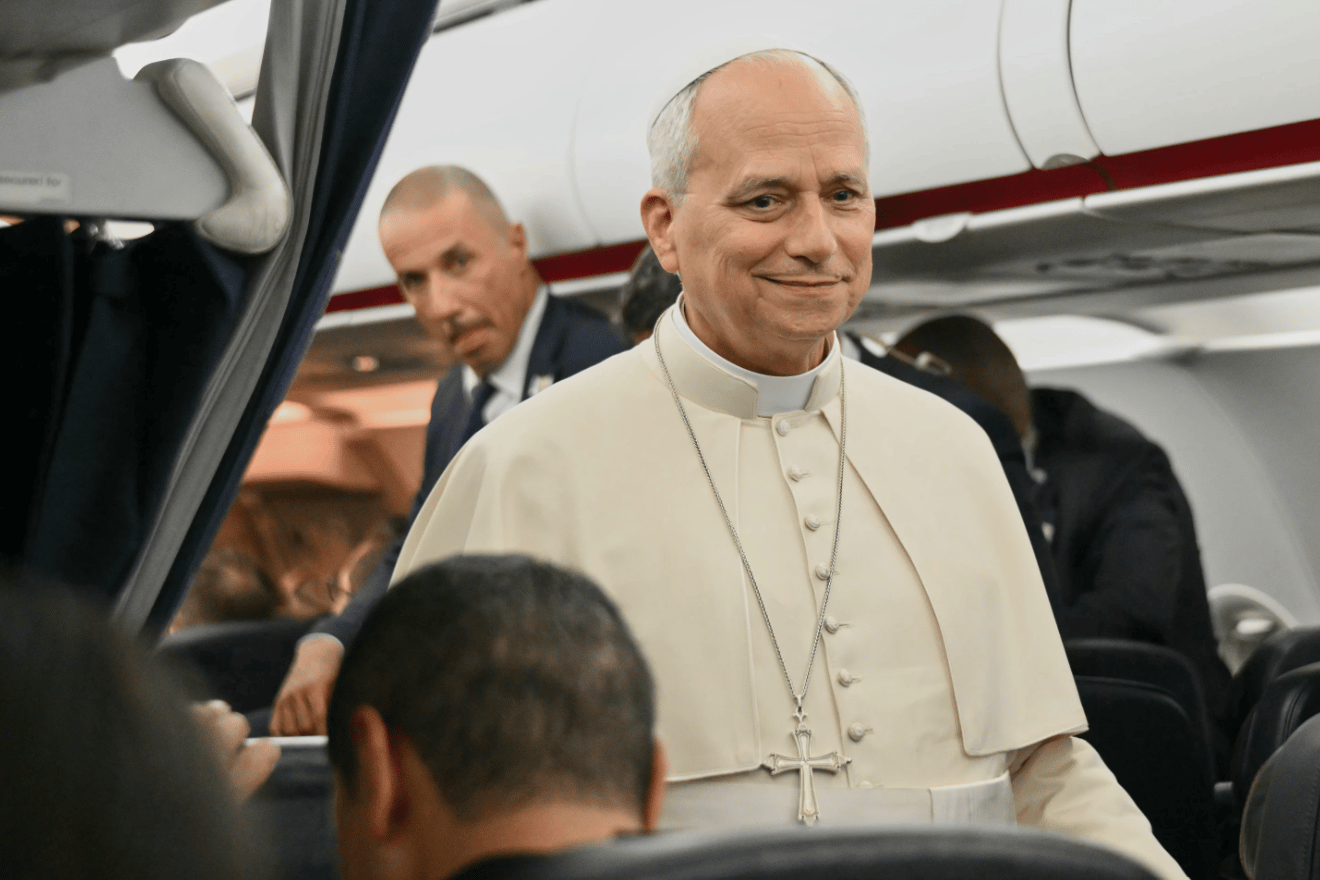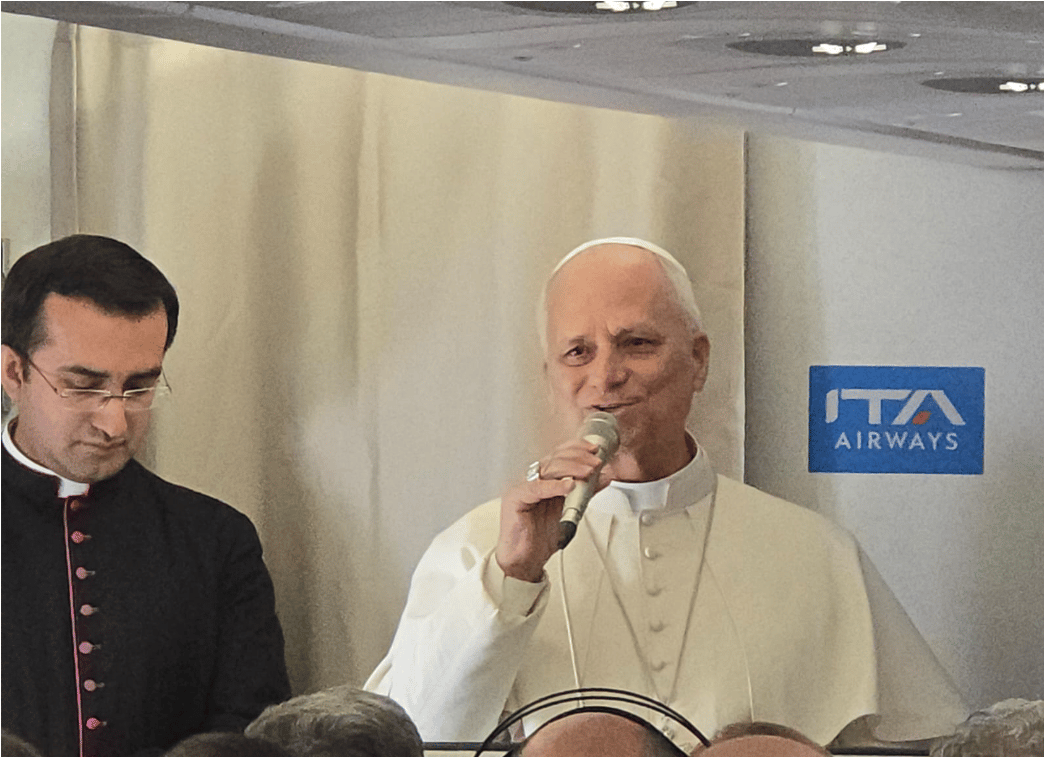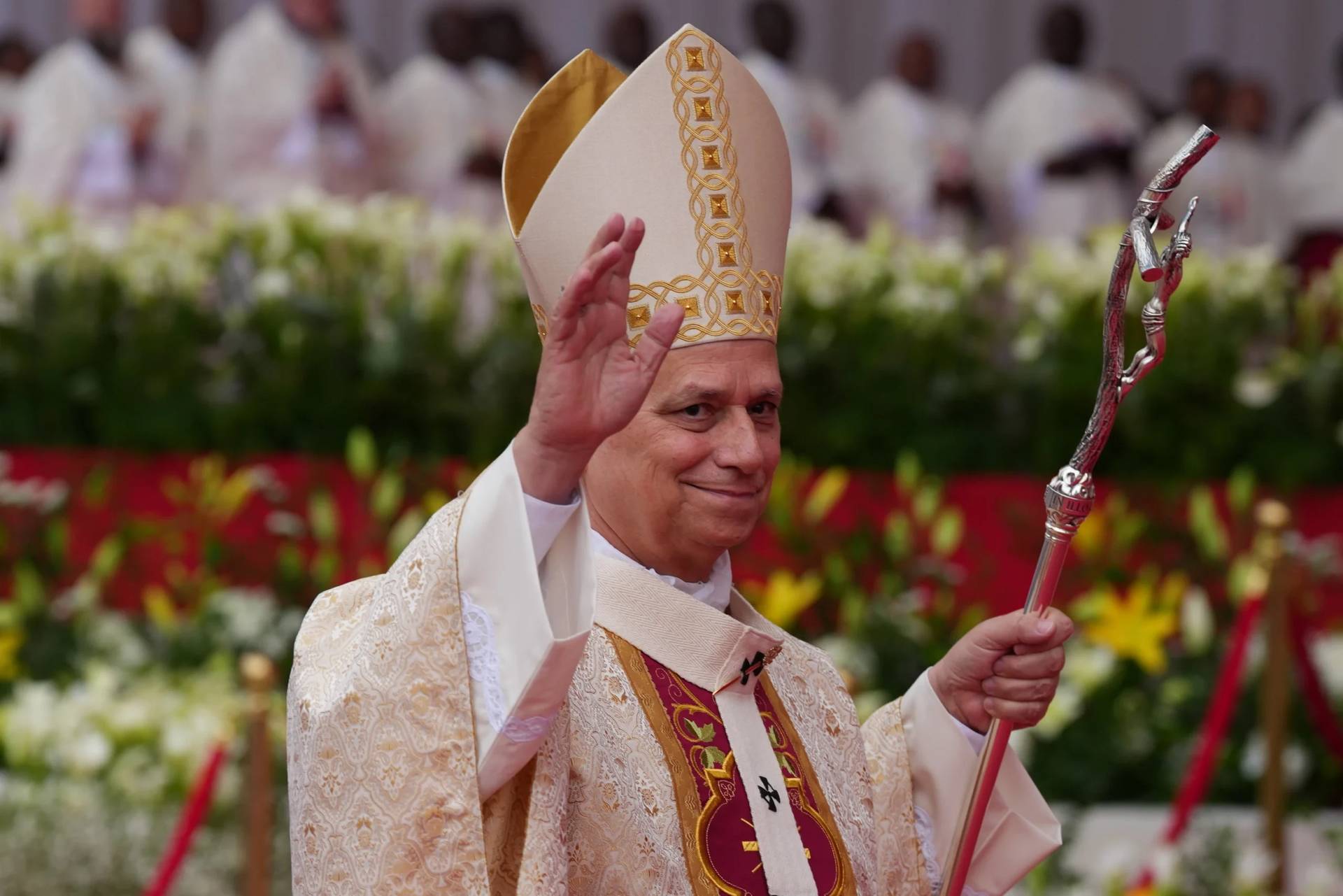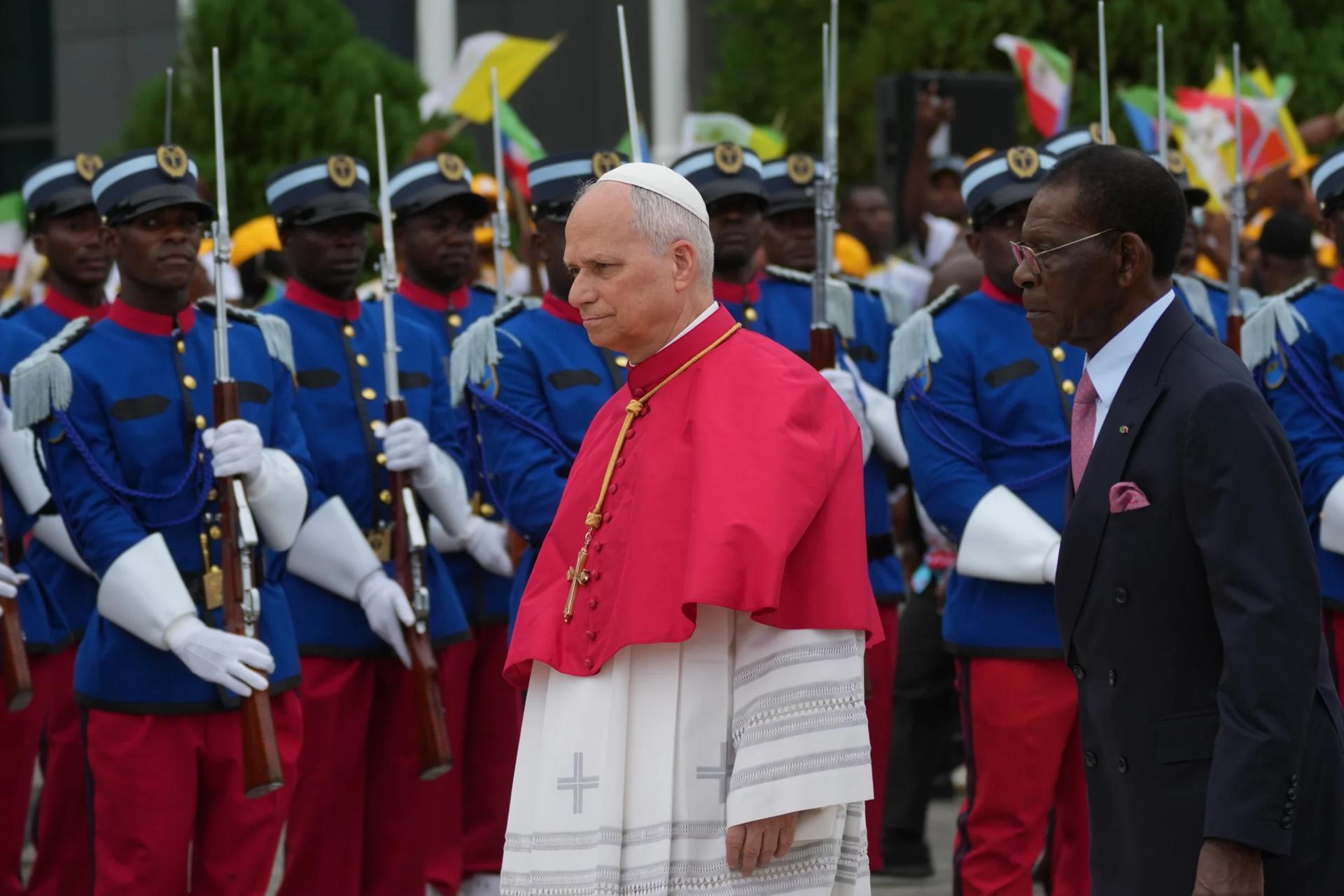
MALAMBA – Pope Leo XIV arrived in Equatorial Guinea on Tuesday, an African country led by the world’s longest-serving president and infamous for stark poverty and widespread corruption, with a call to justice and peace.
Quoting Pope Francis’s 2013 exhortation Evangelii Gaudium, the pope said in his April 21 speech, one year to the day since Francis died, that, “today we also have to say ‘thou shalt not’ to an economy of exclusion and inequality.”
“Such an economy kills,” he said, after landing in one of Sub-Saharan Africa’s largest oil producers, a nation governed by a president who has led the nation for 37 years, taking office in 1979.
In a speech to national civil authorities, Leo lamented that “the proliferation of armed conflicts is increasingly driven by the exploitation of oil and mineral deposits, occurring with no regard for international law or the self-determination of peoples.”
He noted that these technologies can be used for war, as evidenced by the increased reliance on military drones in armed conflict around the world, including the war in Ukraine.
“The destiny of humanity risks being tragically compromised without a change of direction in the assumption of political responsibility and without respect for institutions and international agreements. God does not want this,” the pope said.
Leo again repeated his condemnation of the use of religion or God to justify war and violence, saying, “his holy Name must not be profaned by the will to dominate, by arrogance or by discrimination; above all, it must never be invoked to justify choices and actions of death.”
“May your country not hesitate to evaluate its own paths of development and the positive opportunities of positioning itself on the international stage in the service of law and justice,” he said.
Plagued by poverty and inequality
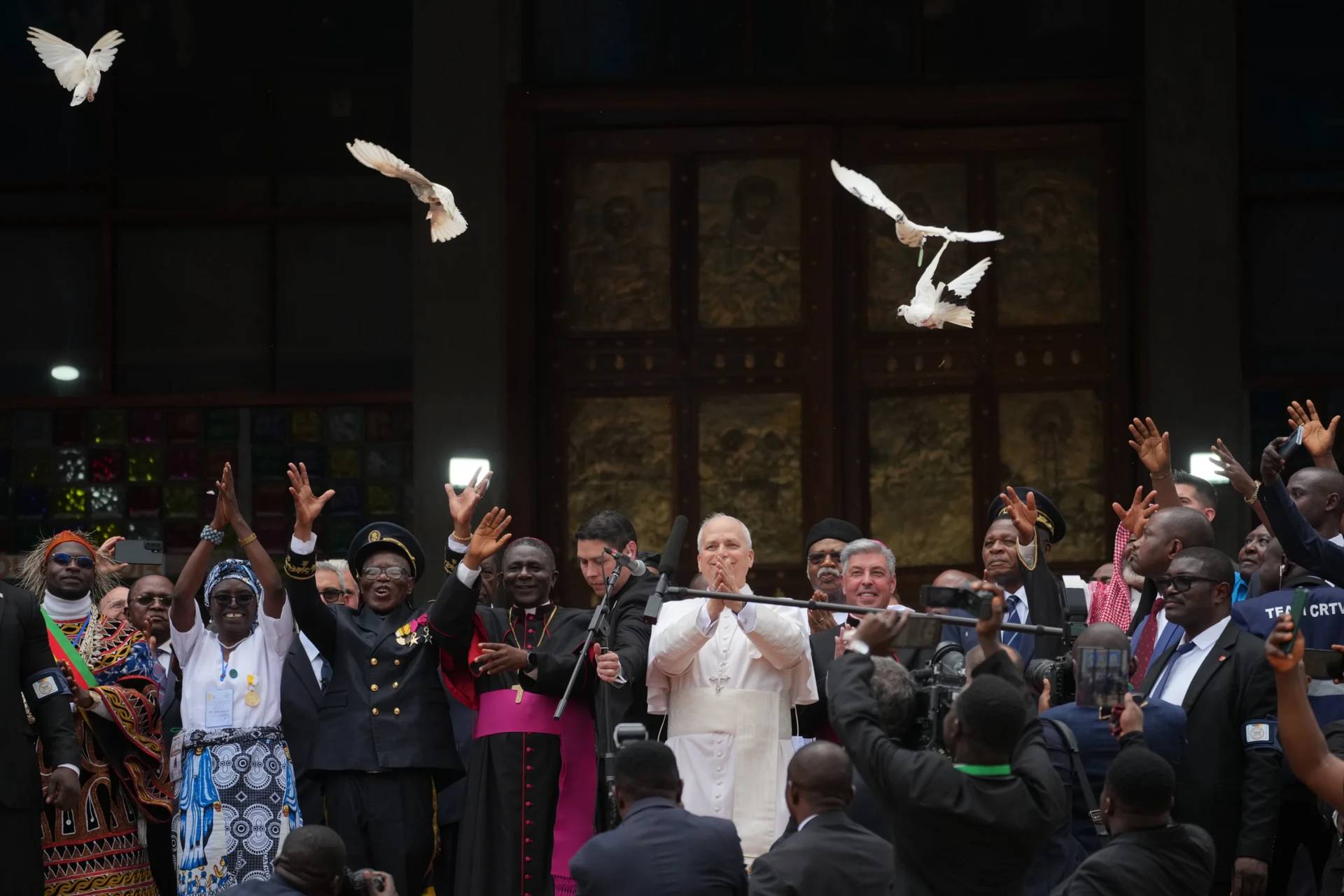
Pope Leo arrived in Malabo, the capital of Equatorial Guinea, which was recently renamed Ciudad de la Paz (“City of Peace”), on Tuesday, marking the last stop on his 4-nation odyssey in Africa, which has so far taken him to Algeria, Cameroon, and Angola.
Situated on the west coast of Central Africa, Equatorial Guinea is a former colony of Spanish Guinea and is therefore Spanish-speaking. Leo, who is fluent given his more than two decades as a missionary in Peru, will deliver his public remarks throughout his two-day visit in Spanish.
Equatorial Guinea is predominantly Christian, with Roman Catholicism being the largest denomination. Around 80-88 percent of the population identifies as Catholic.
Since the mid-1990s, the country has developed into one of the largest oil producers in Sub-Saharan Africa; however, wealth distribution is highly uneven, with just a fraction of the population benefiting from the nation’s vast resources.
A paradox in natural wealth and extreme poverty, Equatorial Guinean society is a juxtaposition, with some 50 percent of the population living in poverty despite the country having one of the highest GDP rates in Africa.
Causes of the crisis are deemed to be severe income inequality, sparce social spending on health and education, and limited economic diversification, increasing the risk of poverty.
According to the World Bank, as of 2023, the national poverty rate in Equatorial Guinea was roughly 50.7 percent, a decrease from previous years, but still stark.
Much of the blame has been placed on a low investment in education and healthcare, as well as widespread corruption and the mismanagement of resources.
Equatorial Guinea also struggles with ingrained political woes that are difficult to change, as Nguema Mbasogo, widely considered an autocratic leader, has led the country for 47 years, making him the world’s longest-serving president, accused of corruption, human rights abuses, nepotism, and abuses of power.
A call to reform
After his April 21 arrival in Equatorial Guinea, Leo held a private meeting with President Teodoro Obiang Nguema Mbasogo, 80, who has held office since 1979, and met with national civil authorities, delivering a firm condemnation of income disparity and problems of wealth distribution, packaged with a call to invoke the church’s social doctrine as a means of resolving societal inequalities.
In his speech, the pope said the world is currently “faced with issues that shake the very foundations of the human experience.”
Pointing to his predecessor and namesake Leo XIII and his landmark social encyclical Rerum Novarum, Leo XIV lamented that “exclusion is the new face of social injustice.”
“The gap between a ‘small minority’ – 1 percent of the population – and the overwhelming majority has widened dramatically,” he said, saying there is a sharp “paradox” when it comes to issues of exclusion.
A lack of land, food, housing, and dignified work exists alongside widening access to new technologies booming across the world thanks to globalized markets, he said.
“Cell phones, social networks and even artificial intelligence are in the pockets of millions of persons, including the poor,” he said, saying it is the duty of civil authorities and “sound politics” to eliminate obstacles to a true “integral human development.”
This is a mission, he said, “grounded in the fundamental principles of solidarity and the universal destination of goods” at the heart of the social doctrine of the church.
Speaking directly to authorities, he quoted Pope John Paul II’s speech during the pontiff’s visit in 1982, just three years after the president took power.
On that occasion, John Paul said “the symbolic center to which the living aspirations of a people converge for the establishment of a social climate of authentic liberty, justice, respect and promotion of the rights of every person or group, and better living conditions, which allow everyone to realize themselves as human beings and as children of God.”
“These are words that remain timely and that challenge anyone entrusted with public responsibility,” Leo said, and pointed to Saint Augustine’s concept of humanity as living between two cities, the “city of God” based on unconditional love, and the “earthly city” where humanity dwells.
Leo lamented that the ‘earthly city’ Augustine refers to is often centered on “the proud love of self, on the lust for power and worldly glory that leads to destruction.”
However, Christians, he said, are called “to dwell in the earthly city while keeping their hearts and minds turned toward the heavenly city, their true homeland.”
“It is essential to discern the difference between that which lasts and that which passes, remaining free from the pursuit of unjust wealth and the illusion of dominion,” the pope said.
According to Augustine, those living in the earthly city, including those in power and government, must “seek to apply Christian ethics to civil government.”
Invoking the Catholic Church’s social doctrine, the pope said that it can be a source of guidance “to all who seek to address the ‘new things’ that destabilize our planet and human coexistence, while prioritizing, above all else, the Kingdom of God and his justice.”
It is the church’s task, he said, to provide the world the “moral criteria and authentic ethical principles” with which to move forward, “all while respecting individual freedom and the autonomy of nations and their governments.”
“Ultimately, the aim of the Social Doctrine is to equip people to face ever-evolving problems; for every generation is unique, bringing with it new challenges, new dreams and new questions,” he said.
To this end, Leo issued a firm condemnation of income disparity and the distribution of wealth in society, saying rapid developments in modern technology have compounded and accelerated the speculation of raw materials globally.
“This shift seemingly overshadows fundamental imperatives such as the safeguarding of creation, the rights of local communities, the dignity of labor and the protection of public health,” he said.
Pope Leo pointed to the high number of young people in the country, saying they can pave the way to a better future, and assured of the church’s help in moving forward.
“Within the Church you will find help for the formation of free and responsible consciences, enabling you to advance together toward the future,” he said.
In a world plagued by the consequences of “arrogance,” the people, the pope said, “hunger and thirst for justice.”
“It is necessary to encourage those who believe in peace and to dare to engage in “countercurrent” politics – those which place the common good at their very center,” he said.
The city of God, which he called the “city of peace,” Leo said, is both a gift and is “the horizon toward which our every noble aspiration turns. It is both a promise and a task.”
“Let us walk together, with wisdom and hope, towards the city of God, which is the city of peace,” he said.
Follow Elise Ann Allen on X: @eliseannallen